Hao Wang, Dr. Zhiyou Wei, Dr. Zhiwei Liu, Dr. Bin Zheng, Dr. Zhaoming Zhang, Prof. Xuzhou Yan, Linli He, Dr. Tao Li, Dr. Dong Zhao
{"title":"Energy Dissipation and Toughening of Covalent Networks via a Sacrificial Conformation Approach","authors":"Hao Wang, Dr. Zhiyou Wei, Dr. Zhiwei Liu, Dr. Bin Zheng, Dr. Zhaoming Zhang, Prof. Xuzhou Yan, Linli He, Dr. Tao Li, Dr. Dong Zhao","doi":"10.1002/anie.202416790","DOIUrl":null,"url":null,"abstract":"<p>Covalent polymer networks find wide utility in diverse engineering applications owing to their desirable stiffness and resilience. However, the rigid covalent chemical structure between crosslinking points imposes limitations on enhancing their toughness. Although the incorporation of sacrificial chemical bonds has shown promise in improving toughness through energy dissipation, composite networks struggle to maintain both rapid recovery and stiffness. Consequently, a significant challenge persists in achieving a covalent network that combines high strength, stiffness, toughness, and fast recovery performance. To address this challenge, we propose a novel sacrificial structure termed “sacrificial conformation.” In this approach, β-cyclodextrin is covalently embedded into the network skeleton as the sacrificial conformation element. Compared to traditional covalent networks (LCN), well-designed cyclodextrin-embedded covalent network (CCN) exhibit a 100-fold increase in Young's modulus and a 60-fold increase in toughness. Importantly, CCN maintains excellent elasticity, ensuring swift recovery after deformation. This sacrificial conformational strategy enables efficient energy dissipation without necessitating the rupture of chemical bonds, thereby overcoming the limitations of traditional approaches. This advancement holds great promise for the design and fabrication of advanced elastomers and hydrogels with superior mechanical properties and dynamic behavior.</p>","PeriodicalId":125,"journal":{"name":"Angewandte Chemie International Edition","volume":"64 4","pages":""},"PeriodicalIF":16.9000,"publicationDate":"2024-10-15","publicationTypes":"Journal Article","fieldsOfStudy":null,"isOpenAccess":false,"openAccessPdf":"","citationCount":"0","resultStr":null,"platform":"Semanticscholar","paperid":null,"PeriodicalName":"Angewandte Chemie International Edition","FirstCategoryId":"92","ListUrlMain":"https://onlinelibrary.wiley.com/doi/10.1002/anie.202416790","RegionNum":1,"RegionCategory":"化学","ArticlePicture":[],"TitleCN":null,"AbstractTextCN":null,"PMCID":null,"EPubDate":"","PubModel":"","JCR":"Q1","JCRName":"CHEMISTRY, MULTIDISCIPLINARY","Score":null,"Total":0}
引用次数: 0
Abstract
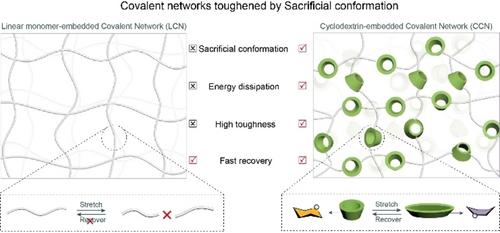
Covalent polymer networks find wide utility in diverse engineering applications owing to their desirable stiffness and resilience. However, the rigid covalent chemical structure between crosslinking points imposes limitations on enhancing their toughness. Although the incorporation of sacrificial chemical bonds has shown promise in improving toughness through energy dissipation, composite networks struggle to maintain both rapid recovery and stiffness. Consequently, a significant challenge persists in achieving a covalent network that combines high strength, stiffness, toughness, and fast recovery performance. To address this challenge, we propose a novel sacrificial structure termed “sacrificial conformation.” In this approach, β-cyclodextrin is covalently embedded into the network skeleton as the sacrificial conformation element. Compared to traditional covalent networks (LCN), well-designed cyclodextrin-embedded covalent network (CCN) exhibit a 100-fold increase in Young's modulus and a 60-fold increase in toughness. Importantly, CCN maintains excellent elasticity, ensuring swift recovery after deformation. This sacrificial conformational strategy enables efficient energy dissipation without necessitating the rupture of chemical bonds, thereby overcoming the limitations of traditional approaches. This advancement holds great promise for the design and fabrication of advanced elastomers and hydrogels with superior mechanical properties and dynamic behavior.
期刊介绍:
Angewandte Chemie, a journal of the German Chemical Society (GDCh), maintains a leading position among scholarly journals in general chemistry with an impressive Impact Factor of 16.6 (2022 Journal Citation Reports, Clarivate, 2023). Published weekly in a reader-friendly format, it features new articles almost every day. Established in 1887, Angewandte Chemie is a prominent chemistry journal, offering a dynamic blend of Review-type articles, Highlights, Communications, and Research Articles on a weekly basis, making it unique in the field.



 京公网安备 11010802042870号
京ICP备2023020795号-1
京公网安备 11010802042870号
京ICP备2023020795号-1

 分享
分享
 求助内容:
求助内容: 应助结果提醒方式:
 扫码关注我们
