Impact of broader ecological and socio-environmental components on Aedes mosquito population dynamics: a spatial–temporal longitudinal study

IF 3.8 1区 农林科学 Q1 AGRONOMY Pest Management Science Pub Date : 2024-10-15 DOI:10.1002/ps.8478
Yifan Wang, Xin Wang, Zhuonan Wang, Zhou Chen, Nannan Liu
{"title":"Impact of broader ecological and socio-environmental components on Aedes mosquito population dynamics: a spatial–temporal longitudinal study","authors":"Yifan Wang,&nbsp;Xin Wang,&nbsp;Zhuonan Wang,&nbsp;Zhou Chen,&nbsp;Nannan Liu","doi":"10.1002/ps.8478","DOIUrl":null,"url":null,"abstract":"<div>\n \n \n <section>\n \n <h3> BACKGROUND</h3>\n \n <p>The increasing spread of mosquito-borne diseases is a significant problem globally, but mosquito management strategies are less efficient. Therefore, a comprehensive understanding of the population dynamics of <i>Aedes</i> mosquito is essential for improving mosquito management strategies. Constructing a model to understand <i>Aedes</i> mosquito development in response to environmental factors is crucial to addressing these challenges.</p>\n </section>\n \n <section>\n \n <h3> RESULTS</h3>\n \n <p>An extensive data set on <i>Aedes</i> spp. mosquito populations was constructed, considering the environmental factors temperature, water vapor pressure, wind speed, daylength, and rainfall. This data set, compiled from mosquito collections over a period of four years across multiple locations in Alabama, USA, facilitated the prediction of mosquito dynamics. The random forest model was used to explain mosquito population changes in response to these factors. These findings indicated that temperature, daylength, and water vapor pressure had the most significant impacts on mosquito population dynamics. The model also allowed predictions of mosquito population changes over time and across different geographic regions, extending beyond Alabama to the southeastern USA.</p>\n </section>\n \n <section>\n \n <h3> CONCLUSION</h3>\n \n <p>This study provided valuable insights into the impacts of environmental factors on mosquito populations. This novel approach using machine learning and the random forest model will enable researchers to predict future mosquito populations and contribute to developing more-effective strategies for mosquito management. © 2024 Society of Chemical Industry.</p>\n </section>\n </div>","PeriodicalId":218,"journal":{"name":"Pest Management Science","volume":"81 2","pages":"755-765"},"PeriodicalIF":3.8000,"publicationDate":"2024-10-15","publicationTypes":"Journal Article","fieldsOfStudy":null,"isOpenAccess":false,"openAccessPdf":"","citationCount":"0","resultStr":null,"platform":"Semanticscholar","paperid":null,"PeriodicalName":"Pest Management Science","FirstCategoryId":"97","ListUrlMain":"https://scijournals.onlinelibrary.wiley.com/doi/10.1002/ps.8478","RegionNum":1,"RegionCategory":"农林科学","ArticlePicture":[],"TitleCN":null,"AbstractTextCN":null,"PMCID":null,"EPubDate":"","PubModel":"","JCR":"Q1","JCRName":"AGRONOMY","Score":null,"Total":0}
引用次数: 0

Abstract

BACKGROUND

The increasing spread of mosquito-borne diseases is a significant problem globally, but mosquito management strategies are less efficient. Therefore, a comprehensive understanding of the population dynamics of Aedes mosquito is essential for improving mosquito management strategies. Constructing a model to understand Aedes mosquito development in response to environmental factors is crucial to addressing these challenges.

RESULTS

An extensive data set on Aedes spp. mosquito populations was constructed, considering the environmental factors temperature, water vapor pressure, wind speed, daylength, and rainfall. This data set, compiled from mosquito collections over a period of four years across multiple locations in Alabama, USA, facilitated the prediction of mosquito dynamics. The random forest model was used to explain mosquito population changes in response to these factors. These findings indicated that temperature, daylength, and water vapor pressure had the most significant impacts on mosquito population dynamics. The model also allowed predictions of mosquito population changes over time and across different geographic regions, extending beyond Alabama to the southeastern USA.

CONCLUSION

This study provided valuable insights into the impacts of environmental factors on mosquito populations. This novel approach using machine learning and the random forest model will enable researchers to predict future mosquito populations and contribute to developing more-effective strategies for mosquito management. © 2024 Society of Chemical Industry.
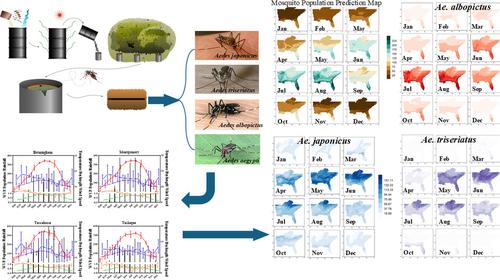
Abstract Image

查看原文
分享 分享
微信好友 朋友圈 QQ好友 复制链接
本刊更多论文
更广泛的生态和社会环境因素对伊蚊种群动态的影响:一项时空纵向研究
蚊子传播的疾病日益蔓延是全球面临的一个重大问题,但蚊子管理策略的效率较低。因此,全面了解伊蚊的种群动态对于改进蚊虫管理策略至关重要。构建一个模型来了解伊蚊的发展对环境因素的反应,对于应对这些挑战至关重要。
本文章由计算机程序翻译,如有差异,请以英文原文为准。
求助全文
约1分钟内获得全文 去求助
来源期刊
Pest Management Science
Pest Management Science 农林科学-昆虫学
CiteScore
7.90
自引率
9.80%
发文量
553
审稿时长
4.8 months
期刊介绍: Pest Management Science is the international journal of research and development in crop protection and pest control. Since its launch in 1970, the journal has become the premier forum for papers on the discovery, application, and impact on the environment of products and strategies designed for pest management. Published for SCI by John Wiley & Sons Ltd.
期刊最新文献
A novel fluopyram-abamectin trunk-injection formulation: enhanced translocation and efficacy against pine wilt disease. Target-site and non-target-site mechanisms confer multiple herbicide resistance in waterhemp (Amaranthus tuberculatus) accessions from Wisconsin. pH-responsive zeolitic imidazolate framework-8 nanoparticles for encapsulating prochloraz to enhance efficacy in controlling strawberry anthracnose. Intraguild predation alters life histories in Neoseiulus barkeri and Scolothrips takahashii: asymmetric effects on development and reproduction. Spray drift evaluation from a four-axis unmanned aerial spraying system: effects of spray parameters under different wind speeds and comparison with a boom sprayer.
×
引用
GB/T 7714-2015
复制
MLA
复制
APA
复制
导出至
BibTeX EndNote RefMan NoteFirst NoteExpress
×
×
提示
您的信息不完整,为了账户安全,请先补充。
现在去补充
×
提示
您因"违规操作"
具体请查看互助需知
我知道了
×
提示
现在去查看 取消
×
提示
确定
0
微信
客服QQ
Book学术公众号 扫码关注我们
反馈
×
意见反馈
请填写您的意见或建议
请填写您的手机或邮箱
已复制链接
已复制链接
快去分享给好友吧!
我知道了
×
扫码分享
扫码分享
Book学术官方微信
Book学术文献互助
Book学术文献互助群
群 号:604180095
Book学术
文献互助 智能选刊 最新文献 互助须知 联系我们:info@booksci.cn
Book学术提供免费学术资源搜索服务,方便国内外学者检索中英文文献。致力于提供最便捷和优质的服务体验。
Copyright © 2023 Book学术 All rights reserved.
ghs 京公网安备 11010802042870号 京ICP备2023020795号-1





