{"title":"Voiceprint-based method for sensing droplet generation and mode transition from a coaxial microfluidic device","authors":"Peng-Nian Chen, Jin-Jia Hu, Chia-Hung Dylan Tsai","doi":"10.1016/j.sna.2024.115943","DOIUrl":null,"url":null,"abstract":"<div><div>A voiceprint-based method is proposed for sensing microdroplets generated from a coaxial microfluidic device in this study. Microdroplet holds significant utility in various fields, such as drug delivery and molecular biology. Real-time sensing of droplet generation is crucial for ensuring droplet quality control. Current sensing techniques, such as high-speed vision, are hindered by cost and system complexity limitations. In our approach, voiceprint features were extracted from the sound accompanying microdroplet generation using the short-time Fourier transform (STFT). These features were employed to determine droplet generation frequency and mode transitions. Experimental validation was conducted using a coaxial capillary microfluidic device capable of generating sub-100-micron droplets via controlled flowrates of water and nitrogen gas in the inner and outer capillaries, respectively. The generation frequency from hundreds to thousands hertz were successfully detected in the experiment. Additionally, real-time detections of dripping-jetting and jetting-dripping mode transition were successfully achieved using the proposed voiceprint method. This work offers a simple, robust and cost-effective solution for sensing microdroplets generated from a microfluidic device.</div></div>","PeriodicalId":21689,"journal":{"name":"Sensors and Actuators A-physical","volume":"379 ","pages":"Article 115943"},"PeriodicalIF":4.9000,"publicationDate":"2024-12-01","publicationTypes":"Journal Article","fieldsOfStudy":null,"isOpenAccess":false,"openAccessPdf":"","citationCount":"0","resultStr":null,"platform":"Semanticscholar","paperid":null,"PeriodicalName":"Sensors and Actuators A-physical","FirstCategoryId":"5","ListUrlMain":"https://www.sciencedirect.com/science/article/pii/S0924424724009373","RegionNum":3,"RegionCategory":"工程技术","ArticlePicture":[],"TitleCN":null,"AbstractTextCN":null,"PMCID":null,"EPubDate":"2024/10/5 0:00:00","PubModel":"Epub","JCR":"Q2","JCRName":"ENGINEERING, ELECTRICAL & ELECTRONIC","Score":null,"Total":0}
引用次数: 0
Abstract
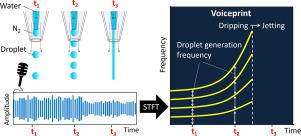
A voiceprint-based method is proposed for sensing microdroplets generated from a coaxial microfluidic device in this study. Microdroplet holds significant utility in various fields, such as drug delivery and molecular biology. Real-time sensing of droplet generation is crucial for ensuring droplet quality control. Current sensing techniques, such as high-speed vision, are hindered by cost and system complexity limitations. In our approach, voiceprint features were extracted from the sound accompanying microdroplet generation using the short-time Fourier transform (STFT). These features were employed to determine droplet generation frequency and mode transitions. Experimental validation was conducted using a coaxial capillary microfluidic device capable of generating sub-100-micron droplets via controlled flowrates of water and nitrogen gas in the inner and outer capillaries, respectively. The generation frequency from hundreds to thousands hertz were successfully detected in the experiment. Additionally, real-time detections of dripping-jetting and jetting-dripping mode transition were successfully achieved using the proposed voiceprint method. This work offers a simple, robust and cost-effective solution for sensing microdroplets generated from a microfluidic device.
期刊介绍:
Sensors and Actuators A: Physical brings together multidisciplinary interests in one journal entirely devoted to disseminating information on all aspects of research and development of solid-state devices for transducing physical signals. Sensors and Actuators A: Physical regularly publishes original papers, letters to the Editors and from time to time invited review articles within the following device areas:
• Fundamentals and Physics, such as: classification of effects, physical effects, measurement theory, modelling of sensors, measurement standards, measurement errors, units and constants, time and frequency measurement. Modeling papers should bring new modeling techniques to the field and be supported by experimental results.
• Materials and their Processing, such as: piezoelectric materials, polymers, metal oxides, III-V and II-VI semiconductors, thick and thin films, optical glass fibres, amorphous, polycrystalline and monocrystalline silicon.
• Optoelectronic sensors, such as: photovoltaic diodes, photoconductors, photodiodes, phototransistors, positron-sensitive photodetectors, optoisolators, photodiode arrays, charge-coupled devices, light-emitting diodes, injection lasers and liquid-crystal displays.
• Mechanical sensors, such as: metallic, thin-film and semiconductor strain gauges, diffused silicon pressure sensors, silicon accelerometers, solid-state displacement transducers, piezo junction devices, piezoelectric field-effect transducers (PiFETs), tunnel-diode strain sensors, surface acoustic wave devices, silicon micromechanical switches, solid-state flow meters and electronic flow controllers.
Etc...




 京公网安备 11010802042870号
京ICP备2023020795号-1
京公网安备 11010802042870号
京ICP备2023020795号-1

 分享
分享
 求助内容:
求助内容: 应助结果提醒方式:
 扫码关注我们
