Shangheng Liu, Xiaocan Wang, Dr. Wei-Hsiang Huang, Prof. Qiugen Zhang, Dr. Jiajia Han, Yingtian Zhang, Dr. Chih-Wen Pao, Prof. Zhiwei Hu, Prof. Yong Xu, Prof. Xiaoqing Huang
{"title":"Solvation Effect-Determined Mechanisms of Cation Exchange Reactions for Efficient Multicomponent Nanocatalysts","authors":"Shangheng Liu, Xiaocan Wang, Dr. Wei-Hsiang Huang, Prof. Qiugen Zhang, Dr. Jiajia Han, Yingtian Zhang, Dr. Chih-Wen Pao, Prof. Zhiwei Hu, Prof. Yong Xu, Prof. Xiaoqing Huang","doi":"10.1002/anie.202418248","DOIUrl":null,"url":null,"abstract":"<p>Cation exchange (CE) reaction is a classical synthesis method for creating complex structures. A lock of study on intrinsic mechanism limits its understanding and practical application. Using X-ray absorption spectroscopy, we observed that the evolution from Ru−Cl to Ru−O/OH occurs during the CE between K<sub>2</sub>RuCl<sub>6</sub> and CoSn(OH)<sub>6</sub> in aqueous solution, while CE between K<sub>2</sub>PtCl<sub>6</sub> and CoSn(OH)<sub>6</sub> is inhibited due to the failure of structural evolution from Pt−Cl to Pt−O/OH. Theoretical simulations imply that the interaction between Ru−O and CoSn(OH)<sub>6</sub> with Co vacancy (CoV<sub>Co</sub>Sn(OH)<sub>6</sub>) endows the electron transfer, as a result of strengthened adsorption on CoV<sub>Co</sub>Sn(OH)<sub>6</sub>. Moreover, this mechanism is validated for CE between K<sub>2</sub>RuCl<sub>6</sub> and ASn(OH)<sub>6</sub> (A=Mg, Ca, Mn, Co, Cu, Zn), and CE between K<sub>2</sub>PdCl<sub>6</sub>/Na<sub>3</sub>RhCl<sub>6</sub>/K<sub>2</sub>IrCl<sub>6</sub> and CoSn(OH)<sub>6</sub>. Impressively, the Pt-free CoRuSn(OH)<sub>x</sub> produced via CE displays a mass activity and a power density of 15.0 A mg<sub>Ru</sub><sup>−1</sup> and 11.6 W mg<sub>Ru</sub><sup>−1</sup>, respectively, for anion exchange membrane fuel cell (AEMFC) exceeding the values of commercial PtRu/C (11.8 A mg<sub>Ru+Pt</sub><sup>−1</sup> and 9.0 W mg<sub>Ru+Pt</sub><sup>−1</sup>). This work, for the first time, reveals the intrinsic mechanism of CE as structural evolution of target ion breaking through the traditional classic etch-adsorption mechanism and will promote fundamental research and practical application in various fields.</p>","PeriodicalId":125,"journal":{"name":"Angewandte Chemie International Edition","volume":"64 6","pages":""},"PeriodicalIF":17.6000,"publicationDate":"2024-10-16","publicationTypes":"Journal Article","fieldsOfStudy":null,"isOpenAccess":false,"openAccessPdf":"","citationCount":"0","resultStr":null,"platform":"Semanticscholar","paperid":null,"PeriodicalName":"Angewandte Chemie International Edition","FirstCategoryId":"92","ListUrlMain":"https://onlinelibrary.wiley.com/doi/10.1002/anie.202418248","RegionNum":1,"RegionCategory":"化学","ArticlePicture":[],"TitleCN":null,"AbstractTextCN":null,"PMCID":null,"EPubDate":"","PubModel":"","JCR":"Q1","JCRName":"CHEMISTRY, MULTIDISCIPLINARY","Score":null,"Total":0}
引用次数: 0
Abstract
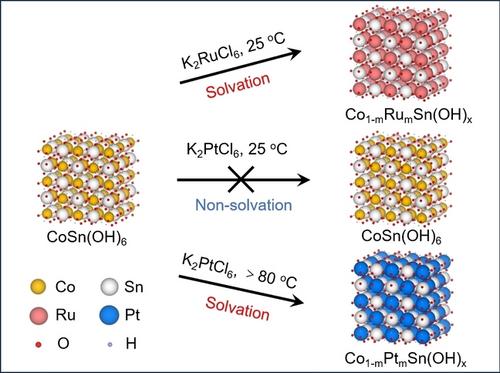
Cation exchange (CE) reaction is a classical synthesis method for creating complex structures. A lock of study on intrinsic mechanism limits its understanding and practical application. Using X-ray absorption spectroscopy, we observed that the evolution from Ru−Cl to Ru−O/OH occurs during the CE between K2RuCl6 and CoSn(OH)6 in aqueous solution, while CE between K2PtCl6 and CoSn(OH)6 is inhibited due to the failure of structural evolution from Pt−Cl to Pt−O/OH. Theoretical simulations imply that the interaction between Ru−O and CoSn(OH)6 with Co vacancy (CoVCoSn(OH)6) endows the electron transfer, as a result of strengthened adsorption on CoVCoSn(OH)6. Moreover, this mechanism is validated for CE between K2RuCl6 and ASn(OH)6 (A=Mg, Ca, Mn, Co, Cu, Zn), and CE between K2PdCl6/Na3RhCl6/K2IrCl6 and CoSn(OH)6. Impressively, the Pt-free CoRuSn(OH)x produced via CE displays a mass activity and a power density of 15.0 A mgRu−1 and 11.6 W mgRu−1, respectively, for anion exchange membrane fuel cell (AEMFC) exceeding the values of commercial PtRu/C (11.8 A mgRu+Pt−1 and 9.0 W mgRu+Pt−1). This work, for the first time, reveals the intrinsic mechanism of CE as structural evolution of target ion breaking through the traditional classic etch-adsorption mechanism and will promote fundamental research and practical application in various fields.
期刊介绍:
Angewandte Chemie, a journal of the German Chemical Society (GDCh), maintains a leading position among scholarly journals in general chemistry with an impressive Impact Factor of 16.6 (2022 Journal Citation Reports, Clarivate, 2023). Published weekly in a reader-friendly format, it features new articles almost every day. Established in 1887, Angewandte Chemie is a prominent chemistry journal, offering a dynamic blend of Review-type articles, Highlights, Communications, and Research Articles on a weekly basis, making it unique in the field.




 京公网安备 11010802042870号
京ICP备2023020795号-1
京公网安备 11010802042870号
京ICP备2023020795号-1

 分享
分享
 求助内容:
求助内容: 应助结果提醒方式:
 扫码关注我们
