Emma Borland, Niklas Mattson-Carlgren, Pontus Tideman, the Alzheimer's Disease Neuroimaging Initiative, Erik Stomrud, Oskar Hansson, Sebastian Palmqvist
{"title":"Individualized, cross-validated prediction of future dementia using cognitive assessments in people with mild cognitive symptoms","authors":"Emma Borland, Niklas Mattson-Carlgren, Pontus Tideman, the Alzheimer's Disease Neuroimaging Initiative, Erik Stomrud, Oskar Hansson, Sebastian Palmqvist","doi":"10.1002/alz.14305","DOIUrl":null,"url":null,"abstract":"<div>\n \n \n <section>\n \n <h3> INTRODUCTION</h3>\n \n <p>We aimed to develop an algorithm to predict the individualized risk of future dementia using brief cognitive tests suitable for primary care.</p>\n </section>\n \n <section>\n \n <h3> METHODS</h3>\n \n <p>We included 612 participants with subjective cognitive decline (SCD) or mild cognitive impairment (MCI) from the Alzheimer's Disease Neuroimaging Initiative (ADNI) study, assessed for at least 4 years or until progression to dementia. A logistic regression model, using cognitive tests as predictors and dementia progression as an outcome, stratified participants into low, intermediate, or high risk. A second model, including 1-year cognitive test changes, was applied to the intermediate group. The models were replicated in 392 SCD/MCI participants from the BioFINDER-1 study.</p>\n </section>\n \n <section>\n \n <h3> RESULTS</h3>\n \n <p>The best two-step model for predicting dementia incorporated Trail Making Test B (attention/executive function), Animal Fluency (verbal fluency), Mini-Mental State Examination (global cognition), and 10-word list recall (memory). The model's positive predictive value in ADNI was 85.8% and negative predictive value was 92.2% versus 62.5% and 95.6%, respectively, in BioFINDER-1.</p>\n </section>\n \n <section>\n \n <h3> DISCUSSION</h3>\n \n <p>This two-step model accurately predicts individualized dementia risk.</p>\n </section>\n \n <section>\n \n <h3> Highlights</h3>\n \n <div>\n <ul>\n \n <li>To our knowledge, this is the first algorithm for predicting all-cause dementia using a novel two-step model utilizing brief cognitive tests.</li>\n \n <li>Applying a validated model including the Trail Making Test B, Animal Fluency, MMSE, Alzheimer's Disease Assessment Scale delayed, and immediate recall can robustly and accurately categorize individuals into low, intermediate, or high risk of dementia progression and can facilitate clinical decision-making and personalized patient care.</li>\n \n <li>We created an app that is available for research and educational purposes at https://brainapps.shinyapps.io/PredictAllCauseDementia to provide an individualized risk score for dementia progression.</li>\n </ul>\n </div>\n </section>\n </div>","PeriodicalId":7471,"journal":{"name":"Alzheimer's & Dementia","volume":"20 12","pages":"8625-8638"},"PeriodicalIF":11.1000,"publicationDate":"2024-10-17","publicationTypes":"Journal Article","fieldsOfStudy":null,"isOpenAccess":false,"openAccessPdf":"https://onlinelibrary.wiley.com/doi/epdf/10.1002/alz.14305","citationCount":"0","resultStr":null,"platform":"Semanticscholar","paperid":null,"PeriodicalName":"Alzheimer's & Dementia","FirstCategoryId":"3","ListUrlMain":"https://alz-journals.onlinelibrary.wiley.com/doi/10.1002/alz.14305","RegionNum":1,"RegionCategory":"医学","ArticlePicture":[],"TitleCN":null,"AbstractTextCN":null,"PMCID":null,"EPubDate":"","PubModel":"","JCR":"Q1","JCRName":"CLINICAL NEUROLOGY","Score":null,"Total":0}
引用次数: 0
Abstract
INTRODUCTION
We aimed to develop an algorithm to predict the individualized risk of future dementia using brief cognitive tests suitable for primary care.
METHODS
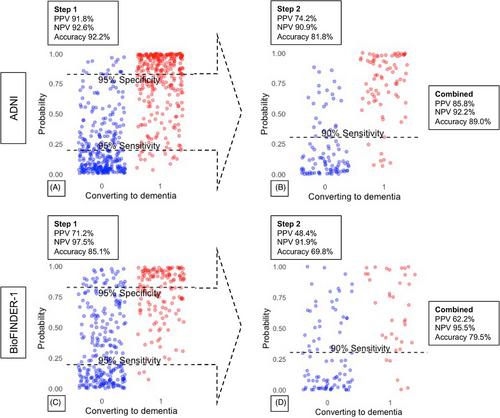
We included 612 participants with subjective cognitive decline (SCD) or mild cognitive impairment (MCI) from the Alzheimer's Disease Neuroimaging Initiative (ADNI) study, assessed for at least 4 years or until progression to dementia. A logistic regression model, using cognitive tests as predictors and dementia progression as an outcome, stratified participants into low, intermediate, or high risk. A second model, including 1-year cognitive test changes, was applied to the intermediate group. The models were replicated in 392 SCD/MCI participants from the BioFINDER-1 study.
RESULTS
The best two-step model for predicting dementia incorporated Trail Making Test B (attention/executive function), Animal Fluency (verbal fluency), Mini-Mental State Examination (global cognition), and 10-word list recall (memory). The model's positive predictive value in ADNI was 85.8% and negative predictive value was 92.2% versus 62.5% and 95.6%, respectively, in BioFINDER-1.
DISCUSSION
This two-step model accurately predicts individualized dementia risk.
Highlights
To our knowledge, this is the first algorithm for predicting all-cause dementia using a novel two-step model utilizing brief cognitive tests.
Applying a validated model including the Trail Making Test B, Animal Fluency, MMSE, Alzheimer's Disease Assessment Scale delayed, and immediate recall can robustly and accurately categorize individuals into low, intermediate, or high risk of dementia progression and can facilitate clinical decision-making and personalized patient care.
We created an app that is available for research and educational purposes at https://brainapps.shinyapps.io/PredictAllCauseDementia to provide an individualized risk score for dementia progression.
期刊介绍:
Alzheimer's & Dementia is a peer-reviewed journal that aims to bridge knowledge gaps in dementia research by covering the entire spectrum, from basic science to clinical trials to social and behavioral investigations. It provides a platform for rapid communication of new findings and ideas, optimal translation of research into practical applications, increasing knowledge across diverse disciplines for early detection, diagnosis, and intervention, and identifying promising new research directions. In July 2008, Alzheimer's & Dementia was accepted for indexing by MEDLINE, recognizing its scientific merit and contribution to Alzheimer's research.




 京公网安备 11010802042870号
京ICP备2023020795号-1
京公网安备 11010802042870号
京ICP备2023020795号-1

 分享
分享
 求助内容:
求助内容: 应助结果提醒方式:
 扫码关注我们
