Lloyd Prosser, Carole H. Sudre, Neil P. Oxtoby, Alexandra L. Young, Ian B. Malone, Emily N. Manning, Hugh Pemberton, Phoebe Walsh, Frederik Barkhof, Geert Jan Biessels, David M. Cash, Josephine Barnes, for the Alzheimer's Disease Neuroimaging Initiative
{"title":"Biomarker pathway heterogeneity of amyloid-positive individuals","authors":"Lloyd Prosser, Carole H. Sudre, Neil P. Oxtoby, Alexandra L. Young, Ian B. Malone, Emily N. Manning, Hugh Pemberton, Phoebe Walsh, Frederik Barkhof, Geert Jan Biessels, David M. Cash, Josephine Barnes, for the Alzheimer's Disease Neuroimaging Initiative","doi":"10.1002/alz.14287","DOIUrl":null,"url":null,"abstract":"<div>\n \n \n <section>\n \n <h3> INTRODUCTION</h3>\n \n <p>In amyloid-positive individuals, disease-related biomarker heterogeneity is understudied.</p>\n </section>\n \n <section>\n \n <h3> METHODS</h3>\n \n <p>We used Subtype and Stage Inference (SuStaIn) to identify data-driven subtypes among cerebrospinal fluid (CSF) amyloid beta (1-42)–positive individuals from the Alzheimer's Disease Neuroimaging Initiative (ADNIGO/2 [<i>n </i>= 376]). Variables included: CSF phosphorylated tau (p-tau181), hippocampal and whole-brain volume, logical memory (LM), composite Trail Making Test score, and white matter hyperintensity (WMH) volumes. CSF amyloid-negative, apolipoprotein E ε4 non-carrier cognitively unimpaired controls (<i>n </i>= 86) were used to calculate <i>z</i> scores.</p>\n </section>\n \n <section>\n \n <h3> RESULTS</h3>\n \n <p>One subtype (<i>n </i>= 145) had early LM changes, with later p-tau and WMH changes. A second subtype (<i>n </i>= 88) had early WMH changes, were older, and more hypertensive. A third subtype (<i>n </i>= 100) had early p-tau changes, and reflected typical Alzheimer's disease. Some amyloid positive (<i>n </i>= 43) individuals were similar to the amyloid-negative group.</p>\n </section>\n \n <section>\n \n <h3> DISCUSSION</h3>\n \n <p>This work identified heterogeneity in individuals who are conventionally considered homogeneous, which is likely driven by co-pathologies including cerebrovascular disease.</p>\n </section>\n \n <section>\n \n <h3> Highlights</h3>\n \n <div>\n <ul>\n \n <li>Data-driven modeling identified marker heterogeneity in amyloid-positive individuals.</li>\n \n <li>Heterogeneity reflected Alzheimer's disease-like, vascular-like, and mixed pathology presentations.</li>\n \n <li>Some amyloid-positive individuals were more similar to amyloid-negative controls.</li>\n \n <li>Vascular pathology plays a key role in understanding heterogeneity in those on the amyloid pathway.</li>\n </ul>\n </div>\n </section>\n </div>","PeriodicalId":7471,"journal":{"name":"Alzheimer's & Dementia","volume":"20 12","pages":"8503-8515"},"PeriodicalIF":11.1000,"publicationDate":"2024-10-17","publicationTypes":"Journal Article","fieldsOfStudy":null,"isOpenAccess":false,"openAccessPdf":"https://onlinelibrary.wiley.com/doi/epdf/10.1002/alz.14287","citationCount":"0","resultStr":null,"platform":"Semanticscholar","paperid":null,"PeriodicalName":"Alzheimer's & Dementia","FirstCategoryId":"3","ListUrlMain":"https://alz-journals.onlinelibrary.wiley.com/doi/10.1002/alz.14287","RegionNum":1,"RegionCategory":"医学","ArticlePicture":[],"TitleCN":null,"AbstractTextCN":null,"PMCID":null,"EPubDate":"","PubModel":"","JCR":"Q1","JCRName":"CLINICAL NEUROLOGY","Score":null,"Total":0}
引用次数: 0
Abstract
INTRODUCTION
In amyloid-positive individuals, disease-related biomarker heterogeneity is understudied.
METHODS
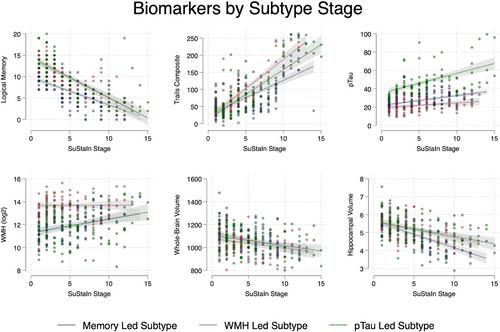
We used Subtype and Stage Inference (SuStaIn) to identify data-driven subtypes among cerebrospinal fluid (CSF) amyloid beta (1-42)–positive individuals from the Alzheimer's Disease Neuroimaging Initiative (ADNIGO/2 [n = 376]). Variables included: CSF phosphorylated tau (p-tau181), hippocampal and whole-brain volume, logical memory (LM), composite Trail Making Test score, and white matter hyperintensity (WMH) volumes. CSF amyloid-negative, apolipoprotein E ε4 non-carrier cognitively unimpaired controls (n = 86) were used to calculate z scores.
RESULTS
One subtype (n = 145) had early LM changes, with later p-tau and WMH changes. A second subtype (n = 88) had early WMH changes, were older, and more hypertensive. A third subtype (n = 100) had early p-tau changes, and reflected typical Alzheimer's disease. Some amyloid positive (n = 43) individuals were similar to the amyloid-negative group.
DISCUSSION
This work identified heterogeneity in individuals who are conventionally considered homogeneous, which is likely driven by co-pathologies including cerebrovascular disease.
Highlights
Data-driven modeling identified marker heterogeneity in amyloid-positive individuals.
Heterogeneity reflected Alzheimer's disease-like, vascular-like, and mixed pathology presentations.
Some amyloid-positive individuals were more similar to amyloid-negative controls.
Vascular pathology plays a key role in understanding heterogeneity in those on the amyloid pathway.
期刊介绍:
Alzheimer's & Dementia is a peer-reviewed journal that aims to bridge knowledge gaps in dementia research by covering the entire spectrum, from basic science to clinical trials to social and behavioral investigations. It provides a platform for rapid communication of new findings and ideas, optimal translation of research into practical applications, increasing knowledge across diverse disciplines for early detection, diagnosis, and intervention, and identifying promising new research directions. In July 2008, Alzheimer's & Dementia was accepted for indexing by MEDLINE, recognizing its scientific merit and contribution to Alzheimer's research.




 京公网安备 11010802042870号
京ICP备2023020795号-1
京公网安备 11010802042870号
京ICP备2023020795号-1

 分享
分享
 求助内容:
求助内容: 应助结果提醒方式:
 扫码关注我们
