Xu Zhang, Kai Zhang, Yadong Zhu, Baozeng Zhou and Xiaocha Wang
{"title":"Tunable valley polarization and high Curie temperature in two-dimensional GdF2/WSe2 van der Waals heterojunctions†","authors":"Xu Zhang, Kai Zhang, Yadong Zhu, Baozeng Zhou and Xiaocha Wang","doi":"10.1039/D4CP03578J","DOIUrl":null,"url":null,"abstract":"<p >Two-dimensional (2D) van der Waals (vdW) heterojunctions have potential applications in spintronic devices owing to their unique electronic structure and properties. The 2D ferromagnetic material GdF<small><sub>2</sub></small>, formed by the rare earth element (Gd) with 4f electrons and fluorine, exhibits spontaneous valley polarization, perpendicular magnetic anisotropy and other excellent properties. Monolayer WSe<small><sub>2</sub></small> has a similar structure to monolayer GdF<small><sub>2</sub></small> and can be used to construct a vdW heterojunction. The heterojunction not only retains the original excellent properties but also generates new physical properties due to interfacial charge transfer and coupling. Therefore, this work investigates the electronic structure, magnetic anisotropy energy and Curie temperature (<em>T</em><small><sub>c</sub></small>) of the GdF<small><sub>2</sub></small>/WSe<small><sub>2</sub></small> heterojunction. The GdF<small><sub>2</sub></small>/WSe<small><sub>2</sub></small> heterojunction exhibits spontaneous valley polarization and can be modulated by biaxial strain. Additionally, valley polarization can be regulated by applying an external electric field and changing interface spacing. These results indicate that the GdF<small><sub>2</sub></small>/WSe<small><sub>2</sub></small> heterojunction can be used as a promising platform for the study of spintronic and valleytronic devices and provide ideas for the development of new electronic devices.</p>","PeriodicalId":99,"journal":{"name":"Physical Chemistry Chemical Physics","volume":" 44","pages":" 27922-27932"},"PeriodicalIF":2.9000,"publicationDate":"2024-10-17","publicationTypes":"Journal Article","fieldsOfStudy":null,"isOpenAccess":false,"openAccessPdf":"","citationCount":"0","resultStr":null,"platform":"Semanticscholar","paperid":null,"PeriodicalName":"Physical Chemistry Chemical Physics","FirstCategoryId":"92","ListUrlMain":"https://pubs.rsc.org/en/content/articlelanding/2024/cp/d4cp03578j","RegionNum":3,"RegionCategory":"化学","ArticlePicture":[],"TitleCN":null,"AbstractTextCN":null,"PMCID":null,"EPubDate":"","PubModel":"","JCR":"Q3","JCRName":"CHEMISTRY, PHYSICAL","Score":null,"Total":0}
引用次数: 0
Abstract
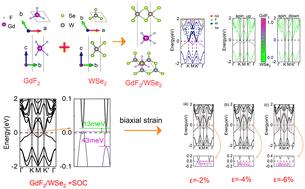
Two-dimensional (2D) van der Waals (vdW) heterojunctions have potential applications in spintronic devices owing to their unique electronic structure and properties. The 2D ferromagnetic material GdF2, formed by the rare earth element (Gd) with 4f electrons and fluorine, exhibits spontaneous valley polarization, perpendicular magnetic anisotropy and other excellent properties. Monolayer WSe2 has a similar structure to monolayer GdF2 and can be used to construct a vdW heterojunction. The heterojunction not only retains the original excellent properties but also generates new physical properties due to interfacial charge transfer and coupling. Therefore, this work investigates the electronic structure, magnetic anisotropy energy and Curie temperature (Tc) of the GdF2/WSe2 heterojunction. The GdF2/WSe2 heterojunction exhibits spontaneous valley polarization and can be modulated by biaxial strain. Additionally, valley polarization can be regulated by applying an external electric field and changing interface spacing. These results indicate that the GdF2/WSe2 heterojunction can be used as a promising platform for the study of spintronic and valleytronic devices and provide ideas for the development of new electronic devices.
期刊介绍:
Physical Chemistry Chemical Physics (PCCP) is an international journal co-owned by 19 physical chemistry and physics societies from around the world. This journal publishes original, cutting-edge research in physical chemistry, chemical physics and biophysical chemistry. To be suitable for publication in PCCP, articles must include significant innovation and/or insight into physical chemistry; this is the most important criterion that reviewers and Editors will judge against when evaluating submissions.
The journal has a broad scope and welcomes contributions spanning experiment, theory, computation and data science. Topical coverage includes spectroscopy, dynamics, kinetics, statistical mechanics, thermodynamics, electrochemistry, catalysis, surface science, quantum mechanics, quantum computing and machine learning. Interdisciplinary research areas such as polymers and soft matter, materials, nanoscience, energy, surfaces/interfaces, and biophysical chemistry are welcomed if they demonstrate significant innovation and/or insight into physical chemistry. Joined experimental/theoretical studies are particularly appreciated when complementary and based on up-to-date approaches.





 京公网安备 11010802042870号
京ICP备2023020795号-1
京公网安备 11010802042870号
京ICP备2023020795号-1

 分享
分享
 求助内容:
求助内容: 应助结果提醒方式:
 扫码关注我们
