Xun Lu, Chengcheng Shen, Chenghao Yang, Weikun Xu, Juan Yang, Chunsheng Wang, Dong Sun
{"title":"Megabenthic Diversity Patterns on a Seamount in the Philippine Sea: Implications for Conservation Planning on the Kyushu-Palau Ridge","authors":"Xun Lu, Chengcheng Shen, Chenghao Yang, Weikun Xu, Juan Yang, Chunsheng Wang, Dong Sun","doi":"10.1002/ece3.70427","DOIUrl":null,"url":null,"abstract":"<p>The oligotrophic tropical western Pacific region is characterized by a high density of seamounts, with the Kyushu-Palau Ridge (KPR) being the longest seamount chain here. Effective spatial management plans for seamount ecosystems necessitate an understanding of distribution patterns and key environmental factors influencing benthic communities. However, knowledge regarding deep-sea biodiversity patterns over intricate topography remains limited. In this study, we investigated a seamount with a water depth of 522 m at the summit located in the southern section of KPR. Survey transects were conducted from 522 m to 4059 m. By analyzing video-recorded data obtained by a human-occupied vehicle (HOV) during dives and environmental variables derived from bathymetry, distinct assemblages were identified through noise clustering. α- and β-diversity patterns within the seamount megabenthic community were analyzed across the depth gradient, along with investigation of their environmental drivers. A total of 10,596 megafauna individuals were documented, categorized into 88 morphospecies and statistically separated into six distinct community clusters using noise clustering analysis. Species abundance and richness were highest within the 700–800 m water depth range, declining notably beyond 2100 m, indicating a critical threshold for habitat classification in this region. The β-diversity of megabenthic communities was high (0.836). Although β-diversity patterns along the depth gradient were mostly dominated by differences in species richness, the contribution of species replacement increased with depth, becoming dominant at depths greater than 3000 m. Depth emerged as the primary driver of spatial variation in community structure, while near-bottom current velocity, topographic parameters (bathymetric position index, slope), and substrate type also influenced the formation of microhabitats. The study highlights the depth gradients, thresholds, and other intricate environmental factors shaping the spatial heterogeneity of these communities. It provides valuable insights for the future development of effective survey and conservation strategies for benthic biodiversity on the KPR.</p>","PeriodicalId":11467,"journal":{"name":"Ecology and Evolution","volume":"14 10","pages":""},"PeriodicalIF":2.3000,"publicationDate":"2024-10-17","publicationTypes":"Journal Article","fieldsOfStudy":null,"isOpenAccess":false,"openAccessPdf":"https://onlinelibrary.wiley.com/doi/epdf/10.1002/ece3.70427","citationCount":"0","resultStr":null,"platform":"Semanticscholar","paperid":null,"PeriodicalName":"Ecology and Evolution","FirstCategoryId":"99","ListUrlMain":"https://onlinelibrary.wiley.com/doi/10.1002/ece3.70427","RegionNum":2,"RegionCategory":"生物学","ArticlePicture":[],"TitleCN":null,"AbstractTextCN":null,"PMCID":null,"EPubDate":"","PubModel":"","JCR":"Q2","JCRName":"ECOLOGY","Score":null,"Total":0}
引用次数: 0
Abstract
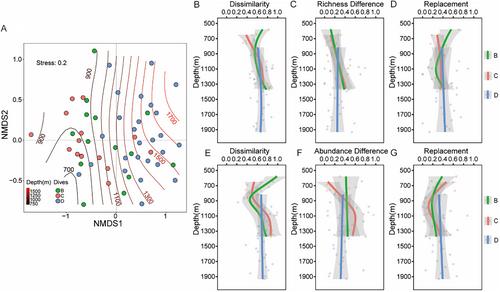
The oligotrophic tropical western Pacific region is characterized by a high density of seamounts, with the Kyushu-Palau Ridge (KPR) being the longest seamount chain here. Effective spatial management plans for seamount ecosystems necessitate an understanding of distribution patterns and key environmental factors influencing benthic communities. However, knowledge regarding deep-sea biodiversity patterns over intricate topography remains limited. In this study, we investigated a seamount with a water depth of 522 m at the summit located in the southern section of KPR. Survey transects were conducted from 522 m to 4059 m. By analyzing video-recorded data obtained by a human-occupied vehicle (HOV) during dives and environmental variables derived from bathymetry, distinct assemblages were identified through noise clustering. α- and β-diversity patterns within the seamount megabenthic community were analyzed across the depth gradient, along with investigation of their environmental drivers. A total of 10,596 megafauna individuals were documented, categorized into 88 morphospecies and statistically separated into six distinct community clusters using noise clustering analysis. Species abundance and richness were highest within the 700–800 m water depth range, declining notably beyond 2100 m, indicating a critical threshold for habitat classification in this region. The β-diversity of megabenthic communities was high (0.836). Although β-diversity patterns along the depth gradient were mostly dominated by differences in species richness, the contribution of species replacement increased with depth, becoming dominant at depths greater than 3000 m. Depth emerged as the primary driver of spatial variation in community structure, while near-bottom current velocity, topographic parameters (bathymetric position index, slope), and substrate type also influenced the formation of microhabitats. The study highlights the depth gradients, thresholds, and other intricate environmental factors shaping the spatial heterogeneity of these communities. It provides valuable insights for the future development of effective survey and conservation strategies for benthic biodiversity on the KPR.
期刊介绍:
Ecology and Evolution is the peer reviewed journal for rapid dissemination of research in all areas of ecology, evolution and conservation science. The journal gives priority to quality research reports, theoretical or empirical, that develop our understanding of organisms and their diversity, interactions between them, and the natural environment.
Ecology and Evolution gives prompt and equal consideration to papers reporting theoretical, experimental, applied and descriptive work in terrestrial and aquatic environments. The journal will consider submissions across taxa in areas including but not limited to micro and macro ecological and evolutionary processes, characteristics of and interactions between individuals, populations, communities and the environment, physiological responses to environmental change, population genetics and phylogenetics, relatedness and kin selection, life histories, systematics and taxonomy, conservation genetics, extinction, speciation, adaption, behaviour, biodiversity, species abundance, macroecology, population and ecosystem dynamics, and conservation policy.



 京公网安备 11010802042870号
京ICP备2023020795号-1
京公网安备 11010802042870号
京ICP备2023020795号-1

 分享
分享
 求助内容:
求助内容: 应助结果提醒方式:
 扫码关注我们
