Scott T. Koenigbauer, Zachary S. Feiner, Benjamin Dickinson, Stephanie L. Shaw, L. Zoe Almeida, Mark R. DuFour, Alexander J. Gatch, Claire Schraidt, Tomas O. Höök
{"title":"Egg Size Scales Negatively With System Size in a Periodic Fish Species","authors":"Scott T. Koenigbauer, Zachary S. Feiner, Benjamin Dickinson, Stephanie L. Shaw, L. Zoe Almeida, Mark R. DuFour, Alexander J. Gatch, Claire Schraidt, Tomas O. Höök","doi":"10.1002/ece3.70426","DOIUrl":null,"url":null,"abstract":"<p>Optimal egg size theory implies that female organisms balance between fecundity and individual offspring investment according to their environment. Past interspecific studies suggest that fishes in large marine systems generally produce smaller eggs than those in small freshwater systems. We tested whether intraspecific egg size variation reflected a similar pattern by comparing egg size among yellow perch (<i>Perca flavescens</i>) populations inhabiting a range of system sizes. In 2018, 2019, and 2023, we collected yellow perch egg samples from 12 locations in systems ranging in surface area from 37 to 5,390,492 ha. First, we found that egg diameter significantly increased with maternal total length in five of eight individually tested populations. After accounting for these maternal effects, we found a significant interaction, where females inhabiting larger lakes, such as the main basins of Lakes Erie and Michigan, produced smaller eggs than those in smaller inland lakes, and the greatest differences were demonstrated among females of greater total length. This egg size variation in the largest females is consistent with interspecific egg size comparisons between marine and freshwater fishes. However, by examining a single species across vastly different environments, we were able to support theoretical expectations that maternal investment in offspring should vary with environmental conditions controlling early-life resource acquisition and competition.</p>","PeriodicalId":11467,"journal":{"name":"Ecology and Evolution","volume":"14 10","pages":""},"PeriodicalIF":2.3000,"publicationDate":"2024-10-17","publicationTypes":"Journal Article","fieldsOfStudy":null,"isOpenAccess":false,"openAccessPdf":"https://onlinelibrary.wiley.com/doi/epdf/10.1002/ece3.70426","citationCount":"0","resultStr":null,"platform":"Semanticscholar","paperid":null,"PeriodicalName":"Ecology and Evolution","FirstCategoryId":"99","ListUrlMain":"https://onlinelibrary.wiley.com/doi/10.1002/ece3.70426","RegionNum":2,"RegionCategory":"生物学","ArticlePicture":[],"TitleCN":null,"AbstractTextCN":null,"PMCID":null,"EPubDate":"","PubModel":"","JCR":"Q2","JCRName":"ECOLOGY","Score":null,"Total":0}
引用次数: 0
Abstract
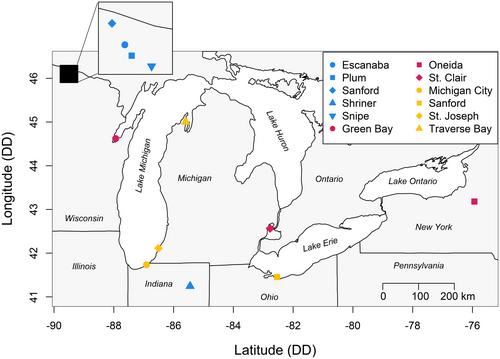
Optimal egg size theory implies that female organisms balance between fecundity and individual offspring investment according to their environment. Past interspecific studies suggest that fishes in large marine systems generally produce smaller eggs than those in small freshwater systems. We tested whether intraspecific egg size variation reflected a similar pattern by comparing egg size among yellow perch (Perca flavescens) populations inhabiting a range of system sizes. In 2018, 2019, and 2023, we collected yellow perch egg samples from 12 locations in systems ranging in surface area from 37 to 5,390,492 ha. First, we found that egg diameter significantly increased with maternal total length in five of eight individually tested populations. After accounting for these maternal effects, we found a significant interaction, where females inhabiting larger lakes, such as the main basins of Lakes Erie and Michigan, produced smaller eggs than those in smaller inland lakes, and the greatest differences were demonstrated among females of greater total length. This egg size variation in the largest females is consistent with interspecific egg size comparisons between marine and freshwater fishes. However, by examining a single species across vastly different environments, we were able to support theoretical expectations that maternal investment in offspring should vary with environmental conditions controlling early-life resource acquisition and competition.
期刊介绍:
Ecology and Evolution is the peer reviewed journal for rapid dissemination of research in all areas of ecology, evolution and conservation science. The journal gives priority to quality research reports, theoretical or empirical, that develop our understanding of organisms and their diversity, interactions between them, and the natural environment.
Ecology and Evolution gives prompt and equal consideration to papers reporting theoretical, experimental, applied and descriptive work in terrestrial and aquatic environments. The journal will consider submissions across taxa in areas including but not limited to micro and macro ecological and evolutionary processes, characteristics of and interactions between individuals, populations, communities and the environment, physiological responses to environmental change, population genetics and phylogenetics, relatedness and kin selection, life histories, systematics and taxonomy, conservation genetics, extinction, speciation, adaption, behaviour, biodiversity, species abundance, macroecology, population and ecosystem dynamics, and conservation policy.



 京公网安备 11010802042870号
京ICP备2023020795号-1
京公网安备 11010802042870号
京ICP备2023020795号-1

 分享
分享
 求助内容:
求助内容: 应助结果提醒方式:
 扫码关注我们
