Shaohua Luo;Yongduan Song;Ya Zhang;Hassen M. Ouakad;Frank L. Lewis
{"title":"Dynamic Analysis and Neural-Adaptive Prescribed-Time Control of the FO Memristive Magnetic-Field Electromechanical Transducer","authors":"Shaohua Luo;Yongduan Song;Ya Zhang;Hassen M. Ouakad;Frank L. Lewis","doi":"10.1109/TCYB.2024.3474248","DOIUrl":null,"url":null,"abstract":"This article is concerned with dynamic analysis and neural-adaptive prescribed-time control of the magnetic-field electromechanical transducer incorporating a memristor. First, a fractional-order (FO) mathematical model is developed, which comprehensively characterizes fractional properties of various dielectrics and establishes the relationship between magnetic flux and electric charge. The dynamical analysis explores internal evolution and complexity performance concerning a single factor or double factors among the FO, system parameter, and memristor configuration by the Bifurcation diagram, sample entropy, and \n<inline-formula> <tex-math>$C_{0}$ </tex-math></inline-formula>\n complexity from multiple perspectives. Subsequently, a neural-adaptive prescribed-time control scheme is proposed to transform detrimental chaotic oscillations into orderly motions, achieve the pregiven tracking precision and accommodating both actuator fault and system uncertainty. The controller design consists of three key steps: 1) a deferred constraint function is imposed on the tracking error starting from anywhere to get assignable tracking precision within a specified time, ensuring collision avoidance; 2) a type-2 fuzzy wavelet neural network (FWNN) is utilized effectively to handle parameter perturbations and system uncertainties; and 3) a second-order FO tracking differentiator (TD) is utilized to address the “explosion of complexity” of traditional backstepping under actuator fault model. It is shown that the proposed scheme is able to ensure the boundness of all signals of the closed-loop system. Finally, extensive simulation experiments are conducted to validate the effectiveness and robustness of the rendered scheme.","PeriodicalId":13112,"journal":{"name":"IEEE Transactions on Cybernetics","volume":"55 1","pages":"99-110"},"PeriodicalIF":10.5000,"publicationDate":"2024-10-18","publicationTypes":"Journal Article","fieldsOfStudy":null,"isOpenAccess":false,"openAccessPdf":"","citationCount":"0","resultStr":null,"platform":"Semanticscholar","paperid":null,"PeriodicalName":"IEEE Transactions on Cybernetics","FirstCategoryId":"94","ListUrlMain":"https://ieeexplore.ieee.org/document/10722854/","RegionNum":1,"RegionCategory":"计算机科学","ArticlePicture":[],"TitleCN":null,"AbstractTextCN":null,"PMCID":null,"EPubDate":"","PubModel":"","JCR":"Q1","JCRName":"AUTOMATION & CONTROL SYSTEMS","Score":null,"Total":0}
引用次数: 0
Abstract
This article is concerned with dynamic analysis and neural-adaptive prescribed-time control of the magnetic-field electromechanical transducer incorporating a memristor. First, a fractional-order (FO) mathematical model is developed, which comprehensively characterizes fractional properties of various dielectrics and establishes the relationship between magnetic flux and electric charge. The dynamical analysis explores internal evolution and complexity performance concerning a single factor or double factors among the FO, system parameter, and memristor configuration by the Bifurcation diagram, sample entropy, and
$C_{0}$
complexity from multiple perspectives. Subsequently, a neural-adaptive prescribed-time control scheme is proposed to transform detrimental chaotic oscillations into orderly motions, achieve the pregiven tracking precision and accommodating both actuator fault and system uncertainty. The controller design consists of three key steps: 1) a deferred constraint function is imposed on the tracking error starting from anywhere to get assignable tracking precision within a specified time, ensuring collision avoidance; 2) a type-2 fuzzy wavelet neural network (FWNN) is utilized effectively to handle parameter perturbations and system uncertainties; and 3) a second-order FO tracking differentiator (TD) is utilized to address the “explosion of complexity” of traditional backstepping under actuator fault model. It is shown that the proposed scheme is able to ensure the boundness of all signals of the closed-loop system. Finally, extensive simulation experiments are conducted to validate the effectiveness and robustness of the rendered scheme.
期刊介绍:
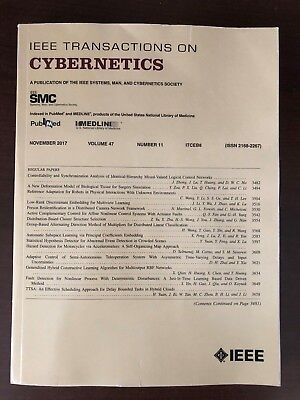
The scope of the IEEE Transactions on Cybernetics includes computational approaches to the field of cybernetics. Specifically, the transactions welcomes papers on communication and control across machines or machine, human, and organizations. The scope includes such areas as computational intelligence, computer vision, neural networks, genetic algorithms, machine learning, fuzzy systems, cognitive systems, decision making, and robotics, to the extent that they contribute to the theme of cybernetics or demonstrate an application of cybernetics principles.




 京公网安备 11010802042870号
京ICP备2023020795号-1
京公网安备 11010802042870号
京ICP备2023020795号-1

 分享
分享
 求助内容:
求助内容: 应助结果提醒方式:
 扫码关注我们
