Charlotte S. Matthews, James Kennedy, Anna H. Ólafsdóttir, Christophe Pampoulie
{"title":"Biological Characteristics of the Glacier Lantern Fish Benthosema glaciale (Myctophidae) in Icelandic Waters and the Irminger Sea During Summer","authors":"Charlotte S. Matthews, James Kennedy, Anna H. Ólafsdóttir, Christophe Pampoulie","doi":"10.1002/ece3.70386","DOIUrl":null,"url":null,"abstract":"<p>Myctophids are one of the most diverse and abundant fish families in the mesopelagic zone, making them a key component in the marine pelagic community. In the North Atlantic, <i>Benthosema glaciale</i> (glacier lantern fish) is considered the most abundant myctophid north of 35° N, yet some regions within its extensive range lack information on its basic biological parameters. We investigated the growth and described the distribution of <i>B. glaciale</i> in Icelandic waters, including the southern continental shelf, Iceland Basin, and Irminger Sea. Length distribution, growth, relative body condition, age, and otolith-fish size relationships were analyzed from samples collected opportunistically with pelagic trawls during the International Ecosystem Summer Survey in the Nordic Seas (IESSNS) in July 2020. In total, 1374 individuals were caught, and only a subset of 225 were measured fresh at sea and 89 were frozen and dissected on land. Total lengths of fresh fish ranged from 38 to 85 mm, while dissected individuals ranged from 40 to 74 mm and were 2 to 6 years old. Located over the Reykjanes Ridge in the Iceland Basin region, individuals had a significantly higher mean standard length and mean age, and a lower mean body condition. We reported length–weight relationships for both fresh and frozen samples, indicating evidence that preserving of the specimens through freezing affected relationships. The von Bertalanffy growth curve was calculated along with significant otolith-fish size relationships where <i>r</i><sup><i>2</i></sup> values ranged between 0.87 and 0.92. Our research highlights the importance of cross-regional studies and provides baseline biology for <i>B. glaciale</i> in Icelandic waters, specifically in the southern continental slope and Reykjanes Ridge.</p>","PeriodicalId":11467,"journal":{"name":"Ecology and Evolution","volume":"14 10","pages":""},"PeriodicalIF":2.3000,"publicationDate":"2024-10-17","publicationTypes":"Journal Article","fieldsOfStudy":null,"isOpenAccess":false,"openAccessPdf":"https://onlinelibrary.wiley.com/doi/epdf/10.1002/ece3.70386","citationCount":"0","resultStr":null,"platform":"Semanticscholar","paperid":null,"PeriodicalName":"Ecology and Evolution","FirstCategoryId":"99","ListUrlMain":"https://onlinelibrary.wiley.com/doi/10.1002/ece3.70386","RegionNum":2,"RegionCategory":"生物学","ArticlePicture":[],"TitleCN":null,"AbstractTextCN":null,"PMCID":null,"EPubDate":"","PubModel":"","JCR":"Q2","JCRName":"ECOLOGY","Score":null,"Total":0}
引用次数: 0
Abstract
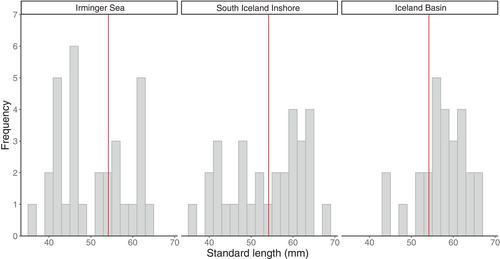
Myctophids are one of the most diverse and abundant fish families in the mesopelagic zone, making them a key component in the marine pelagic community. In the North Atlantic, Benthosema glaciale (glacier lantern fish) is considered the most abundant myctophid north of 35° N, yet some regions within its extensive range lack information on its basic biological parameters. We investigated the growth and described the distribution of B. glaciale in Icelandic waters, including the southern continental shelf, Iceland Basin, and Irminger Sea. Length distribution, growth, relative body condition, age, and otolith-fish size relationships were analyzed from samples collected opportunistically with pelagic trawls during the International Ecosystem Summer Survey in the Nordic Seas (IESSNS) in July 2020. In total, 1374 individuals were caught, and only a subset of 225 were measured fresh at sea and 89 were frozen and dissected on land. Total lengths of fresh fish ranged from 38 to 85 mm, while dissected individuals ranged from 40 to 74 mm and were 2 to 6 years old. Located over the Reykjanes Ridge in the Iceland Basin region, individuals had a significantly higher mean standard length and mean age, and a lower mean body condition. We reported length–weight relationships for both fresh and frozen samples, indicating evidence that preserving of the specimens through freezing affected relationships. The von Bertalanffy growth curve was calculated along with significant otolith-fish size relationships where r2 values ranged between 0.87 and 0.92. Our research highlights the importance of cross-regional studies and provides baseline biology for B. glaciale in Icelandic waters, specifically in the southern continental slope and Reykjanes Ridge.
期刊介绍:
Ecology and Evolution is the peer reviewed journal for rapid dissemination of research in all areas of ecology, evolution and conservation science. The journal gives priority to quality research reports, theoretical or empirical, that develop our understanding of organisms and their diversity, interactions between them, and the natural environment.
Ecology and Evolution gives prompt and equal consideration to papers reporting theoretical, experimental, applied and descriptive work in terrestrial and aquatic environments. The journal will consider submissions across taxa in areas including but not limited to micro and macro ecological and evolutionary processes, characteristics of and interactions between individuals, populations, communities and the environment, physiological responses to environmental change, population genetics and phylogenetics, relatedness and kin selection, life histories, systematics and taxonomy, conservation genetics, extinction, speciation, adaption, behaviour, biodiversity, species abundance, macroecology, population and ecosystem dynamics, and conservation policy.



 京公网安备 11010802042870号
京ICP备2023020795号-1
京公网安备 11010802042870号
京ICP备2023020795号-1

 分享
分享
 求助内容:
求助内容: 应助结果提醒方式:
 扫码关注我们
