{"title":"Fight, retreat, repeat: The male–male agonistic behavior in the wood-feeding cockroach, Panesthia angustipennis spadica (Dictyoptera: Blattodea: Blaberidae)","authors":"Haruka Osaki, Tomohiro Nakazono, Kiyotaka Yabe, Mamoru Takata, Aram Mikaelyan","doi":"10.1002/ece3.70319","DOIUrl":null,"url":null,"abstract":"<p>Competition is one of the most critical factors affecting animal behaviors. Aggressive interactions are central to acquiring resources or mating partners. Agonistic behavior is more common among males than females. Although laboratory observations of these behaviors give detailed descriptions under controlled conditions, field observations without human intervention are required because those supply information that provides insights into their function. In this paper, we report on the field observation and auxiliary laboratory experiments of male–male agonistic behavior of a wood-feeding cockroach, <i>Panesthia angustipennis</i>, and discuss its strategy. In the field, a male pushed the opponent with the horn on the pronotum out of a gap between two logs, under which a female was. After pushing, the male repeatedly returned to a place close to the female, even if it did not subdue the opponent entirely. It suggests that the male–male agonistic behavior in <i>P. angustipennis</i> has both attack and avoidance. The bout was repeated as the ejected male reapproached the male. In contrast, the inferior male often escaped in the laboratory recording after field observation. Keeping the fighting experience for several days may contribute to the males avoiding a “losing battle.” This study significantly enhances our understanding of the mating strategy of <i>P. angustipennis</i> through male–male agonistic behavior and provides possibilities for its cognitive aspects from the fighting experience.</p>","PeriodicalId":11467,"journal":{"name":"Ecology and Evolution","volume":"14 10","pages":""},"PeriodicalIF":2.3000,"publicationDate":"2024-10-17","publicationTypes":"Journal Article","fieldsOfStudy":null,"isOpenAccess":false,"openAccessPdf":"https://onlinelibrary.wiley.com/doi/epdf/10.1002/ece3.70319","citationCount":"0","resultStr":null,"platform":"Semanticscholar","paperid":null,"PeriodicalName":"Ecology and Evolution","FirstCategoryId":"99","ListUrlMain":"https://onlinelibrary.wiley.com/doi/10.1002/ece3.70319","RegionNum":2,"RegionCategory":"生物学","ArticlePicture":[],"TitleCN":null,"AbstractTextCN":null,"PMCID":null,"EPubDate":"","PubModel":"","JCR":"Q2","JCRName":"ECOLOGY","Score":null,"Total":0}
引用次数: 0
Abstract
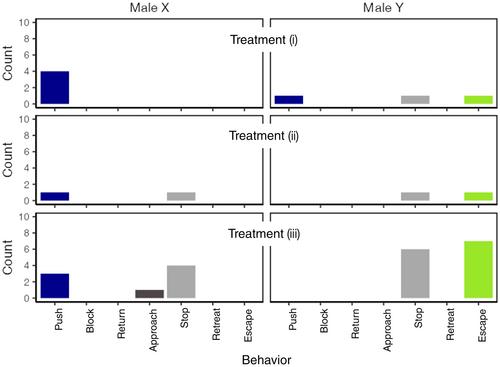
Competition is one of the most critical factors affecting animal behaviors. Aggressive interactions are central to acquiring resources or mating partners. Agonistic behavior is more common among males than females. Although laboratory observations of these behaviors give detailed descriptions under controlled conditions, field observations without human intervention are required because those supply information that provides insights into their function. In this paper, we report on the field observation and auxiliary laboratory experiments of male–male agonistic behavior of a wood-feeding cockroach, Panesthia angustipennis, and discuss its strategy. In the field, a male pushed the opponent with the horn on the pronotum out of a gap between two logs, under which a female was. After pushing, the male repeatedly returned to a place close to the female, even if it did not subdue the opponent entirely. It suggests that the male–male agonistic behavior in P. angustipennis has both attack and avoidance. The bout was repeated as the ejected male reapproached the male. In contrast, the inferior male often escaped in the laboratory recording after field observation. Keeping the fighting experience for several days may contribute to the males avoiding a “losing battle.” This study significantly enhances our understanding of the mating strategy of P. angustipennis through male–male agonistic behavior and provides possibilities for its cognitive aspects from the fighting experience.
期刊介绍:
Ecology and Evolution is the peer reviewed journal for rapid dissemination of research in all areas of ecology, evolution and conservation science. The journal gives priority to quality research reports, theoretical or empirical, that develop our understanding of organisms and their diversity, interactions between them, and the natural environment.
Ecology and Evolution gives prompt and equal consideration to papers reporting theoretical, experimental, applied and descriptive work in terrestrial and aquatic environments. The journal will consider submissions across taxa in areas including but not limited to micro and macro ecological and evolutionary processes, characteristics of and interactions between individuals, populations, communities and the environment, physiological responses to environmental change, population genetics and phylogenetics, relatedness and kin selection, life histories, systematics and taxonomy, conservation genetics, extinction, speciation, adaption, behaviour, biodiversity, species abundance, macroecology, population and ecosystem dynamics, and conservation policy.



 京公网安备 11010802042870号
京ICP备2023020795号-1
京公网安备 11010802042870号
京ICP备2023020795号-1

 分享
分享
 求助内容:
求助内容: 应助结果提醒方式:
 扫码关注我们
