Srikanta Debata, Suvendu Kumar Panda and Dhruv Pratap Singh
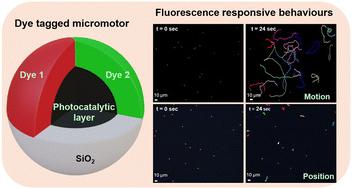
{"title":"Engineering light-driven micromotors with fluorescent dye coatings for easy detection and tracking†","authors":"Srikanta Debata, Suvendu Kumar Panda and Dhruv Pratap Singh","doi":"10.1039/D4NR03274H","DOIUrl":null,"url":null,"abstract":"<p >Micromotors are the backbone of material research as they are small-sized, self-propelled, intelligent systems capable of performing multiple tasks ranging from biomedicine to environmental monitoring. One of the primary obstacles the field faces is the live detection and differentiation of individual units through a complex environment. In this study, we demonstrate a facile approach for designing light-activated dye-tagged micromotors on a large scale. The micromotors are titanium dioxide (TiO<small><sub>2</sub></small>)/copper oxide (Cu<small><sub>2</sub></small>O)-silica Janus spheres that are self-propelled under the illumination of low-intensity light in aqueous peroxide medium. The micromotors were modified with different dyes, such as Alq3, Alizarin, zinc phthalocyanine, <em>etc</em>. The fabrication of micromotors and coating with dyes were performed using a simple and versatile physical vapor deposition-based glancing angle deposition (GLAD) technique. The fluorescent dyes help to detect the motion and position of micromotors independently. Moreover, they also help to identify the swimming direction as well as differentiate the micromotors in a complex medium consisting of similar configurations of other particles (bacteria and passive fluorescent particles). Light provides full control over the dynamics as well as the fluorescence nature of micromotors. To present the versatility of our design scheme, micromotors of different shapes, materials, and dye coatings are designed and explored for fluorescence-based observations. The simplistic design approach with easy-to-load multiple fluorescent dyes is an interesting feature that makes the micromotors suitable candidates for various microfluidic and lab-on-a-chip studies, including biological or fluorescent samples.</p>","PeriodicalId":92,"journal":{"name":"Nanoscale","volume":" 47","pages":" 21893-21901"},"PeriodicalIF":5.1000,"publicationDate":"2024-10-21","publicationTypes":"Journal Article","fieldsOfStudy":null,"isOpenAccess":false,"openAccessPdf":"","citationCount":"0","resultStr":null,"platform":"Semanticscholar","paperid":null,"PeriodicalName":"Nanoscale","FirstCategoryId":"88","ListUrlMain":"https://pubs.rsc.org/en/content/articlelanding/2024/nr/d4nr03274h","RegionNum":3,"RegionCategory":"材料科学","ArticlePicture":[],"TitleCN":null,"AbstractTextCN":null,"PMCID":null,"EPubDate":"","PubModel":"","JCR":"Q1","JCRName":"CHEMISTRY, MULTIDISCIPLINARY","Score":null,"Total":0}
引用次数: 0
Abstract
Micromotors are the backbone of material research as they are small-sized, self-propelled, intelligent systems capable of performing multiple tasks ranging from biomedicine to environmental monitoring. One of the primary obstacles the field faces is the live detection and differentiation of individual units through a complex environment. In this study, we demonstrate a facile approach for designing light-activated dye-tagged micromotors on a large scale. The micromotors are titanium dioxide (TiO2)/copper oxide (Cu2O)-silica Janus spheres that are self-propelled under the illumination of low-intensity light in aqueous peroxide medium. The micromotors were modified with different dyes, such as Alq3, Alizarin, zinc phthalocyanine, etc. The fabrication of micromotors and coating with dyes were performed using a simple and versatile physical vapor deposition-based glancing angle deposition (GLAD) technique. The fluorescent dyes help to detect the motion and position of micromotors independently. Moreover, they also help to identify the swimming direction as well as differentiate the micromotors in a complex medium consisting of similar configurations of other particles (bacteria and passive fluorescent particles). Light provides full control over the dynamics as well as the fluorescence nature of micromotors. To present the versatility of our design scheme, micromotors of different shapes, materials, and dye coatings are designed and explored for fluorescence-based observations. The simplistic design approach with easy-to-load multiple fluorescent dyes is an interesting feature that makes the micromotors suitable candidates for various microfluidic and lab-on-a-chip studies, including biological or fluorescent samples.
期刊介绍:
Nanoscale is a high-impact international journal, publishing high-quality research across nanoscience and nanotechnology. Nanoscale publishes a full mix of research articles on experimental and theoretical work, including reviews, communications, and full papers.Highly interdisciplinary, this journal appeals to scientists, researchers and professionals interested in nanoscience and nanotechnology, quantum materials and quantum technology, including the areas of physics, chemistry, biology, medicine, materials, energy/environment, information technology, detection science, healthcare and drug discovery, and electronics.



 京公网安备 11010802042870号
京ICP备2023020795号-1
京公网安备 11010802042870号
京ICP备2023020795号-1

 分享
分享
 求助内容:
求助内容: 应助结果提醒方式:
 扫码关注我们
