Sara D. Irish, Andreas Sutter, Livia Pinzoni, Mabel C. Sydney, Laura Travers, David Murray, Jean-Charles de Coriolis, Simone Immler
{"title":"Heatwave-Induced Paternal Effects Have Limited Adaptive Benefits in Offspring","authors":"Sara D. Irish, Andreas Sutter, Livia Pinzoni, Mabel C. Sydney, Laura Travers, David Murray, Jean-Charles de Coriolis, Simone Immler","doi":"10.1002/ece3.70399","DOIUrl":null,"url":null,"abstract":"<p>As the threat of climate change and associated heatwaves grows, we need to understand how natural populations will respond. Inter-generational non-genetic inheritance may play a key role in rapid adaptation, but whether such mechanisms are truly adaptive and sufficient to protect wild populations is unclear. The contribution of paternal effects in particular is not fully understood, even though the male reproductive system may be highly sensitive to heatwaves. We used the zebrafish <i>Danio rerio</i> to investigate the effects of heatwaves on male fertility and assess potential adaptive benefits to their offspring in a number of large-scale heatwave experiments. Heatwave conditions had negative effects on male fertility by reducing gamete quality and fertilisation success, and we found indications of an adaptive effect on hatching in offspring produced by heatwave-exposed males. Our findings highlight the importance of including male and female fertility when determining species ability to cope with extreme conditions and suggest that parental effects provide limited adaptive benefits.</p>","PeriodicalId":11467,"journal":{"name":"Ecology and Evolution","volume":"14 10","pages":""},"PeriodicalIF":2.3000,"publicationDate":"2024-10-20","publicationTypes":"Journal Article","fieldsOfStudy":null,"isOpenAccess":false,"openAccessPdf":"https://onlinelibrary.wiley.com/doi/epdf/10.1002/ece3.70399","citationCount":"0","resultStr":null,"platform":"Semanticscholar","paperid":null,"PeriodicalName":"Ecology and Evolution","FirstCategoryId":"99","ListUrlMain":"https://onlinelibrary.wiley.com/doi/10.1002/ece3.70399","RegionNum":2,"RegionCategory":"生物学","ArticlePicture":[],"TitleCN":null,"AbstractTextCN":null,"PMCID":null,"EPubDate":"","PubModel":"","JCR":"Q2","JCRName":"ECOLOGY","Score":null,"Total":0}
引用次数: 0
Abstract
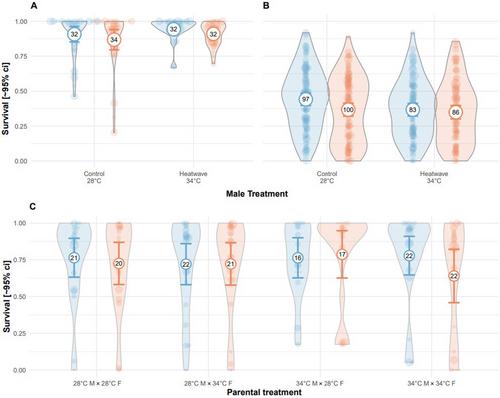
As the threat of climate change and associated heatwaves grows, we need to understand how natural populations will respond. Inter-generational non-genetic inheritance may play a key role in rapid adaptation, but whether such mechanisms are truly adaptive and sufficient to protect wild populations is unclear. The contribution of paternal effects in particular is not fully understood, even though the male reproductive system may be highly sensitive to heatwaves. We used the zebrafish Danio rerio to investigate the effects of heatwaves on male fertility and assess potential adaptive benefits to their offspring in a number of large-scale heatwave experiments. Heatwave conditions had negative effects on male fertility by reducing gamete quality and fertilisation success, and we found indications of an adaptive effect on hatching in offspring produced by heatwave-exposed males. Our findings highlight the importance of including male and female fertility when determining species ability to cope with extreme conditions and suggest that parental effects provide limited adaptive benefits.
期刊介绍:
Ecology and Evolution is the peer reviewed journal for rapid dissemination of research in all areas of ecology, evolution and conservation science. The journal gives priority to quality research reports, theoretical or empirical, that develop our understanding of organisms and their diversity, interactions between them, and the natural environment.
Ecology and Evolution gives prompt and equal consideration to papers reporting theoretical, experimental, applied and descriptive work in terrestrial and aquatic environments. The journal will consider submissions across taxa in areas including but not limited to micro and macro ecological and evolutionary processes, characteristics of and interactions between individuals, populations, communities and the environment, physiological responses to environmental change, population genetics and phylogenetics, relatedness and kin selection, life histories, systematics and taxonomy, conservation genetics, extinction, speciation, adaption, behaviour, biodiversity, species abundance, macroecology, population and ecosystem dynamics, and conservation policy.



 京公网安备 11010802042870号
京ICP备2023020795号-1
京公网安备 11010802042870号
京ICP备2023020795号-1

 分享
分享
 求助内容:
求助内容: 应助结果提醒方式:
 扫码关注我们
