Association of common and rare variants with Alzheimer's disease in more than 13,000 diverse individuals with whole-genome sequencing from the Alzheimer's Disease Sequencing Project
Wan-Ping Lee, Seung Hoan Choi, Margaret G. Shea, Po-Liang Cheng, Beth A. Dombroski, Achilleas N. Pitsillides, Nancy L. Heard-Costa, Hui Wang, Katia Bulekova, Amanda B. Kuzma, Yuk Yee Leung, John J. Farrell, Honghuang Lin, Brian W. Kunkle, Adam Naj, Elizabeth E. Blue, Frederick Nusetor, Dongyu Wang, Eric Boerwinkle, William S. Bush, Xiaoling Zhang, Philip L. De Jager, Josée Dupuis, Lindsay A. Farrer, Myriam Fornage, Eden Martin, Margaret Pericak-Vance, Sudha Seshadri, Ellen M. Wijsman, Li-San Wang, The Alzheimer's Disease Sequencing Project, Gerard D. Schellenberg, Anita L. Destefano, Jonathan L. Haines, Gina M. Peloso
{"title":"Association of common and rare variants with Alzheimer's disease in more than 13,000 diverse individuals with whole-genome sequencing from the Alzheimer's Disease Sequencing Project","authors":"Wan-Ping Lee, Seung Hoan Choi, Margaret G. Shea, Po-Liang Cheng, Beth A. Dombroski, Achilleas N. Pitsillides, Nancy L. Heard-Costa, Hui Wang, Katia Bulekova, Amanda B. Kuzma, Yuk Yee Leung, John J. Farrell, Honghuang Lin, Brian W. Kunkle, Adam Naj, Elizabeth E. Blue, Frederick Nusetor, Dongyu Wang, Eric Boerwinkle, William S. Bush, Xiaoling Zhang, Philip L. De Jager, Josée Dupuis, Lindsay A. Farrer, Myriam Fornage, Eden Martin, Margaret Pericak-Vance, Sudha Seshadri, Ellen M. Wijsman, Li-San Wang, The Alzheimer's Disease Sequencing Project, Gerard D. Schellenberg, Anita L. Destefano, Jonathan L. Haines, Gina M. Peloso","doi":"10.1002/alz.14283","DOIUrl":null,"url":null,"abstract":"<div>\n \n \n <section>\n \n <h3> INTRODUCTION</h3>\n \n <p>Alzheimer's disease (AD) is a common disorder of the elderly that is both highly heritable and genetically heterogeneous.</p>\n </section>\n \n <section>\n \n <h3> METHODS</h3>\n \n <p>We investigated the association of AD with both common variants and aggregates of rare coding and non-coding variants in 13,371 individuals of diverse ancestry with whole genome sequencing (WGS) data.</p>\n </section>\n \n <section>\n \n <h3> RESULTS</h3>\n \n <p>Pooled-population analyses of all individuals identified genetic variants at apolipoprotein E (<i>APOE</i>) and <i>BIN1</i> associated with AD (<i>p</i> < 5 × 10<sup>−8</sup>). Subgroup-specific analyses identified a haplotype on chromosome 14 including <i>PSEN1</i> associated with AD in Hispanics, further supported by aggregate testing of rare coding and non-coding variants in the region. Common variants in <i>LINC00320</i> were observed associated with AD in Black individuals (<i>p</i> = 1.9 × 10<sup>−9</sup>). Finally, we observed rare non-coding variants in the promoter of <i>TOMM40</i> distinct of <i>APOE</i> in pooled-population analyses (<i>p</i> = 7.2 × 10<sup>−8</sup>).</p>\n </section>\n \n <section>\n \n <h3> DISCUSSION</h3>\n \n <p>We observed that complementary pooled-population and subgroup-specific analyses offered unique insights into the genetic architecture of AD.</p>\n </section>\n \n <section>\n \n <h3> Highlights</h3>\n \n <div>\n <ul>\n \n <li>We determine the association of genetic variants with Alzheimer's disease (AD) using 13,371 individuals of diverse ancestry with whole genome sequencing (WGS) data.</li>\n \n <li>We identified genetic variants at apolipoprotein E (<i>APOE</i>), <i>BIN1</i>, <i>PSEN1</i>, and <i>LINC00320</i> associated with AD.</li>\n \n <li>We observed rare non-coding variants in the promoter of <i>TOMM40</i> distinct of <i>APOE</i>.</li>\n </ul>\n </div>\n </section>\n </div>","PeriodicalId":7471,"journal":{"name":"Alzheimer's & Dementia","volume":"20 12","pages":"8470-8483"},"PeriodicalIF":11.1000,"publicationDate":"2024-10-20","publicationTypes":"Journal Article","fieldsOfStudy":null,"isOpenAccess":false,"openAccessPdf":"https://onlinelibrary.wiley.com/doi/epdf/10.1002/alz.14283","citationCount":"0","resultStr":null,"platform":"Semanticscholar","paperid":null,"PeriodicalName":"Alzheimer's & Dementia","FirstCategoryId":"3","ListUrlMain":"https://alz-journals.onlinelibrary.wiley.com/doi/10.1002/alz.14283","RegionNum":1,"RegionCategory":"医学","ArticlePicture":[],"TitleCN":null,"AbstractTextCN":null,"PMCID":null,"EPubDate":"","PubModel":"","JCR":"Q1","JCRName":"CLINICAL NEUROLOGY","Score":null,"Total":0}
引用次数: 0
Abstract
INTRODUCTION
Alzheimer's disease (AD) is a common disorder of the elderly that is both highly heritable and genetically heterogeneous.
METHODS
We investigated the association of AD with both common variants and aggregates of rare coding and non-coding variants in 13,371 individuals of diverse ancestry with whole genome sequencing (WGS) data.
RESULTS
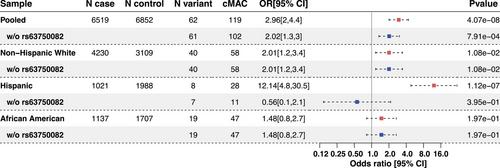
Pooled-population analyses of all individuals identified genetic variants at apolipoprotein E (APOE) and BIN1 associated with AD (p < 5 × 10⁻⁸). Subgroup-specific analyses identified a haplotype on chromosome 14 including PSEN1 associated with AD in Hispanics, further supported by aggregate testing of rare coding and non-coding variants in the region. Common variants in LINC00320 were observed associated with AD in Black individuals (p = 1.9 × 10⁻⁹). Finally, we observed rare non-coding variants in the promoter of TOMM40 distinct of APOE in pooled-population analyses (p = 7.2 × 10⁻⁸).
DISCUSSION
We observed that complementary pooled-population and subgroup-specific analyses offered unique insights into the genetic architecture of AD.
Highlights
We determine the association of genetic variants with Alzheimer's disease (AD) using 13,371 individuals of diverse ancestry with whole genome sequencing (WGS) data.
We identified genetic variants at apolipoprotein E (APOE), BIN1, PSEN1, and LINC00320 associated with AD.
We observed rare non-coding variants in the promoter of TOMM40 distinct of APOE.
期刊介绍:
Alzheimer's & Dementia is a peer-reviewed journal that aims to bridge knowledge gaps in dementia research by covering the entire spectrum, from basic science to clinical trials to social and behavioral investigations. It provides a platform for rapid communication of new findings and ideas, optimal translation of research into practical applications, increasing knowledge across diverse disciplines for early detection, diagnosis, and intervention, and identifying promising new research directions. In July 2008, Alzheimer's & Dementia was accepted for indexing by MEDLINE, recognizing its scientific merit and contribution to Alzheimer's research.




 京公网安备 11010802042870号
京ICP备2023020795号-1
京公网安备 11010802042870号
京ICP备2023020795号-1

 分享
分享
 求助内容:
求助内容: 应助结果提醒方式:
 扫码关注我们
