Guoxiang Zheng, Yifan Jin, Michal Sedlačík, Elif Vargun, Yifan Zhang, Ying He, Petr Saha and Qilin Cheng
{"title":"A mortise–tenon-like ionic/electronic conductive interface facilitates long-cycle solid-state lithium metal batteries†","authors":"Guoxiang Zheng, Yifan Jin, Michal Sedlačík, Elif Vargun, Yifan Zhang, Ying He, Petr Saha and Qilin Cheng","doi":"10.1039/D4TA05312E","DOIUrl":null,"url":null,"abstract":"<p >Solid-state lithium metal batteries (SSLMBs) with high energy density and superior safety have been recognized as next-generation energy storage systems and have attracted a lot of attention. Garnet-type oxide solid-state electrolytes, especially Li<small><sub>6.4</sub></small>La<small><sub>3</sub></small>Zr<small><sub>1.4</sub></small>Ta<small><sub>0.6</sub></small>O<small><sub>12</sub></small> (LLZTO), with high ionic conductivity, low activation energy and superior stability with Li, are among the most promising solid-state electrolyte materials. However, high interfacial resistance, uneven lithium deposition and lithium dendrite growth between Li/LLZTO interfaces have hindered the industrialization of SSLMBs. In this work, a novel mortise–tenon-like hybrid ionic/electronic conductive interface (Li/LZFC@LLZTO) is constructed, which is composed of LiF, LiCl, and a Li–Zn alloy through an <em>in situ</em> transformation reaction. As expected, the interfacial impedance of Li|LZFC@LLZTO|Li is significantly reduced from 128 Ω cm<small><sup>2</sup></small> to 2.7 Ω cm<small><sup>2</sup></small>, the critical current density increases from 0.3 mA cm<small><sup>−2</sup></small> to 2.1 mA cm<small><sup>−2</sup></small>, and a prominent cycling performance of 6600 h at 0.2 mA cm<small><sup>−2</sup></small> or 900 h at 0.4 mA cm<small><sup>−2</sup></small> is achieved. Consequently, both the Li|LZFC@LLZTO|LiFePO<small><sub>4</sub></small> and Li|LZFC@LLZTO|LiNi<small><sub>0.8</sub></small>Co<small><sub>0.1</sub></small>Mn<small><sub>0.1</sub></small>O<small><sub>2</sub></small> full cells exhibit excellent rate performance. Furthermore, Li|LZFC@LLZTO|LiFePO<small><sub>4</sub></small> can maintain a high discharge specific capacity close to 140 mA h g<small><sup>−1</sup></small> at 0.2C after 150 cycles of stable cycling. This work lays the foundation for developing garnet-based SSLMBs with high critical current density, low interfacial impedance and long-term cycling performance.</p>","PeriodicalId":82,"journal":{"name":"Journal of Materials Chemistry A","volume":" 45","pages":" 31570-31580"},"PeriodicalIF":9.5000,"publicationDate":"2024-10-21","publicationTypes":"Journal Article","fieldsOfStudy":null,"isOpenAccess":false,"openAccessPdf":"","citationCount":"0","resultStr":null,"platform":"Semanticscholar","paperid":null,"PeriodicalName":"Journal of Materials Chemistry A","FirstCategoryId":"88","ListUrlMain":"https://pubs.rsc.org/en/content/articlelanding/2024/ta/d4ta05312e","RegionNum":2,"RegionCategory":"材料科学","ArticlePicture":[],"TitleCN":null,"AbstractTextCN":null,"PMCID":null,"EPubDate":"","PubModel":"","JCR":"Q1","JCRName":"CHEMISTRY, PHYSICAL","Score":null,"Total":0}
引用次数: 0
Abstract
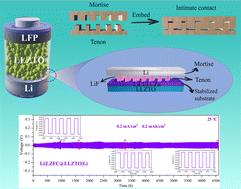
Solid-state lithium metal batteries (SSLMBs) with high energy density and superior safety have been recognized as next-generation energy storage systems and have attracted a lot of attention. Garnet-type oxide solid-state electrolytes, especially Li6.4La3Zr1.4Ta0.6O12 (LLZTO), with high ionic conductivity, low activation energy and superior stability with Li, are among the most promising solid-state electrolyte materials. However, high interfacial resistance, uneven lithium deposition and lithium dendrite growth between Li/LLZTO interfaces have hindered the industrialization of SSLMBs. In this work, a novel mortise–tenon-like hybrid ionic/electronic conductive interface (Li/LZFC@LLZTO) is constructed, which is composed of LiF, LiCl, and a Li–Zn alloy through an in situ transformation reaction. As expected, the interfacial impedance of Li|LZFC@LLZTO|Li is significantly reduced from 128 Ω cm2 to 2.7 Ω cm2, the critical current density increases from 0.3 mA cm−2 to 2.1 mA cm−2, and a prominent cycling performance of 6600 h at 0.2 mA cm−2 or 900 h at 0.4 mA cm−2 is achieved. Consequently, both the Li|LZFC@LLZTO|LiFePO4 and Li|LZFC@LLZTO|LiNi0.8Co0.1Mn0.1O2 full cells exhibit excellent rate performance. Furthermore, Li|LZFC@LLZTO|LiFePO4 can maintain a high discharge specific capacity close to 140 mA h g−1 at 0.2C after 150 cycles of stable cycling. This work lays the foundation for developing garnet-based SSLMBs with high critical current density, low interfacial impedance and long-term cycling performance.
期刊介绍:
The Journal of Materials Chemistry A, B & C covers a wide range of high-quality studies in the field of materials chemistry, with each section focusing on specific applications of the materials studied. Journal of Materials Chemistry A emphasizes applications in energy and sustainability, including topics such as artificial photosynthesis, batteries, and fuel cells. Journal of Materials Chemistry B focuses on applications in biology and medicine, while Journal of Materials Chemistry C covers applications in optical, magnetic, and electronic devices. Example topic areas within the scope of Journal of Materials Chemistry A include catalysis, green/sustainable materials, sensors, and water treatment, among others.



 京公网安备 11010802042870号
京ICP备2023020795号-1
京公网安备 11010802042870号
京ICP备2023020795号-1

 分享
分享
 求助内容:
求助内容: 应助结果提醒方式:
 扫码关注我们
