{"title":"<i>UltraStat</i>: Ultrafast Spectroscopy beyond the Fourier Limit Using Bayesian Inference.","authors":"Elad Harel","doi":"10.1021/acs.jpca.4c04385","DOIUrl":null,"url":null,"abstract":"<p><p>The discrete Fourier transform (dFT) plays a central role in many ultrafast experiments, allowing the recovery of spectroscopic observables from time-domain measurements. In resonant experiments when population relaxation and coherence components of the signal coexist, the dFT is usually preceded by multiexponential fitting to remove the large population term. However, this procedure results in errors in both the recovered decay rates and the line shapes of the coherence spectral components. While other methods such as linear prediction singular value decomposition fit both terms simultaneously, they are limited to specific models that may not represent the true signal. These methods do not allow for systematic noise analysis or error estimation and require <i>a priori</i> knowledge of the signal rank. Here, we describe a general approach to parameter estimation in ultrafast spectroscopy─<i>UltraStat</i>─grounded in Bayesian analysis without the limitations set by Fourier theory. Using simulated, but realistic data, we demonstrate in a statistical sense how <i>UltraStat</i> provides accurate parameter estimation in the presence of many experimental constraints: noise, signal truncation, limited photon budget, and nonuniform sampling. <i>UltraStat</i> provides superior resolution compared to the dFT, up to an order of magnitude in cases where the line shapes are well-approximated. In these cases, we establish that primarily noise, not sampling, limits spectral resolution. Moreover, we show that subsampling may reduce the number of acquired points by 90% compared to the Nyquist-Shannon criteria. <i>UltraStat</i> greatly improves parameter estimation by providing statistically bound spectral and dynamics analysis, pushing the limits of ultrafast science.</p>","PeriodicalId":59,"journal":{"name":"The Journal of Physical Chemistry A","volume":" ","pages":"9323-9336"},"PeriodicalIF":2.8000,"publicationDate":"2024-10-24","publicationTypes":"Journal Article","fieldsOfStudy":null,"isOpenAccess":false,"openAccessPdf":"https://www.ncbi.nlm.nih.gov/pmc/articles/PMC11514019/pdf/","citationCount":"0","resultStr":null,"platform":"Semanticscholar","paperid":null,"PeriodicalName":"The Journal of Physical Chemistry A","FirstCategoryId":"1","ListUrlMain":"https://doi.org/10.1021/acs.jpca.4c04385","RegionNum":2,"RegionCategory":"化学","ArticlePicture":[],"TitleCN":null,"AbstractTextCN":null,"PMCID":null,"EPubDate":"2024/10/16 0:00:00","PubModel":"Epub","JCR":"Q3","JCRName":"CHEMISTRY, PHYSICAL","Score":null,"Total":0}
引用次数: 0
Abstract
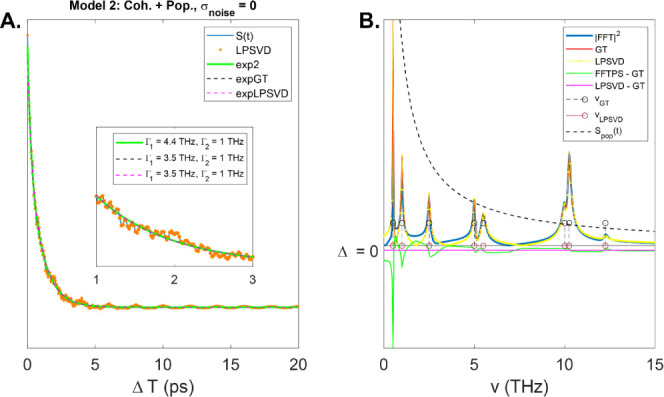
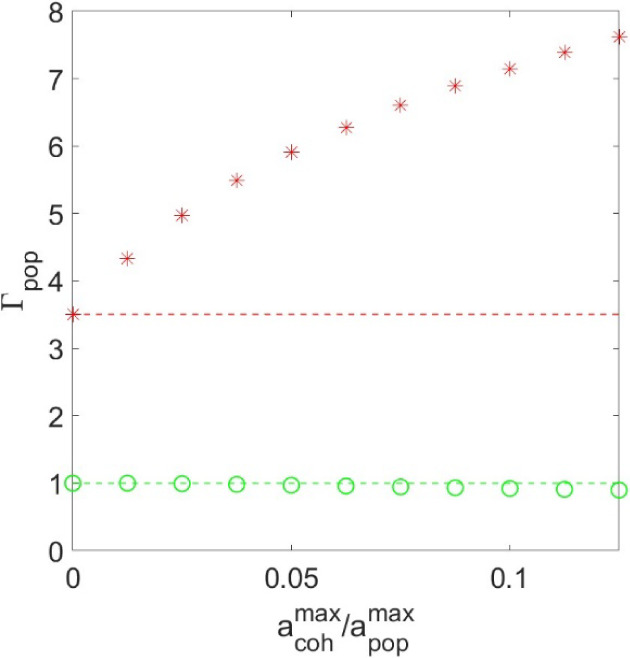
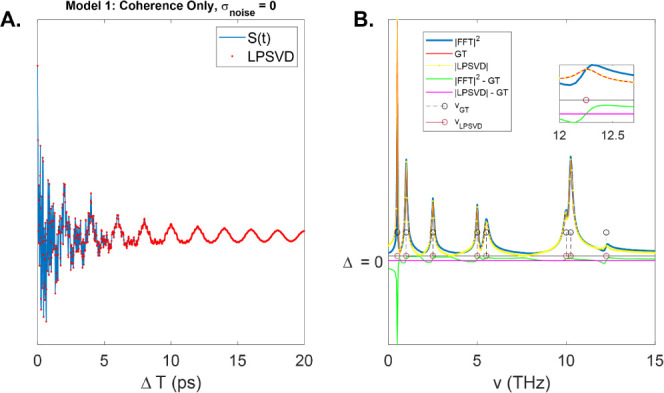
The discrete Fourier transform (dFT) plays a central role in many ultrafast experiments, allowing the recovery of spectroscopic observables from time-domain measurements. In resonant experiments when population relaxation and coherence components of the signal coexist, the dFT is usually preceded by multiexponential fitting to remove the large population term. However, this procedure results in errors in both the recovered decay rates and the line shapes of the coherence spectral components. While other methods such as linear prediction singular value decomposition fit both terms simultaneously, they are limited to specific models that may not represent the true signal. These methods do not allow for systematic noise analysis or error estimation and require a priori knowledge of the signal rank. Here, we describe a general approach to parameter estimation in ultrafast spectroscopy─UltraStat─grounded in Bayesian analysis without the limitations set by Fourier theory. Using simulated, but realistic data, we demonstrate in a statistical sense how UltraStat provides accurate parameter estimation in the presence of many experimental constraints: noise, signal truncation, limited photon budget, and nonuniform sampling. UltraStat provides superior resolution compared to the dFT, up to an order of magnitude in cases where the line shapes are well-approximated. In these cases, we establish that primarily noise, not sampling, limits spectral resolution. Moreover, we show that subsampling may reduce the number of acquired points by 90% compared to the Nyquist-Shannon criteria. UltraStat greatly improves parameter estimation by providing statistically bound spectral and dynamics analysis, pushing the limits of ultrafast science.
期刊介绍:
The Journal of Physical Chemistry A is devoted to reporting new and original experimental and theoretical basic research of interest to physical chemists, biophysical chemists, and chemical physicists.




 京公网安备 11010802042870号
京ICP备2023020795号-1
京公网安备 11010802042870号
京ICP备2023020795号-1

 分享
分享
 求助内容:
求助内容: 应助结果提醒方式:
 扫码关注我们
