Mengmeng Zhang, Wei Zhou, Qingqing Wang, Ning Wang, Xin Wang, Youping Liu and Xin Di
{"title":"A water compatible magnetic molecularly imprinted nanocomposite for the class-selective enrichment of quinoxaline-1,4-dioxides in environmental water†","authors":"Mengmeng Zhang, Wei Zhou, Qingqing Wang, Ning Wang, Xin Wang, Youping Liu and Xin Di","doi":"10.1039/D4AY01250J","DOIUrl":null,"url":null,"abstract":"<p >In this work, a novel water compatible core–shell magnetic molecularly imprinted nanocomposite (Fe<small><sub>3</sub></small>O<small><sub>4</sub></small>–COOH@MIPs) was synthesized in an acetonitrile–water reaction system by adopting carboxyl group-functionalized Fe<small><sub>3</sub></small>O<small><sub>4</sub></small> nanoparticles as the magnetic core, olaquindox as the template molecule and acrylamide as the functional monomer. The resulting Fe<small><sub>3</sub></small>O<small><sub>4</sub></small>–COOH@MIPs was characterized and applied as an adsorbent for magnetic solid-phase extraction (MSPE) of three quinoline-1,4-dioxides (QdNOs). The Fe<small><sub>3</sub></small>O<small><sub>4</sub></small>–COOH@MIPs possessed strong magnetic responsiveness, fast adsorption equilibrium rate (equilibrium within 5 min) and excellent selectivity. By coupling Fe<small><sub>3</sub></small>O<small><sub>4</sub></small>–COOH@MIPs based MSPE with high performance liquid chromatography-tandem mass spectrometry (HPLC-MS/MS), good linearity (<em>R</em><small><sup>2</sup></small> ≥ 0.9985) and low limits of detection (0.83–5.0 ng L<small><sup>−1</sup></small>) for QdNOs were obtained. Finally, the proposed method was applied to determine trace QdNOs in environmental water samples, and the recoveries were in the range of 68.08–99.88% with RSD less than 12.5%.</p>","PeriodicalId":64,"journal":{"name":"Analytical Methods","volume":" 45","pages":" 7763-7771"},"PeriodicalIF":2.6000,"publicationDate":"2024-10-08","publicationTypes":"Journal Article","fieldsOfStudy":null,"isOpenAccess":false,"openAccessPdf":"","citationCount":"0","resultStr":null,"platform":"Semanticscholar","paperid":null,"PeriodicalName":"Analytical Methods","FirstCategoryId":"92","ListUrlMain":"https://pubs.rsc.org/en/content/articlelanding/2024/ay/d4ay01250j","RegionNum":3,"RegionCategory":"化学","ArticlePicture":[],"TitleCN":null,"AbstractTextCN":null,"PMCID":null,"EPubDate":"","PubModel":"","JCR":"Q2","JCRName":"CHEMISTRY, ANALYTICAL","Score":null,"Total":0}
引用次数: 0
Abstract
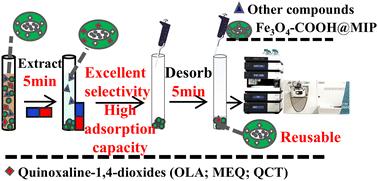
In this work, a novel water compatible core–shell magnetic molecularly imprinted nanocomposite (Fe3O4–COOH@MIPs) was synthesized in an acetonitrile–water reaction system by adopting carboxyl group-functionalized Fe3O4 nanoparticles as the magnetic core, olaquindox as the template molecule and acrylamide as the functional monomer. The resulting Fe3O4–COOH@MIPs was characterized and applied as an adsorbent for magnetic solid-phase extraction (MSPE) of three quinoline-1,4-dioxides (QdNOs). The Fe3O4–COOH@MIPs possessed strong magnetic responsiveness, fast adsorption equilibrium rate (equilibrium within 5 min) and excellent selectivity. By coupling Fe3O4–COOH@MIPs based MSPE with high performance liquid chromatography-tandem mass spectrometry (HPLC-MS/MS), good linearity (R2 ≥ 0.9985) and low limits of detection (0.83–5.0 ng L−1) for QdNOs were obtained. Finally, the proposed method was applied to determine trace QdNOs in environmental water samples, and the recoveries were in the range of 68.08–99.88% with RSD less than 12.5%.



 京公网安备 11010802042870号
京ICP备2023020795号-1
京公网安备 11010802042870号
京ICP备2023020795号-1

 分享
分享
 求助内容:
求助内容: 应助结果提醒方式:
 扫码关注我们
