Kenia Chávez-Ramos and María del Pilar Cañizares-Macías
{"title":"Continuous flow microfluidic system with magnetic nanoparticles for the spectrophotometric quantification of urea in urine and plasma samples†","authors":"Kenia Chávez-Ramos and María del Pilar Cañizares-Macías","doi":"10.1039/D4AY01593B","DOIUrl":null,"url":null,"abstract":"<p >Urea, synthesized exclusively in the liver, is primarily transported through the bloodstream to the kidneys, where it is excreted in urine, accounting for 80–90% of nitrogen excretion in humans. Elevated blood urea levels, indicative of kidney dysfunction, make it a crucial biomarker for assessing renal function. Previous studies on urea detection using microdevices have largely focused on conductometric methods. In this study, we demonstrated the application of a continuous flow miniaturized system for rapid spectrophotometric urea quantification using polydimethylsiloxane (PDMS) microdevices. The microdevice featured two distinct zones: an enzymatic reaction zone, where urease-conjugated magnetic nanoparticles were immobilized, and a detection zone, where reagents were incorporated to produce a colored reaction product <em>via</em> a modified Berthelot reaction. Integrating magnetic nanoparticles as a solid support for the enzyme enabled the reuse of PDMS microdevices without compromising the analytical signal. Spectrophotometric detection was performed in an additional microdevice acting as a microflow cell coupled with optical fibers. A calibration curve was constructed using urea standards diluted in phosphate buffer solution (PBS), yielding a linear range of 0.12–3.00 mg dL<small><sup>−1</sup></small>. The method demonstrated detection and quantification limits of 0.04 mg dL<small><sup>−1</sup></small> and 0.12 mg dL<small><sup>−1</sup></small>, respectively. Precision and accuracy assessments yielded a repeatability of 0.90% and intermediate precision of 4.52%, with recovery rates near 100%. The method was applied to plasma and urine samples, showing urea concentrations within normal physiological ranges and an analysis throughput of 36 measurements per hour.</p>","PeriodicalId":64,"journal":{"name":"Analytical Methods","volume":" 45","pages":" 7752-7762"},"PeriodicalIF":2.6000,"publicationDate":"2024-10-10","publicationTypes":"Journal Article","fieldsOfStudy":null,"isOpenAccess":false,"openAccessPdf":"https://pubs.rsc.org/en/content/articlepdf/2024/ay/d4ay01593b?page=search","citationCount":"0","resultStr":null,"platform":"Semanticscholar","paperid":null,"PeriodicalName":"Analytical Methods","FirstCategoryId":"92","ListUrlMain":"https://pubs.rsc.org/en/content/articlelanding/2024/ay/d4ay01593b","RegionNum":3,"RegionCategory":"化学","ArticlePicture":[],"TitleCN":null,"AbstractTextCN":null,"PMCID":null,"EPubDate":"","PubModel":"","JCR":"Q2","JCRName":"CHEMISTRY, ANALYTICAL","Score":null,"Total":0}
引用次数: 0
Abstract
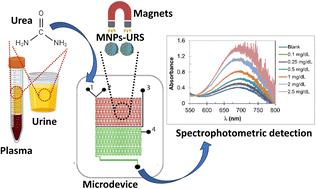
Urea, synthesized exclusively in the liver, is primarily transported through the bloodstream to the kidneys, where it is excreted in urine, accounting for 80–90% of nitrogen excretion in humans. Elevated blood urea levels, indicative of kidney dysfunction, make it a crucial biomarker for assessing renal function. Previous studies on urea detection using microdevices have largely focused on conductometric methods. In this study, we demonstrated the application of a continuous flow miniaturized system for rapid spectrophotometric urea quantification using polydimethylsiloxane (PDMS) microdevices. The microdevice featured two distinct zones: an enzymatic reaction zone, where urease-conjugated magnetic nanoparticles were immobilized, and a detection zone, where reagents were incorporated to produce a colored reaction product via a modified Berthelot reaction. Integrating magnetic nanoparticles as a solid support for the enzyme enabled the reuse of PDMS microdevices without compromising the analytical signal. Spectrophotometric detection was performed in an additional microdevice acting as a microflow cell coupled with optical fibers. A calibration curve was constructed using urea standards diluted in phosphate buffer solution (PBS), yielding a linear range of 0.12–3.00 mg dL−1. The method demonstrated detection and quantification limits of 0.04 mg dL−1 and 0.12 mg dL−1, respectively. Precision and accuracy assessments yielded a repeatability of 0.90% and intermediate precision of 4.52%, with recovery rates near 100%. The method was applied to plasma and urine samples, showing urea concentrations within normal physiological ranges and an analysis throughput of 36 measurements per hour.



 京公网安备 11010802042870号
京ICP备2023020795号-1
京公网安备 11010802042870号
京ICP备2023020795号-1

 分享
分享
 求助内容:
求助内容: 应助结果提醒方式:
 扫码关注我们
