{"title":"Highly sensitive electrochemical biosensor for MUC1 detection based on DNA-functionalized CdTe quantum dots as signal enhancers","authors":"JiaJia Wang, Chun Kan and Baokang Jin","doi":"10.1039/D4AY01544D","DOIUrl":null,"url":null,"abstract":"<p >In this paper, an electrochemical biosensor based on a cadmium telluride/polypyrrole (CdTe/PPy) nanocomposite was developed for the detection of MUC1 with high selectivity and sensitivity. Results indicate that the CdTe/PPy nanocomposite is modified on the surface of the glassy carbon electrode (GCE), which affords a large surface area for immobilizing cap-DNA, ensuring its high selectivity and sensitivity. Next, CdTe-linked sig-DNA (MUC1 aptamer) was introduced, allowing the MUC1 aptamer to hybridize with cap-DNA. CdTe is a signal amplification element used to generate a differential pulse voltammetry (DPV) signal. Conceivably, target MUC1 detection was based on current signal change due to concentration change in the signal amplification element CdTe. In the presence of MUC1, the MUC1 aptamer specifically binds to MUC1, resulting in the release of CdTe-sig-DNA from the electrode surface and a decrease in peak current. Under optimized experimental conditions, the electrochemical biosensor is highly selective, sensitive, stable, and reproducible for MUC1 ranging from 0.1 nM to 100 nM with a detection limit of 0.05 nM (S/N = 3). Therefore, the electrochemical biosensor has potential applications in medical disease diagnosis.</p>","PeriodicalId":64,"journal":{"name":"Analytical Methods","volume":" 45","pages":" 7806-7815"},"PeriodicalIF":2.6000,"publicationDate":"2024-10-06","publicationTypes":"Journal Article","fieldsOfStudy":null,"isOpenAccess":false,"openAccessPdf":"","citationCount":"0","resultStr":null,"platform":"Semanticscholar","paperid":null,"PeriodicalName":"Analytical Methods","FirstCategoryId":"92","ListUrlMain":"https://pubs.rsc.org/en/content/articlelanding/2024/ay/d4ay01544d","RegionNum":3,"RegionCategory":"化学","ArticlePicture":[],"TitleCN":null,"AbstractTextCN":null,"PMCID":null,"EPubDate":"","PubModel":"","JCR":"Q2","JCRName":"CHEMISTRY, ANALYTICAL","Score":null,"Total":0}
引用次数: 0
Abstract
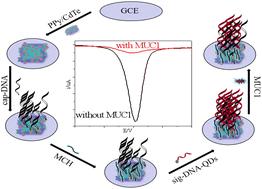
In this paper, an electrochemical biosensor based on a cadmium telluride/polypyrrole (CdTe/PPy) nanocomposite was developed for the detection of MUC1 with high selectivity and sensitivity. Results indicate that the CdTe/PPy nanocomposite is modified on the surface of the glassy carbon electrode (GCE), which affords a large surface area for immobilizing cap-DNA, ensuring its high selectivity and sensitivity. Next, CdTe-linked sig-DNA (MUC1 aptamer) was introduced, allowing the MUC1 aptamer to hybridize with cap-DNA. CdTe is a signal amplification element used to generate a differential pulse voltammetry (DPV) signal. Conceivably, target MUC1 detection was based on current signal change due to concentration change in the signal amplification element CdTe. In the presence of MUC1, the MUC1 aptamer specifically binds to MUC1, resulting in the release of CdTe-sig-DNA from the electrode surface and a decrease in peak current. Under optimized experimental conditions, the electrochemical biosensor is highly selective, sensitive, stable, and reproducible for MUC1 ranging from 0.1 nM to 100 nM with a detection limit of 0.05 nM (S/N = 3). Therefore, the electrochemical biosensor has potential applications in medical disease diagnosis.




 京公网安备 11010802042870号
京ICP备2023020795号-1
京公网安备 11010802042870号
京ICP备2023020795号-1

 分享
分享
 求助内容:
求助内容: 应助结果提醒方式:
 扫码关注我们
