Viviana Mancuso, Mihail N. Popescu and William E. Uspal
{"title":"Chemotactic behavior for a self-phoretic Janus particle near a patch source of fuel","authors":"Viviana Mancuso, Mihail N. Popescu and William E. Uspal","doi":"10.1039/D4SM00733F","DOIUrl":null,"url":null,"abstract":"<p >Many biological microswimmers are capable of chemotaxis, <em>i.e.</em>, they can sense an ambient chemical gradient and adjust their mechanism of motility to move towards or away from the source of the gradient. Synthetic active colloids endowed with chemotactic behavior hold considerable promise for targeted drug delivery and the realization of programmable and reconfigurable materials. Here, we study the chemotactic behavior of a Janus particle, which converts “fuel” molecules, released at an axisymmetric chemical patch located on a planar wall, into “product” molecules at its catalytic cap and moves by self-phoresis induced by the product. The chemotactic behavior is characterized as a function of the interplay between the rates of release (at the patch) and the consumption (at the particle) of fuel, as well as of details of the phoretic response of the particle (<em>i.e.</em>, its phoretic mobility). Among other results, we find that, under certain conditions, the particle is attracted to a stable “hovering state” in which it aligns its axis normal to the wall and rests (positions itself) at an activity-dependent distance above the center of the patch.</p>","PeriodicalId":103,"journal":{"name":"Soft Matter","volume":" 44","pages":" 8742-8764"},"PeriodicalIF":2.8000,"publicationDate":"2024-10-08","publicationTypes":"Journal Article","fieldsOfStudy":null,"isOpenAccess":false,"openAccessPdf":"https://pubs.rsc.org/en/content/articlepdf/2024/sm/d4sm00733f?page=search","citationCount":"0","resultStr":null,"platform":"Semanticscholar","paperid":null,"PeriodicalName":"Soft Matter","FirstCategoryId":"92","ListUrlMain":"https://pubs.rsc.org/en/content/articlelanding/2024/sm/d4sm00733f","RegionNum":3,"RegionCategory":"化学","ArticlePicture":[],"TitleCN":null,"AbstractTextCN":null,"PMCID":null,"EPubDate":"","PubModel":"","JCR":"Q3","JCRName":"CHEMISTRY, PHYSICAL","Score":null,"Total":0}
引用次数: 0
Abstract
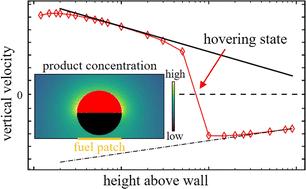
Many biological microswimmers are capable of chemotaxis, i.e., they can sense an ambient chemical gradient and adjust their mechanism of motility to move towards or away from the source of the gradient. Synthetic active colloids endowed with chemotactic behavior hold considerable promise for targeted drug delivery and the realization of programmable and reconfigurable materials. Here, we study the chemotactic behavior of a Janus particle, which converts “fuel” molecules, released at an axisymmetric chemical patch located on a planar wall, into “product” molecules at its catalytic cap and moves by self-phoresis induced by the product. The chemotactic behavior is characterized as a function of the interplay between the rates of release (at the patch) and the consumption (at the particle) of fuel, as well as of details of the phoretic response of the particle (i.e., its phoretic mobility). Among other results, we find that, under certain conditions, the particle is attracted to a stable “hovering state” in which it aligns its axis normal to the wall and rests (positions itself) at an activity-dependent distance above the center of the patch.
期刊介绍:
Soft Matter is an international journal published by the Royal Society of Chemistry using Engineering-Materials Science: A Synthesis as its research focus. It publishes original research articles, review articles, and synthesis articles related to this field, reporting the latest discoveries in the relevant theoretical, practical, and applied disciplines in a timely manner, and aims to promote the rapid exchange of scientific information in this subject area. The journal is an open access journal. The journal is an open access journal and has not been placed on the alert list in the last three years.



 京公网安备 11010802042870号
京ICP备2023020795号-1
京公网安备 11010802042870号
京ICP备2023020795号-1

 分享
分享
 求助内容:
求助内容: 应助结果提醒方式:
 扫码关注我们
