Andrei Filippov, Maiia Rudakova, Victor P. Archipov and Faiz Ullah Shah
{"title":"Nanoconfinement effects on the dynamics of an ionic liquid-based electrolyte probed by multinuclear NMR†","authors":"Andrei Filippov, Maiia Rudakova, Victor P. Archipov and Faiz Ullah Shah","doi":"10.1039/D4SM01058B","DOIUrl":null,"url":null,"abstract":"<p >The measurement of ion diffusivity inside nanoporous materials by Pulsed-Field Gradient (PFG) NMR is not an easy task due to enhanced NMR relaxation. Here, we employed multinuclear (<small><sup>1</sup></small>H, <small><sup>31</sup></small>P, and <small><sup>7</sup></small>Li) NMR spectrometry and diffusometry to probe ion dynamics of a fluorine-free battery electrolyte comprising the [P<small><sub>4,4,4,4</sub></small>][MEEA] ionic liquid (IL) and LiMEEA salt in a 7 : 3 molar ratio, confined in three different nanoporous SiO<small><sub>2</sub></small> glasses with pore diameters of 3.7, 7 and 98 nm. Confinement of the electrolyte leads to NMR resonance line broadening and variation in the <small><sup>31</sup></small>P and <small><sup>7</sup></small>Li NMR chemical shifts. The complicated diffusion decays are explained taking into consideration the complex porous structure of the porous glasses, the presence of pore “necks” and the “partially isolated volumes” containing the liquid, which is in a “slow exchange” regime with the rest of the liquid. The mean apparent diffusivity is controlled by the exchange of ions between the “narrow” and the “large” pores and the boundary separating these pores to measure diffusion coefficients by PFG NMR is in the range of pore sizes of Vycor and Varapor. The temperature-dependent ion diffusivities in the “large” pores deviate from the Arrhenius law and the exchange of diffusing units between the “narrow” and the “large” pores leads to abnormal temperature-dependent diffusion coefficients. Like the bulk, diffusivity of the small Li<small><sup>+</sup></small> is slower than that of the larger organic ions in the confinement, demonstrating the solvation of Li<small><sup>+</sup></small> inside the pores.</p>","PeriodicalId":103,"journal":{"name":"Soft Matter","volume":" 42","pages":" 8436-8445"},"PeriodicalIF":2.8000,"publicationDate":"2024-10-03","publicationTypes":"Journal Article","fieldsOfStudy":null,"isOpenAccess":false,"openAccessPdf":"https://pubs.rsc.org/en/content/articlepdf/2024/sm/d4sm01058b?page=search","citationCount":"0","resultStr":null,"platform":"Semanticscholar","paperid":null,"PeriodicalName":"Soft Matter","FirstCategoryId":"92","ListUrlMain":"https://pubs.rsc.org/en/content/articlelanding/2024/sm/d4sm01058b","RegionNum":3,"RegionCategory":"化学","ArticlePicture":[],"TitleCN":null,"AbstractTextCN":null,"PMCID":null,"EPubDate":"","PubModel":"","JCR":"Q3","JCRName":"CHEMISTRY, PHYSICAL","Score":null,"Total":0}
引用次数: 0
Abstract
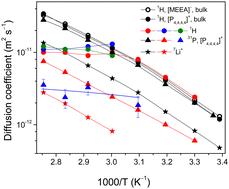
The measurement of ion diffusivity inside nanoporous materials by Pulsed-Field Gradient (PFG) NMR is not an easy task due to enhanced NMR relaxation. Here, we employed multinuclear (1H, 31P, and 7Li) NMR spectrometry and diffusometry to probe ion dynamics of a fluorine-free battery electrolyte comprising the [P4,4,4,4][MEEA] ionic liquid (IL) and LiMEEA salt in a 7 : 3 molar ratio, confined in three different nanoporous SiO2 glasses with pore diameters of 3.7, 7 and 98 nm. Confinement of the electrolyte leads to NMR resonance line broadening and variation in the 31P and 7Li NMR chemical shifts. The complicated diffusion decays are explained taking into consideration the complex porous structure of the porous glasses, the presence of pore “necks” and the “partially isolated volumes” containing the liquid, which is in a “slow exchange” regime with the rest of the liquid. The mean apparent diffusivity is controlled by the exchange of ions between the “narrow” and the “large” pores and the boundary separating these pores to measure diffusion coefficients by PFG NMR is in the range of pore sizes of Vycor and Varapor. The temperature-dependent ion diffusivities in the “large” pores deviate from the Arrhenius law and the exchange of diffusing units between the “narrow” and the “large” pores leads to abnormal temperature-dependent diffusion coefficients. Like the bulk, diffusivity of the small Li+ is slower than that of the larger organic ions in the confinement, demonstrating the solvation of Li+ inside the pores.
期刊介绍:
Soft Matter is an international journal published by the Royal Society of Chemistry using Engineering-Materials Science: A Synthesis as its research focus. It publishes original research articles, review articles, and synthesis articles related to this field, reporting the latest discoveries in the relevant theoretical, practical, and applied disciplines in a timely manner, and aims to promote the rapid exchange of scientific information in this subject area. The journal is an open access journal. The journal is an open access journal and has not been placed on the alert list in the last three years.



 京公网安备 11010802042870号
京ICP备2023020795号-1
京公网安备 11010802042870号
京ICP备2023020795号-1

 分享
分享
 求助内容:
求助内容: 应助结果提醒方式:
 扫码关注我们
