Linfeng Li, Dr. Markus Leutzsch, Phil Hesse, Dr. Chuanhao Wang, Dr. Bolun Wang, Prof. Dr. Ferdi Schüth
{"title":"Polyethylene Recycling via Water Activation by Ball Milling","authors":"Linfeng Li, Dr. Markus Leutzsch, Phil Hesse, Dr. Chuanhao Wang, Dr. Bolun Wang, Prof. Dr. Ferdi Schüth","doi":"10.1002/anie.202413132","DOIUrl":null,"url":null,"abstract":"<p>Polyethylene (PE) is the most prevalent type of plastic waste and also the most challenging to depolymerize because of its inert carbon-carbon (C−C) bonds.<sup>[1]</sup> High temperature and noble metals are usually required for depolymerization.<sup>[2]</sup> To avoid using noble metals, costly reagents and harsh reaction conditions, it is worthwhile but challenging to explore new reaction pathways.<sup>[3]</sup> We report an unprecedented mechanochemical reaction of PE and water to result in shorter-chain alkanes, alkenes, alcohols, and ketones (C<sub>n</sub>, where n≲50), with above 80 % of starting carbon converted into these products, which could be a valuable feedstock for re-entering chemical value chains. This reaction is driven solely by ball milling, without heating and pressurizing. No costly catalysts are used. Instead, only earth-abundant Al<sub>2</sub>O<sub>3</sub> was milled with reactants.</p>","PeriodicalId":125,"journal":{"name":"Angewandte Chemie International Edition","volume":"64 1","pages":""},"PeriodicalIF":16.9000,"publicationDate":"2024-10-22","publicationTypes":"Journal Article","fieldsOfStudy":null,"isOpenAccess":false,"openAccessPdf":"https://onlinelibrary.wiley.com/doi/epdf/10.1002/anie.202413132","citationCount":"0","resultStr":null,"platform":"Semanticscholar","paperid":null,"PeriodicalName":"Angewandte Chemie International Edition","FirstCategoryId":"92","ListUrlMain":"https://onlinelibrary.wiley.com/doi/10.1002/anie.202413132","RegionNum":1,"RegionCategory":"化学","ArticlePicture":[],"TitleCN":null,"AbstractTextCN":null,"PMCID":null,"EPubDate":"","PubModel":"","JCR":"Q1","JCRName":"CHEMISTRY, MULTIDISCIPLINARY","Score":null,"Total":0}
引用次数: 0
Abstract
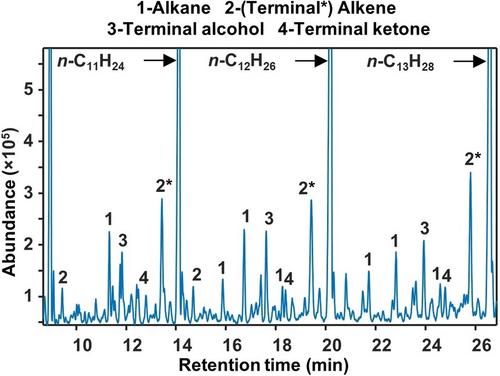
Polyethylene (PE) is the most prevalent type of plastic waste and also the most challenging to depolymerize because of its inert carbon-carbon (C−C) bonds.[1] High temperature and noble metals are usually required for depolymerization.[2] To avoid using noble metals, costly reagents and harsh reaction conditions, it is worthwhile but challenging to explore new reaction pathways.[3] We report an unprecedented mechanochemical reaction of PE and water to result in shorter-chain alkanes, alkenes, alcohols, and ketones (Cn, where n≲50), with above 80 % of starting carbon converted into these products, which could be a valuable feedstock for re-entering chemical value chains. This reaction is driven solely by ball milling, without heating and pressurizing. No costly catalysts are used. Instead, only earth-abundant Al2O3 was milled with reactants.
期刊介绍:
Angewandte Chemie, a journal of the German Chemical Society (GDCh), maintains a leading position among scholarly journals in general chemistry with an impressive Impact Factor of 16.6 (2022 Journal Citation Reports, Clarivate, 2023). Published weekly in a reader-friendly format, it features new articles almost every day. Established in 1887, Angewandte Chemie is a prominent chemistry journal, offering a dynamic blend of Review-type articles, Highlights, Communications, and Research Articles on a weekly basis, making it unique in the field.



 京公网安备 11010802042870号
京ICP备2023020795号-1
京公网安备 11010802042870号
京ICP备2023020795号-1

 分享
分享
 求助内容:
求助内容: 应助结果提醒方式:
 扫码关注我们
