Development and validation of a novel method for evaluation of multiple islet autoantibodies in dried blood spot using dissociation-enhanced lanthanide fluorescent immunoassays technology, specific and suitable for paediatric screening programmes
{"title":"Development and validation of a novel method for evaluation of multiple islet autoantibodies in dried blood spot using dissociation-enhanced lanthanide fluorescent immunoassays technology, specific and suitable for paediatric screening programmes","authors":"Beatrice Dufrusine PhD, Luca Natale MSc, Michele Sallese PhD, Enza Mozzillo MD, Francesca Di Candia MD, Irene Cuccurullo MSc, Dario Iafusco MD, Angela Zanfardino MD, Luana Passariello MSc, Antonio Iannilli MD, Sara Santarelli MD, Luca Federici PhD, Vincenzo De Laurenzi MD, Valentino Cherubini MD, Damiana Pieragostino PhD","doi":"10.1111/dom.16002","DOIUrl":null,"url":null,"abstract":"<p>Italy made history by becoming the first country to establish and fund a long-term screening programme for type 1 diabetes (T1D) and celiac disease (CD)<span><sup>1</sup></span>; indeed, the Istituto Superiore di Sanità (ISS) has been commissioned by the Ministry of Health to organize a pilot study that will be carried out in four Italian regions: Lombardia, Marche, Campania and Sardegna, called D1Ce (Diabete tipo 1 e Celiachia) Screen. This study is preparatory to the national screening programme and aims to assess the acceptability of a screening programme to parents and children and the problems associated with sampling procedures and dosage of autoantibodies.</p><p>T1D is a chronic autoimmune disease and has a known pre-symptomatic phase that can be detected by testing for the presence of circulating anti-islet autoantibodies (IA). These IAs include four markers: anti-glutamic acid decarboxylase (GADA), anti-zinc transporter-8 (ZnT8A), tyrosine phosphatase (IA2A) and anti-insulin (IAA).<span><sup>2</sup></span> Two or more autoantibodies and normal glucose levels mark stage 1 T1D, whereas stage 2 is marked by antibodies and dysglycemia without any symptoms of T1D. Stage 3 is marked by glucose levels consistent with the American Diabetes Association (ADA) definition of diabetes mellitus.<span><sup>3</sup></span> Studies have shown that the rate of progression to clinical Stage 3 diabetes is similar if islet autoantibody positivity at the early stage of T1D is identified through screening of the general population or a first-degree relative.<span><sup>3</sup></span> The screening programme for T1D has the goal of identifying children and adolescents at risk of developing T1D, thus preventing or reducing the associated complications, such as diabetic ketoacidosis, which affects over 40% of the T1D at onset in Italy.<span><sup>4</sup></span> Blood tests are generally used for screening purposes; however, conventional venous blood sampling is not always well accepted due to venipuncture, especially in children. In contrast, a simple, rapid and more tolerable capillary blood sampling by finger pricking could overcome these limitations and offer a valid alternative (WHO Guidelines on Drawing Blood: Best Practices in Phlebotomy 2010). Moreover, analysis of autoantibodies on capillary blood for T1D has the limitation of complex management of liquid samples in terms of biosafety, storage at controlled temperature, risk of haemolysis and insufficient blood volume collection.<span><sup>5</sup></span> An efficient and well-established micro sampling technique already used for neonatal screening of metabolic disorders is the dried blood spot (DBS).<span><sup>6</sup></span> This sample is easy to collect, requiring a simple prick of the finger, very stable and safe and has already been used for the measurement of antibodies.<span><sup>7</sup></span> Standard enzyme-linked immunosorbent assay (ELISA) tests, however, are usually not sensitive enough to analyse DBS samples,<span><sup>8-10</sup></span> and RIA-based assays have the problem of handling radioactive material.</p><p>The aim of this work therefore was the development of a multiplex, dissociation-enhanced lanthanide fluorescent immunoassays (DELFIA) based method for the detection of three of the autoantibodies (GADA, ZnT8A and IA2A) on DBS, a potentially simple matrix to collect and deliver samples to laboratories, suitable for a population screening programme in paediatric population. Moreover, the viability of an additional, reliable screening method would allow more laboratories to be included in the screening network. The use of the three antibodies included in the assay has been previously shown to be sufficient for identifying potentially affected individuals.<span><sup>11</sup></span> Positive samples will then be analysed for the presence of the three antibodies and the IAA separately to allow disease classification as described earlier.</p><p>See Supplementary Appendix; Data S1.</p><p>We collected sera and DBS samples from 68 paediatrics patients with T1D and 51 paediatric healthy controls (Power value was 0.99, as better described in Supplementary Appendix; Data S1). The clinical features of patients and controls are reported in Table 1. We initially evaluated the positivity of our samples for each autoantibody separately using a commercially available, clinically validated ELISA test (RSR Limited, Cardiff, United Kingdom) on serum samples. The frequency of autoantibodies detected by the three immunoassays is summarized in Figure 1A. We then compared the ability of a Ce-IVD commercially available ELISA multiplex assay for anti-GAD, anti-ZnT8 and anti-IA2 on serum samples (Figure 1B) and our DELFIA multiplex assay (Figure 1C) on DBS to detect diabetic patients. The cut-off for DELFIA multiplex was established for optimal sensitivity (95.59%), specificity (94.12%) and is shown in Figure 1C. The Spearman's rank correlation, calculated between time-resolved fluorescence (T.R.F.) values from DELFIA assay and optical density (O.D.) values from ELISA assay, is statistically significant (<i>r</i> = 0.96, <i>p</i> < 0.0001) (Figure 1D). The area under curve (AUC) using ROC analysis was 0.98 and is reported in Figure 1E. We evaluated the repeatability of DELFIA multiplex on DBS by performing intra- and inter-day assay tests. We evaluated the T.R.F. value variability by performing five measurements with a triple positive sample and reported the CV% with the standard deviation (SD) on Table S1 in Supplementary Appendix. Stability of autoantibodies anti-GAD, anti-ZnT8 and anti-IA2 in DBS samples was tested using a triple positive sample; stored at room temperature (RT), 4°C and −20°C up to 30 days from collection; and evaluated in triplicate (Figure 1F–H). Storage at RT induced a significant reduction in detectable autoantibody levels after 4 days to levels that remained stable for up to 15 days (Figure 1F) while levels were stable up to 30 days when samples were stored at 4°C, −20°C (Figure 1G,H). In conclusion, our results indicate that the DBS may be employed for T1D population screening; indeed the data obtained on DBS with our method are comparable to those obtained using classic ELISA tests on serum samples (Figure 1B,C) but overcome collection and shipment problems linked to the use of serum. This is of uttermost importance when sample collection has to be performed by general family paediatricians who also have to deal with sample delivery to centralized laboratories for analysis, overcoming the problems with the initial pilot project protocol, proposed by the ISS that requires the collection of both sera for evaluation of autoantibodies and DBS for the measurement of HLA genes for susceptibility to CD. The collection of two types of samples, however, reduces the patients and physicians' compliance and results in difficult management of the programme. In contrast the use of only one type of sample, that is easy to collect and ship, in particular, increases the chances of success.</p><p>It has to be mentioned, however, that there are some limitations in the use of DBS samples: the haematocrit (Hct) changes the blood volume per paper area and therefore the amount of blood analysed, as Hct increases the viscosity in relation to the higher percentage of red blood cells and finally the chromatographic effect can determine a heterogeneity of sample composition.<span><sup>12</sup></span> These analytical problems, however, are not relevant in screening programmes that do not require high accuracy, but only a semi-quantitative measurement that allows access to second tier analysis that confirms the diagnostic suspect.</p><p>In conclusion, our data show that the DELFIA multiplex assay performs well in terms of repeatability with an intra- and inter-assay CVs of ≤7.7% and ≤13.2%, respectively (Table S1, Supplementary Appendix). It shows a clear correspondence between classical serological tests and DBS tests with a Spearman test showing a <i>r</i> = 0.96 (Figure 1D), strongly supporting the use of DBS to determine autoantibodies in T1D screening programmes. Despite the low amount of blood in a 3.2 mm spot, the ROC curve indicates good sensitivity (95.59%) and specificity (94.12%) in subjects' reclassification (Figure 1E). Moreover, DBS samples are stable up to 30 days when stored at 4°C or at −20°C (Figure 1G,H), and can be safely delivered using a refrigerated bag, avoiding the problems related to sample treatment (centrifugation) and biosafety permits required for proper collection and shipment of serum samples (as required by Ministry of Health no. 3 May 2003, OMS Guidelines of 1997).</p><p>We have confidence that this method is simple and reliable, and it will make screening for T1D affordable and achievable for families and paediatricians. However, it is essential to broaden the analysis to include a larger sample, encompassing other prevalent types of diabetes in children and adolescents, like type 2 diabetes and monogenic diabetes, as well as a more extensive group of participants without diabetes.</p><p>Internal institutional funds were used to support this study.</p><p>The authors declare no conflicts of interest.</p>","PeriodicalId":158,"journal":{"name":"Diabetes, Obesity & Metabolism","volume":"27 1","pages":"414-418"},"PeriodicalIF":5.7000,"publicationDate":"2024-10-21","publicationTypes":"Journal Article","fieldsOfStudy":null,"isOpenAccess":false,"openAccessPdf":"https://www.ncbi.nlm.nih.gov/pmc/articles/PMC11618293/pdf/","citationCount":"0","resultStr":null,"platform":"Semanticscholar","paperid":null,"PeriodicalName":"Diabetes, Obesity & Metabolism","FirstCategoryId":"3","ListUrlMain":"https://dom-pubs.onlinelibrary.wiley.com/doi/10.1111/dom.16002","RegionNum":2,"RegionCategory":"医学","ArticlePicture":[],"TitleCN":null,"AbstractTextCN":null,"PMCID":null,"EPubDate":"","PubModel":"","JCR":"Q1","JCRName":"ENDOCRINOLOGY & METABOLISM","Score":null,"Total":0}
引用次数: 0
Abstract
Italy made history by becoming the first country to establish and fund a long-term screening programme for type 1 diabetes (T1D) and celiac disease (CD)1; indeed, the Istituto Superiore di Sanità (ISS) has been commissioned by the Ministry of Health to organize a pilot study that will be carried out in four Italian regions: Lombardia, Marche, Campania and Sardegna, called D1Ce (Diabete tipo 1 e Celiachia) Screen. This study is preparatory to the national screening programme and aims to assess the acceptability of a screening programme to parents and children and the problems associated with sampling procedures and dosage of autoantibodies.
T1D is a chronic autoimmune disease and has a known pre-symptomatic phase that can be detected by testing for the presence of circulating anti-islet autoantibodies (IA). These IAs include four markers: anti-glutamic acid decarboxylase (GADA), anti-zinc transporter-8 (ZnT8A), tyrosine phosphatase (IA2A) and anti-insulin (IAA).2 Two or more autoantibodies and normal glucose levels mark stage 1 T1D, whereas stage 2 is marked by antibodies and dysglycemia without any symptoms of T1D. Stage 3 is marked by glucose levels consistent with the American Diabetes Association (ADA) definition of diabetes mellitus.3 Studies have shown that the rate of progression to clinical Stage 3 diabetes is similar if islet autoantibody positivity at the early stage of T1D is identified through screening of the general population or a first-degree relative.3 The screening programme for T1D has the goal of identifying children and adolescents at risk of developing T1D, thus preventing or reducing the associated complications, such as diabetic ketoacidosis, which affects over 40% of the T1D at onset in Italy.4 Blood tests are generally used for screening purposes; however, conventional venous blood sampling is not always well accepted due to venipuncture, especially in children. In contrast, a simple, rapid and more tolerable capillary blood sampling by finger pricking could overcome these limitations and offer a valid alternative (WHO Guidelines on Drawing Blood: Best Practices in Phlebotomy 2010). Moreover, analysis of autoantibodies on capillary blood for T1D has the limitation of complex management of liquid samples in terms of biosafety, storage at controlled temperature, risk of haemolysis and insufficient blood volume collection.5 An efficient and well-established micro sampling technique already used for neonatal screening of metabolic disorders is the dried blood spot (DBS).6 This sample is easy to collect, requiring a simple prick of the finger, very stable and safe and has already been used for the measurement of antibodies.7 Standard enzyme-linked immunosorbent assay (ELISA) tests, however, are usually not sensitive enough to analyse DBS samples,8-10 and RIA-based assays have the problem of handling radioactive material.
The aim of this work therefore was the development of a multiplex, dissociation-enhanced lanthanide fluorescent immunoassays (DELFIA) based method for the detection of three of the autoantibodies (GADA, ZnT8A and IA2A) on DBS, a potentially simple matrix to collect and deliver samples to laboratories, suitable for a population screening programme in paediatric population. Moreover, the viability of an additional, reliable screening method would allow more laboratories to be included in the screening network. The use of the three antibodies included in the assay has been previously shown to be sufficient for identifying potentially affected individuals.11 Positive samples will then be analysed for the presence of the three antibodies and the IAA separately to allow disease classification as described earlier.
See Supplementary Appendix; Data S1.
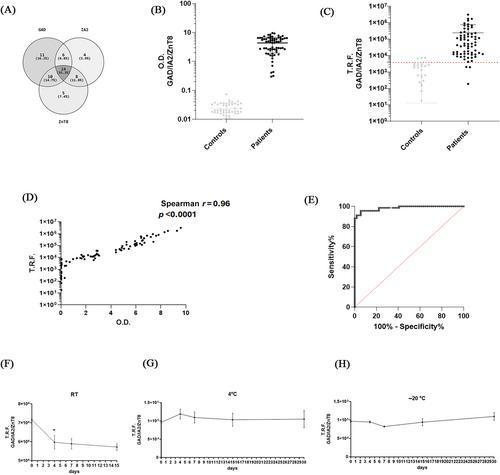
We collected sera and DBS samples from 68 paediatrics patients with T1D and 51 paediatric healthy controls (Power value was 0.99, as better described in Supplementary Appendix; Data S1). The clinical features of patients and controls are reported in Table 1. We initially evaluated the positivity of our samples for each autoantibody separately using a commercially available, clinically validated ELISA test (RSR Limited, Cardiff, United Kingdom) on serum samples. The frequency of autoantibodies detected by the three immunoassays is summarized in Figure 1A. We then compared the ability of a Ce-IVD commercially available ELISA multiplex assay for anti-GAD, anti-ZnT8 and anti-IA2 on serum samples (Figure 1B) and our DELFIA multiplex assay (Figure 1C) on DBS to detect diabetic patients. The cut-off for DELFIA multiplex was established for optimal sensitivity (95.59%), specificity (94.12%) and is shown in Figure 1C. The Spearman's rank correlation, calculated between time-resolved fluorescence (T.R.F.) values from DELFIA assay and optical density (O.D.) values from ELISA assay, is statistically significant (r = 0.96, p < 0.0001) (Figure 1D). The area under curve (AUC) using ROC analysis was 0.98 and is reported in Figure 1E. We evaluated the repeatability of DELFIA multiplex on DBS by performing intra- and inter-day assay tests. We evaluated the T.R.F. value variability by performing five measurements with a triple positive sample and reported the CV% with the standard deviation (SD) on Table S1 in Supplementary Appendix. Stability of autoantibodies anti-GAD, anti-ZnT8 and anti-IA2 in DBS samples was tested using a triple positive sample; stored at room temperature (RT), 4°C and −20°C up to 30 days from collection; and evaluated in triplicate (Figure 1F–H). Storage at RT induced a significant reduction in detectable autoantibody levels after 4 days to levels that remained stable for up to 15 days (Figure 1F) while levels were stable up to 30 days when samples were stored at 4°C, −20°C (Figure 1G,H). In conclusion, our results indicate that the DBS may be employed for T1D population screening; indeed the data obtained on DBS with our method are comparable to those obtained using classic ELISA tests on serum samples (Figure 1B,C) but overcome collection and shipment problems linked to the use of serum. This is of uttermost importance when sample collection has to be performed by general family paediatricians who also have to deal with sample delivery to centralized laboratories for analysis, overcoming the problems with the initial pilot project protocol, proposed by the ISS that requires the collection of both sera for evaluation of autoantibodies and DBS for the measurement of HLA genes for susceptibility to CD. The collection of two types of samples, however, reduces the patients and physicians' compliance and results in difficult management of the programme. In contrast the use of only one type of sample, that is easy to collect and ship, in particular, increases the chances of success.
It has to be mentioned, however, that there are some limitations in the use of DBS samples: the haematocrit (Hct) changes the blood volume per paper area and therefore the amount of blood analysed, as Hct increases the viscosity in relation to the higher percentage of red blood cells and finally the chromatographic effect can determine a heterogeneity of sample composition.12 These analytical problems, however, are not relevant in screening programmes that do not require high accuracy, but only a semi-quantitative measurement that allows access to second tier analysis that confirms the diagnostic suspect.
In conclusion, our data show that the DELFIA multiplex assay performs well in terms of repeatability with an intra- and inter-assay CVs of ≤7.7% and ≤13.2%, respectively (Table S1, Supplementary Appendix). It shows a clear correspondence between classical serological tests and DBS tests with a Spearman test showing a r = 0.96 (Figure 1D), strongly supporting the use of DBS to determine autoantibodies in T1D screening programmes. Despite the low amount of blood in a 3.2 mm spot, the ROC curve indicates good sensitivity (95.59%) and specificity (94.12%) in subjects' reclassification (Figure 1E). Moreover, DBS samples are stable up to 30 days when stored at 4°C or at −20°C (Figure 1G,H), and can be safely delivered using a refrigerated bag, avoiding the problems related to sample treatment (centrifugation) and biosafety permits required for proper collection and shipment of serum samples (as required by Ministry of Health no. 3 May 2003, OMS Guidelines of 1997).
We have confidence that this method is simple and reliable, and it will make screening for T1D affordable and achievable for families and paediatricians. However, it is essential to broaden the analysis to include a larger sample, encompassing other prevalent types of diabetes in children and adolescents, like type 2 diabetes and monogenic diabetes, as well as a more extensive group of participants without diabetes.
Internal institutional funds were used to support this study.
期刊介绍:
Diabetes, Obesity and Metabolism is primarily a journal of clinical and experimental pharmacology and therapeutics covering the interrelated areas of diabetes, obesity and metabolism. The journal prioritises high-quality original research that reports on the effects of new or existing therapies, including dietary, exercise and lifestyle (non-pharmacological) interventions, in any aspect of metabolic and endocrine disease, either in humans or animal and cellular systems. ‘Metabolism’ may relate to lipids, bone and drug metabolism, or broader aspects of endocrine dysfunction. Preclinical pharmacology, pharmacokinetic studies, meta-analyses and those addressing drug safety and tolerability are also highly suitable for publication in this journal. Original research may be published as a main paper or as a research letter.





 京公网安备 11010802042870号
京ICP备2023020795号-1
京公网安备 11010802042870号
京ICP备2023020795号-1

 分享
分享
 求助内容:
求助内容: 应助结果提醒方式:
 扫码关注我们
