Nan Zhang BS , Daiqi Liu BS , Jinhua Zhao BS , Gary Tse MD, PhD , Jiandong Zhou PhD , Qingpeng Zhang PhD , Gregory Y.H. Lip MD , Tong Liu MD, PhD
{"title":"Circulating ketone bodies, genetic susceptibility, with left atrial remodeling and atrial fibrillation: A prospective study from the UK Biobank","authors":"Nan Zhang BS , Daiqi Liu BS , Jinhua Zhao BS , Gary Tse MD, PhD , Jiandong Zhou PhD , Qingpeng Zhang PhD , Gregory Y.H. Lip MD , Tong Liu MD, PhD","doi":"10.1016/j.hrthm.2024.10.028","DOIUrl":null,"url":null,"abstract":"<div><h3>Background</h3><div>Ketone bodies<span><span> (KBs) are an important cardiac metabolic energy source. Metabolic remodeling has recently been found to play an important role in the pathological process of </span>atrial fibrillation (AF).</span></div></div><div><h3>Objective</h3><div>The purpose of this study was to evaluate the associations of circulating KB levels with incident AF risk in the general population.</div></div><div><h3>Methods</h3><div><span>We studied 237,163 participants [mean age, 56.5 years; 129,472 women (55%)] from the UK Biobank who were free of AF at baseline and had data on circulating β-hydroxybutyrate (β-OHB), </span>acetoacetate<span>, and acetone. The associations of KBs with new-onset AF were evaluated using Cox regression in the general population and across the 3 genetic risk groups: low, moderate, and high polygenic risk score of AF.</span></div></div><div><h3>Results</h3><div>During a median follow-up of 14.8 (13.8, 15.5) years, 16,638 participants (7.0%) developed AF. There was a U-shaped association of total KBs and β-OHB with incident AF, with nadirs at 60.6 and 40.8 μmol/L, respectively (<em>P</em><sub>nonlinear</sub><span> < .05), whereas there was a positive association of acetoacetate and acetone with AF (</span><em>P</em><sub>overall</sub> < .001; <em>P</em><sub>nonlinear</sub><span> > .05). Consistently, there was a U-shaped association of total KBs and β-OHB with left atrial (LA) volume parameters, including LA maximum volume, LA minimum volume, and their body surface area–indexed counterparts, and there was an inverted U-shaped association of total KBs and β-OHB with LA ejection fraction (</span><em>P</em><sub>nonlinear</sub> < .05 for all). The associations of KBs with AF were stronger in individuals with low genetic risk (<em>P</em><sub>interaction</sub> < .05), while the highest AF risk was in those with high genetic risk with high KB levels. Significant mediation effects of inflammatory markers on the associations between KBs and AF were identified.</div></div><div><h3>Conclusion</h3><div>There was a U-shaped association of circulating total KBs and β-OHB with incident AF as well as a positive association of acetoacetate and acetone levels with AF risk in the general population.</div></div>","PeriodicalId":12886,"journal":{"name":"Heart rhythm","volume":"22 9","pages":"Pages 2245-2256"},"PeriodicalIF":5.7000,"publicationDate":"2025-09-01","publicationTypes":"Journal Article","fieldsOfStudy":null,"isOpenAccess":false,"openAccessPdf":"","citationCount":"0","resultStr":null,"platform":"Semanticscholar","paperid":null,"PeriodicalName":"Heart rhythm","FirstCategoryId":"3","ListUrlMain":"https://www.sciencedirect.com/science/article/pii/S1547527124034544","RegionNum":2,"RegionCategory":"医学","ArticlePicture":[],"TitleCN":null,"AbstractTextCN":null,"PMCID":null,"EPubDate":"2024/10/19 0:00:00","PubModel":"Epub","JCR":"Q1","JCRName":"CARDIAC & CARDIOVASCULAR SYSTEMS","Score":null,"Total":0}
引用次数: 0
Abstract
Background
Ketone bodies (KBs) are an important cardiac metabolic energy source. Metabolic remodeling has recently been found to play an important role in the pathological process of atrial fibrillation (AF).
Objective
The purpose of this study was to evaluate the associations of circulating KB levels with incident AF risk in the general population.
Methods
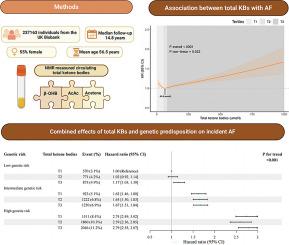
We studied 237,163 participants [mean age, 56.5 years; 129,472 women (55%)] from the UK Biobank who were free of AF at baseline and had data on circulating β-hydroxybutyrate (β-OHB), acetoacetate, and acetone. The associations of KBs with new-onset AF were evaluated using Cox regression in the general population and across the 3 genetic risk groups: low, moderate, and high polygenic risk score of AF.
Results
During a median follow-up of 14.8 (13.8, 15.5) years, 16,638 participants (7.0%) developed AF. There was a U-shaped association of total KBs and β-OHB with incident AF, with nadirs at 60.6 and 40.8 μmol/L, respectively (Pnonlinear < .05), whereas there was a positive association of acetoacetate and acetone with AF (Poverall < .001; Pnonlinear > .05). Consistently, there was a U-shaped association of total KBs and β-OHB with left atrial (LA) volume parameters, including LA maximum volume, LA minimum volume, and their body surface area–indexed counterparts, and there was an inverted U-shaped association of total KBs and β-OHB with LA ejection fraction (Pnonlinear < .05 for all). The associations of KBs with AF were stronger in individuals with low genetic risk (Pinteraction < .05), while the highest AF risk was in those with high genetic risk with high KB levels. Significant mediation effects of inflammatory markers on the associations between KBs and AF were identified.
Conclusion
There was a U-shaped association of circulating total KBs and β-OHB with incident AF as well as a positive association of acetoacetate and acetone levels with AF risk in the general population.
期刊介绍:
HeartRhythm, the official Journal of the Heart Rhythm Society and the Cardiac Electrophysiology Society, is a unique journal for fundamental discovery and clinical applicability.
HeartRhythm integrates the entire cardiac electrophysiology (EP) community from basic and clinical academic researchers, private practitioners, engineers, allied professionals, industry, and trainees, all of whom are vital and interdependent members of our EP community.
The Heart Rhythm Society is the international leader in science, education, and advocacy for cardiac arrhythmia professionals and patients, and the primary information resource on heart rhythm disorders. Its mission is to improve the care of patients by promoting research, education, and optimal health care policies and standards.



 京公网安备 11010802042870号
京ICP备2023020795号-1
京公网安备 11010802042870号
京ICP备2023020795号-1

 分享
分享
 求助内容:
求助内容: 应助结果提醒方式:
 扫码关注我们
