D. Kane, R. Daly, E. Tunney, E. Fullston, R. Gryson, E. Kent, K. Flood, F. Malone
{"title":"Trends in operative vaginal delivery rates: A 20-year retrospective analysis in Ireland","authors":"D. Kane, R. Daly, E. Tunney, E. Fullston, R. Gryson, E. Kent, K. Flood, F. Malone","doi":"10.1002/ijgo.15973","DOIUrl":null,"url":null,"abstract":"<p>Operative vaginal delivery (OVD) rates have been reported to be declining, with the global decline in the use of the obstetric forceps being pronounced.<span><sup>1</sup></span> This reduction coincides with a worldwide increase in cesarean section rates,<span><sup>2</sup></span> raising concerns about the declining skill set for OVD procedures amid the prevailing preference for cesarean deliveries.<span><sup>3</sup></span> Internationally, trainees have reported that they do not feel confident performing forceps deliveries at the end of their training, despite having senior clinicians that are willing to teach this skill.<span><sup>4</sup></span></p><p>To evaluate our experience, we conducted a retrospective analysis at a tertiary referral center in Ireland spanning from 2002 to 2021, examining OVD rates. We also analyzed the incidence of hypoxic ischemic encephalopathy (HIE) and neonatal death (NND) and the incidence of obstetric anal sphincter injury (OASI) associated with these deliveries. All OVD cases during this period were included, and the choice of instrument (forceps or vacuum) and associated morbidities were recorded. Linear regression analysis was used to discern any trends. Ethical approval was not required as this data was irrevocably anonymized and available to the public as part of the annual reports that are available for review in the Rotunda Hospital library.</p><p>We found that over the study period encompassing 162 450 deliveries, OVD constituted 28 239 (17.4%) of all deliveries or 25.0% of vaginal deliveries. The overall OVD rate exhibited a non-significant decrease (<i>P</i> = 0.33, <i>R</i><sup>2</sup> = 0.0528, slope = −0.2299) (Figure 1). Notably, the use of forceps accounted for 7197 deliveries (i.e., 4.4% of all deliveries), whereas vacuum extraction was used in 21 042 (13.0%) deliveries. A significant increase in forceps usage was observed (<i>P</i> = 0.006, <i>R</i><sup>2</sup> = 0.3491, slope = 0.5908) (Figure 1), corresponding with a significant decrease in vacuum-assisted delivery. However, there were no statistically significant disparities noted in NND (<i>P</i> = 0.067) or HIE rates (<i>P</i> = 0.370) associated with OVD. There was a significant increase in OASI after an OVD with a mean rate of 4.59% of all OVDs (<i>P</i> = 0.001, <i>R</i><sup>2</sup> = 0.477 slope = 0.0832).</p><p>While the overall rate of OVD demonstrated a non-significant decline, the use of forceps rose significantly. This increase departs from international trends.<span><sup>1</sup></span> This rise has coincided with an increased OASI rate with no significant difference in neonatal outcomes. It should be noted that a Cochrane review on OVD has shown evidence that forceps might be more likely to achieve vaginal birth and have lower rates of fetal trauma but at a greater risk of perineal trauma and higher pain relief requirements compared with vacuum cups.<span><sup>5</sup></span> Despite this finding, we would argue that it is vital that obstetricians be proficient in all types of OVD to allow choice based on medical conditions, as well as maternal preferences, when faced with difficult deliveries. The increase in the use of forceps in our institution likely stems from various factors and might reflect institutional initiatives aimed at enhancing forceps training for trainees, which should be welcomed. However, we do acknowledge that these findings highlight the need for further vigilance in relation to OASI prevention. These findings hold implications for obstetric training programs, advocating for sustained or augmented exposure to forceps as a valuable obstetric skillset.</p><p>DK, ET, and RD conceptualized the idea for the study. DK, EF, and RG, were involved in data curation and synthesis of this data. DK wrote the first draft, and DK, ET, RD, EF, and EK were involved in reviewing, offer contribution, and finalizing the manuscript. KF and FM supervised the study.</p><p>Data sharing is not applicable to this article as no new data were created or analyzed in this study.</p>","PeriodicalId":14164,"journal":{"name":"International Journal of Gynecology & Obstetrics","volume":"168 3","pages":"1339-1340"},"PeriodicalIF":2.4000,"publicationDate":"2024-10-18","publicationTypes":"Journal Article","fieldsOfStudy":null,"isOpenAccess":false,"openAccessPdf":"https://onlinelibrary.wiley.com/doi/epdf/10.1002/ijgo.15973","citationCount":"0","resultStr":null,"platform":"Semanticscholar","paperid":null,"PeriodicalName":"International Journal of Gynecology & Obstetrics","FirstCategoryId":"3","ListUrlMain":"https://obgyn.onlinelibrary.wiley.com/doi/10.1002/ijgo.15973","RegionNum":3,"RegionCategory":"医学","ArticlePicture":[],"TitleCN":null,"AbstractTextCN":null,"PMCID":null,"EPubDate":"","PubModel":"","JCR":"Q2","JCRName":"OBSTETRICS & GYNECOLOGY","Score":null,"Total":0}
引用次数: 0
Abstract
Operative vaginal delivery (OVD) rates have been reported to be declining, with the global decline in the use of the obstetric forceps being pronounced.1 This reduction coincides with a worldwide increase in cesarean section rates,2 raising concerns about the declining skill set for OVD procedures amid the prevailing preference for cesarean deliveries.3 Internationally, trainees have reported that they do not feel confident performing forceps deliveries at the end of their training, despite having senior clinicians that are willing to teach this skill.4
To evaluate our experience, we conducted a retrospective analysis at a tertiary referral center in Ireland spanning from 2002 to 2021, examining OVD rates. We also analyzed the incidence of hypoxic ischemic encephalopathy (HIE) and neonatal death (NND) and the incidence of obstetric anal sphincter injury (OASI) associated with these deliveries. All OVD cases during this period were included, and the choice of instrument (forceps or vacuum) and associated morbidities were recorded. Linear regression analysis was used to discern any trends. Ethical approval was not required as this data was irrevocably anonymized and available to the public as part of the annual reports that are available for review in the Rotunda Hospital library.
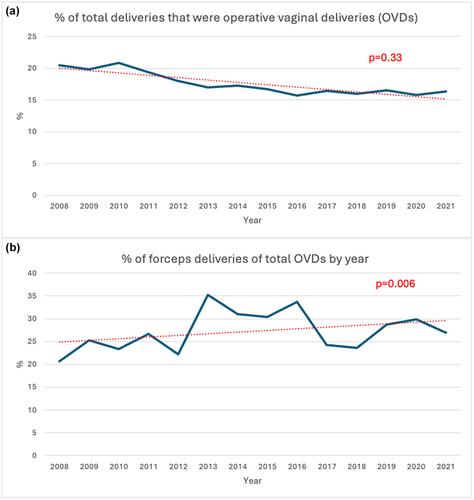
We found that over the study period encompassing 162 450 deliveries, OVD constituted 28 239 (17.4%) of all deliveries or 25.0% of vaginal deliveries. The overall OVD rate exhibited a non-significant decrease (P = 0.33, R2 = 0.0528, slope = −0.2299) (Figure 1). Notably, the use of forceps accounted for 7197 deliveries (i.e., 4.4% of all deliveries), whereas vacuum extraction was used in 21 042 (13.0%) deliveries. A significant increase in forceps usage was observed (P = 0.006, R2 = 0.3491, slope = 0.5908) (Figure 1), corresponding with a significant decrease in vacuum-assisted delivery. However, there were no statistically significant disparities noted in NND (P = 0.067) or HIE rates (P = 0.370) associated with OVD. There was a significant increase in OASI after an OVD with a mean rate of 4.59% of all OVDs (P = 0.001, R2 = 0.477 slope = 0.0832).
While the overall rate of OVD demonstrated a non-significant decline, the use of forceps rose significantly. This increase departs from international trends.1 This rise has coincided with an increased OASI rate with no significant difference in neonatal outcomes. It should be noted that a Cochrane review on OVD has shown evidence that forceps might be more likely to achieve vaginal birth and have lower rates of fetal trauma but at a greater risk of perineal trauma and higher pain relief requirements compared with vacuum cups.5 Despite this finding, we would argue that it is vital that obstetricians be proficient in all types of OVD to allow choice based on medical conditions, as well as maternal preferences, when faced with difficult deliveries. The increase in the use of forceps in our institution likely stems from various factors and might reflect institutional initiatives aimed at enhancing forceps training for trainees, which should be welcomed. However, we do acknowledge that these findings highlight the need for further vigilance in relation to OASI prevention. These findings hold implications for obstetric training programs, advocating for sustained or augmented exposure to forceps as a valuable obstetric skillset.
DK, ET, and RD conceptualized the idea for the study. DK, EF, and RG, were involved in data curation and synthesis of this data. DK wrote the first draft, and DK, ET, RD, EF, and EK were involved in reviewing, offer contribution, and finalizing the manuscript. KF and FM supervised the study.
Data sharing is not applicable to this article as no new data were created or analyzed in this study.
期刊介绍:
The International Journal of Gynecology & Obstetrics publishes articles on all aspects of basic and clinical research in the fields of obstetrics and gynecology and related subjects, with emphasis on matters of worldwide interest.





 京公网安备 11010802042870号
京ICP备2023020795号-1
京公网安备 11010802042870号
京ICP备2023020795号-1

 分享
分享
 求助内容:
求助内容: 应助结果提醒方式:
 扫码关注我们
