Zhongyuan Li , Meiyue Dong , Zinuo Chen , Chengcheng Zhang , Jiayu Jiang , Miaomiao Liu , Qinghua Cui
{"title":"Combining virus-based affinity ultrafiltration method with serum pharmacochemistry to identify the antiviral pharmacodynamic substances in licorice","authors":"Zhongyuan Li , Meiyue Dong , Zinuo Chen , Chengcheng Zhang , Jiayu Jiang , Miaomiao Liu , Qinghua Cui","doi":"10.1016/j.jep.2024.118978","DOIUrl":null,"url":null,"abstract":"<div><h3>Ethnopharmacological relevance</h3><div>Liorice (<em>Glycyrrhiza uralensis</em> Fisch.), a widely used Chinese herbal medicine, is frequently employed in clinical practice to treat viral pneumonia. However, the pharmacodynamic substances and mechanisms of action responsible for its antiviral effects against H1N1 and RSV remain unclear.</div></div><div><h3>Aim of the study</h3><div>To investigate the antiviral effects of licorice against H1N1 and RSV. Building on this, we aimed to more comprehensively and accurately identify the pharmacodynamic substances in licorice responsible for its antiviral activity and mechanisms of action against these two viruses.</div></div><div><h3>Materials and methods</h3><div>Firstly, the antiviral effects of licorice against H1N1 and RSV were confirmed through <em>in vivo</em> and <em>in vitro</em> experiments. Then, a combination of virus-based affinity ultrafiltration method (VAUM) and serum pharmacochemistry were used to screen for pharmacological substances in licorice and identify their molecular targets against H1N1 and RSV. <em>Results</em>: The <em>in vivo</em> experiments showed that licorice effectively alleviates H1N1 and RSV induced weight loss and lung tissue damage in mice, while also reducing viral loads of H1N1 and RSV in the lungs. Subsequent <em>in vitro</em> experiments confirmed the presence of original compounds in licorice that directly inhibit H1N1 and RSV. By combining both methods, glycyrrhizic acid, glycyrrhetinic acid (GA), isoliquiritigenin (ISL), and glyasperin A (targeting the M2 ion channel) were ultimately identified as the pharmacodynamic substances in licorice responsible for anti-H1N1 activity. Additionally, licochalcone A (LCA) and glyasperin A, which target RSV surface proteins, were identified as the pharmacodynamic substances responsible for anti-RSV activity.</div></div><div><h3>Conclusions</h3><div>Traditional Chinese medicine (TCM) exerts its antiviral effects through a ‘multi-component, multi-target’ mechanism, which poses challenges for single active compound screening methods to adequately address. By integrating VAUM and serum pharmacochemistry for the first time, one approach focused on identifying compounds in TCM that directly bind to viral surface proteins, while the other targeted compounds that enter the bloodstream in their original form and exhibit antiviral activity. This provides a novel approach for studying the pharmacodynamic substances of antiviral effects in TCM.</div></div>","PeriodicalId":15761,"journal":{"name":"Journal of ethnopharmacology","volume":"338 ","pages":"Article 118978"},"PeriodicalIF":5.4000,"publicationDate":"2024-10-20","publicationTypes":"Journal Article","fieldsOfStudy":null,"isOpenAccess":false,"openAccessPdf":"","citationCount":"0","resultStr":null,"platform":"Semanticscholar","paperid":null,"PeriodicalName":"Journal of ethnopharmacology","FirstCategoryId":"3","ListUrlMain":"https://www.sciencedirect.com/science/article/pii/S0378874124012777","RegionNum":2,"RegionCategory":"医学","ArticlePicture":[],"TitleCN":null,"AbstractTextCN":null,"PMCID":null,"EPubDate":"","PubModel":"","JCR":"Q1","JCRName":"CHEMISTRY, MEDICINAL","Score":null,"Total":0}
引用次数: 0
Abstract
Ethnopharmacological relevance
Liorice (Glycyrrhiza uralensis Fisch.), a widely used Chinese herbal medicine, is frequently employed in clinical practice to treat viral pneumonia. However, the pharmacodynamic substances and mechanisms of action responsible for its antiviral effects against H1N1 and RSV remain unclear.
Aim of the study
To investigate the antiviral effects of licorice against H1N1 and RSV. Building on this, we aimed to more comprehensively and accurately identify the pharmacodynamic substances in licorice responsible for its antiviral activity and mechanisms of action against these two viruses.
Materials and methods
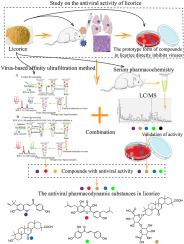
Firstly, the antiviral effects of licorice against H1N1 and RSV were confirmed through in vivo and in vitro experiments. Then, a combination of virus-based affinity ultrafiltration method (VAUM) and serum pharmacochemistry were used to screen for pharmacological substances in licorice and identify their molecular targets against H1N1 and RSV. Results: The in vivo experiments showed that licorice effectively alleviates H1N1 and RSV induced weight loss and lung tissue damage in mice, while also reducing viral loads of H1N1 and RSV in the lungs. Subsequent in vitro experiments confirmed the presence of original compounds in licorice that directly inhibit H1N1 and RSV. By combining both methods, glycyrrhizic acid, glycyrrhetinic acid (GA), isoliquiritigenin (ISL), and glyasperin A (targeting the M2 ion channel) were ultimately identified as the pharmacodynamic substances in licorice responsible for anti-H1N1 activity. Additionally, licochalcone A (LCA) and glyasperin A, which target RSV surface proteins, were identified as the pharmacodynamic substances responsible for anti-RSV activity.
Conclusions
Traditional Chinese medicine (TCM) exerts its antiviral effects through a ‘multi-component, multi-target’ mechanism, which poses challenges for single active compound screening methods to adequately address. By integrating VAUM and serum pharmacochemistry for the first time, one approach focused on identifying compounds in TCM that directly bind to viral surface proteins, while the other targeted compounds that enter the bloodstream in their original form and exhibit antiviral activity. This provides a novel approach for studying the pharmacodynamic substances of antiviral effects in TCM.
期刊介绍:
The Journal of Ethnopharmacology is dedicated to the exchange of information and understandings about people''s use of plants, fungi, animals, microorganisms and minerals and their biological and pharmacological effects based on the principles established through international conventions. Early people confronted with illness and disease, discovered a wealth of useful therapeutic agents in the plant and animal kingdoms. The empirical knowledge of these medicinal substances and their toxic potential was passed on by oral tradition and sometimes recorded in herbals and other texts on materia medica. Many valuable drugs of today (e.g., atropine, ephedrine, tubocurarine, digoxin, reserpine) came into use through the study of indigenous remedies. Chemists continue to use plant-derived drugs (e.g., morphine, taxol, physostigmine, quinidine, emetine) as prototypes in their attempts to develop more effective and less toxic medicinals.




 京公网安备 11010802042870号
京ICP备2023020795号-1
京公网安备 11010802042870号
京ICP备2023020795号-1

 分享
分享
 求助内容:
求助内容: 应助结果提醒方式:
 扫码关注我们
