Review of MrsFreqPhase methods: methods designed to estimate statistically malaria parasite multiplicity of infection, relatedness, frequency and phase.
Aimee R Taylor, Eric Neubauer Vickers, Bryan Greenhouse
{"title":"Review of MrsFreqPhase methods: methods designed to estimate statistically malaria parasite multiplicity of infection, relatedness, frequency and phase.","authors":"Aimee R Taylor, Eric Neubauer Vickers, Bryan Greenhouse","doi":"10.1186/s12936-024-05119-2","DOIUrl":null,"url":null,"abstract":"<p><p>Malaria parasites are haploid within humans, but infections often contain genetically distinct groups of clonal parasites. When the per-infection number of genetically distinct clones (i.e., the multiplicity of infection, MOI) exceeds one, and per-infection genetic data are generated in bulk, important information are obfuscated. For example, the MOI, the phases of the haploid genotypes of genetically distinct clones (i.e., how the alleles concatenate into sequences), and their frequencies. This complicates many downstream analyses, including relatedness estimation. MOIs, parasite sequences, their frequencies, and degrees of relatedness are used ubiquitously in malaria studies: for example, to monitor anti-malarial drug resistance and to track changes in transmission. In this article, MrsFreqPhase methods designed to estimate statistically malaria parasite MOI, relatedness, frequency and phase are reviewed. An overview, a historical account of the literature, and a statistical description of contemporary software is provided for each method class. The article ends with a look towards future method development, needed to make best use of new data types generated by cutting-edge malaria studies reliant on MrsFreqPhase methods.</p>","PeriodicalId":18317,"journal":{"name":"Malaria Journal","volume":"23 1","pages":"308"},"PeriodicalIF":3.0000,"publicationDate":"2024-10-15","publicationTypes":"Journal Article","fieldsOfStudy":null,"isOpenAccess":false,"openAccessPdf":"https://www.ncbi.nlm.nih.gov/pmc/articles/PMC11481338/pdf/","citationCount":"0","resultStr":null,"platform":"Semanticscholar","paperid":null,"PeriodicalName":"Malaria Journal","FirstCategoryId":"3","ListUrlMain":"https://doi.org/10.1186/s12936-024-05119-2","RegionNum":3,"RegionCategory":"医学","ArticlePicture":[],"TitleCN":null,"AbstractTextCN":null,"PMCID":null,"EPubDate":"","PubModel":"","JCR":"Q3","JCRName":"INFECTIOUS DISEASES","Score":null,"Total":0}
引用次数: 0
Abstract
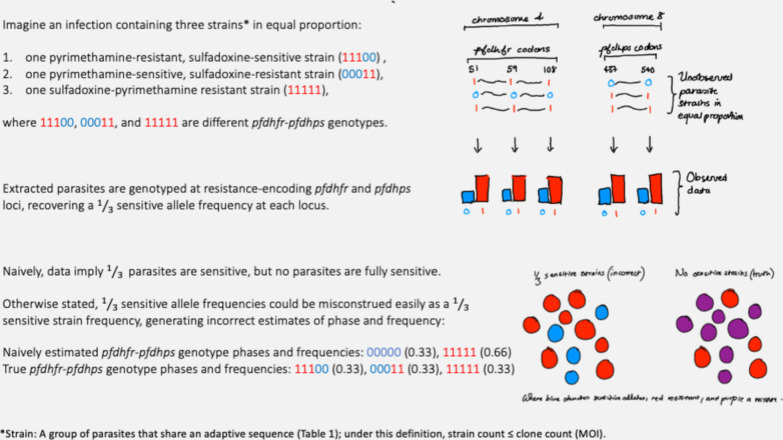
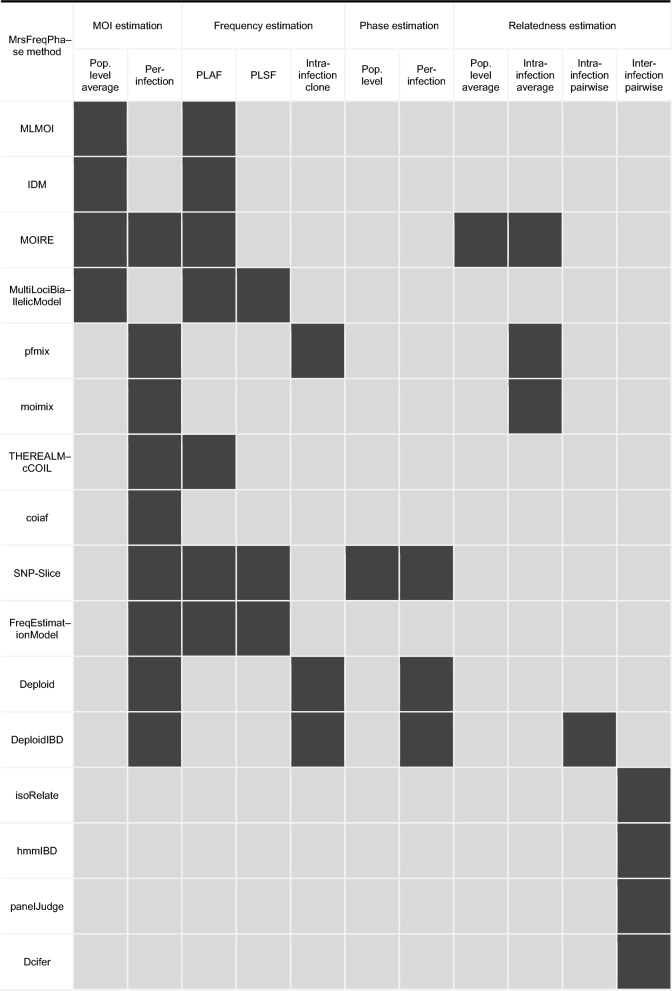
Malaria parasites are haploid within humans, but infections often contain genetically distinct groups of clonal parasites. When the per-infection number of genetically distinct clones (i.e., the multiplicity of infection, MOI) exceeds one, and per-infection genetic data are generated in bulk, important information are obfuscated. For example, the MOI, the phases of the haploid genotypes of genetically distinct clones (i.e., how the alleles concatenate into sequences), and their frequencies. This complicates many downstream analyses, including relatedness estimation. MOIs, parasite sequences, their frequencies, and degrees of relatedness are used ubiquitously in malaria studies: for example, to monitor anti-malarial drug resistance and to track changes in transmission. In this article, MrsFreqPhase methods designed to estimate statistically malaria parasite MOI, relatedness, frequency and phase are reviewed. An overview, a historical account of the literature, and a statistical description of contemporary software is provided for each method class. The article ends with a look towards future method development, needed to make best use of new data types generated by cutting-edge malaria studies reliant on MrsFreqPhase methods.
期刊介绍:
Malaria Journal is aimed at the scientific community interested in malaria in its broadest sense. It is the only journal that publishes exclusively articles on malaria and, as such, it aims to bring together knowledge from the different specialities involved in this very broad discipline, from the bench to the bedside and to the field.



 京公网安备 11010802042870号
京ICP备2023020795号-1
京公网安备 11010802042870号
京ICP备2023020795号-1

 分享
分享
 求助内容:
求助内容: 应助结果提醒方式:
 扫码关注我们
