{"title":"Bi-enzyme assay coupled with silver nanoplate transformation for insecticide detection†","authors":"Thitikan Khampieng, Kaneenard Kewcharoen, Tewarak Parnklang, Sumana Kladsomboon, Orawon Chailapakul and Amara Apilux","doi":"10.1039/D4NA00585F","DOIUrl":null,"url":null,"abstract":"<p >A novel colorimetric method utilizing a bi-enzyme assay using silver nanoplates (AgNPls) as a direct signal source was developed to enable rapid insecticide detection. This innovative system leverages the <em>in situ</em> generated H<small><sub>2</sub></small>O<small><sub>2</sub></small> from the consecutive enzyme-catalyzed reactions of acetylcholine hydrolysis and choline oxidation to introduce oxidative etching of AgNPls, transforming them into aggregated silver nanospheres (AgNSs). The morphological transformation of silver nanoparticles could be observed with the naked eye due to the solution's color shifts from pink-violet to blue-violet. The presence of insecticide, <em>i.e.</em>, dichlorvos (DDVP), could inhibit acetylcholinesterase activity, thereby limiting H<small><sub>2</sub></small>O<small><sub>2</sub></small> production and affecting the transformation of AgNPls into aggregated AgNSs. Furthermore, the extent of AgNPl-to-aggregated AgNS transformation and the subsequent solution's color change was inversely proportional to the amount of DDVP. Under optimal conditions, the developed bi-enzyme assay enables the quantification of DDVP within 5 minutes, achieving detection limits of 0.5 ppm and 0.1 ppm by naked-eye detection and UV-visible spectrophotometry, respectively. Furthermore, the practical application of this assay was validated for detecting insecticides in real vegetable samples, demonstrating both accuracy and reliability.</p>","PeriodicalId":18806,"journal":{"name":"Nanoscale Advances","volume":" 24","pages":" 6221-6228"},"PeriodicalIF":4.6000,"publicationDate":"2024-10-14","publicationTypes":"Journal Article","fieldsOfStudy":null,"isOpenAccess":false,"openAccessPdf":"https://www.ncbi.nlm.nih.gov/pmc/articles/PMC11474407/pdf/","citationCount":"0","resultStr":null,"platform":"Semanticscholar","paperid":null,"PeriodicalName":"Nanoscale Advances","FirstCategoryId":"88","ListUrlMain":"https://pubs.rsc.org/en/content/articlelanding/2024/na/d4na00585f","RegionNum":3,"RegionCategory":"材料科学","ArticlePicture":[],"TitleCN":null,"AbstractTextCN":null,"PMCID":null,"EPubDate":"","PubModel":"","JCR":"Q2","JCRName":"CHEMISTRY, MULTIDISCIPLINARY","Score":null,"Total":0}
引用次数: 0
Abstract
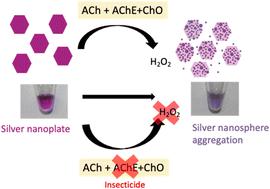
A novel colorimetric method utilizing a bi-enzyme assay using silver nanoplates (AgNPls) as a direct signal source was developed to enable rapid insecticide detection. This innovative system leverages the in situ generated H2O2 from the consecutive enzyme-catalyzed reactions of acetylcholine hydrolysis and choline oxidation to introduce oxidative etching of AgNPls, transforming them into aggregated silver nanospheres (AgNSs). The morphological transformation of silver nanoparticles could be observed with the naked eye due to the solution's color shifts from pink-violet to blue-violet. The presence of insecticide, i.e., dichlorvos (DDVP), could inhibit acetylcholinesterase activity, thereby limiting H2O2 production and affecting the transformation of AgNPls into aggregated AgNSs. Furthermore, the extent of AgNPl-to-aggregated AgNS transformation and the subsequent solution's color change was inversely proportional to the amount of DDVP. Under optimal conditions, the developed bi-enzyme assay enables the quantification of DDVP within 5 minutes, achieving detection limits of 0.5 ppm and 0.1 ppm by naked-eye detection and UV-visible spectrophotometry, respectively. Furthermore, the practical application of this assay was validated for detecting insecticides in real vegetable samples, demonstrating both accuracy and reliability.



 京公网安备 11010802042870号
京ICP备2023020795号-1
京公网安备 11010802042870号
京ICP备2023020795号-1

 分享
分享
 求助内容:
求助内容: 应助结果提醒方式:
 扫码关注我们
