{"title":"Efficient spin filtering through Fe4GeTe2-based van der Waals heterostructures†","authors":"Masoumeh Davoudiniya and Biplab Sanyal","doi":"10.1039/D4NA00639A","DOIUrl":null,"url":null,"abstract":"<p >Utilizing <em>ab initio</em> simulations, we study the spin-dependent electronic transport characteristics within Fe<small><sub>4</sub></small>GeTe<small><sub>2</sub></small>-based van der Waals heterostructures. The electronic density of states for both free-standing and device-configured Fe<small><sub>4</sub></small>GeTe<small><sub>2</sub></small> (F4GT) confirms its ferromagnetic metallic nature and reveals a weak interface interaction between F4GT and PtTe<small><sub>2</sub></small> electrodes, enabling efficient spin filtering. The ballistic transport through a double-layer F4GT with a ferromagnetic configuration sandwiched between two PtTe<small><sub>2</sub></small> electrodes is predicted to exhibit an impressive spin polarization of 97% with spin-up electrons exhibiting higher transmission probability than spin-down electrons. Moreover, we investigate the spin transport properties of Fe<small><sub>4</sub></small>GeTe<small><sub>2</sub></small>/GaTe/Fe<small><sub>4</sub></small>GeTe<small><sub>2</sub></small> van der Waals heterostructures sandwiched between PtTe<small><sub>2</sub></small> electrodes to explore their potential as magnetic tunnel junctions in spintronic devices. The inclusion of monolayer GaTe as a 2D semiconducting spacer between F4GT layers results in a tunnel magnetoresistance of 487% at a low bias and decreases with increasing bias voltage. Overall, our findings underscore the potential of F4GT/GaTe/F4GT heterostructures in advancing spintronic devices based on van der Waals materials.</p>","PeriodicalId":18806,"journal":{"name":"Nanoscale Advances","volume":" 24","pages":" 6278-6289"},"PeriodicalIF":4.6000,"publicationDate":"2024-10-09","publicationTypes":"Journal Article","fieldsOfStudy":null,"isOpenAccess":false,"openAccessPdf":"https://www.ncbi.nlm.nih.gov/pmc/articles/PMC11485126/pdf/","citationCount":"0","resultStr":null,"platform":"Semanticscholar","paperid":null,"PeriodicalName":"Nanoscale Advances","FirstCategoryId":"88","ListUrlMain":"https://pubs.rsc.org/en/content/articlelanding/2024/na/d4na00639a","RegionNum":3,"RegionCategory":"材料科学","ArticlePicture":[],"TitleCN":null,"AbstractTextCN":null,"PMCID":null,"EPubDate":"","PubModel":"","JCR":"Q2","JCRName":"CHEMISTRY, MULTIDISCIPLINARY","Score":null,"Total":0}
引用次数: 0
Abstract
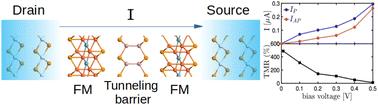
Utilizing ab initio simulations, we study the spin-dependent electronic transport characteristics within Fe4GeTe2-based van der Waals heterostructures. The electronic density of states for both free-standing and device-configured Fe4GeTe2 (F4GT) confirms its ferromagnetic metallic nature and reveals a weak interface interaction between F4GT and PtTe2 electrodes, enabling efficient spin filtering. The ballistic transport through a double-layer F4GT with a ferromagnetic configuration sandwiched between two PtTe2 electrodes is predicted to exhibit an impressive spin polarization of 97% with spin-up electrons exhibiting higher transmission probability than spin-down electrons. Moreover, we investigate the spin transport properties of Fe4GeTe2/GaTe/Fe4GeTe2 van der Waals heterostructures sandwiched between PtTe2 electrodes to explore their potential as magnetic tunnel junctions in spintronic devices. The inclusion of monolayer GaTe as a 2D semiconducting spacer between F4GT layers results in a tunnel magnetoresistance of 487% at a low bias and decreases with increasing bias voltage. Overall, our findings underscore the potential of F4GT/GaTe/F4GT heterostructures in advancing spintronic devices based on van der Waals materials.




 京公网安备 11010802042870号
京ICP备2023020795号-1
京公网安备 11010802042870号
京ICP备2023020795号-1

 分享
分享
 求助内容:
求助内容: 应助结果提醒方式:
 扫码关注我们
