{"title":"RMVar 2.0: an updated database of functional variants in RNA modifications.","authors":"Yuantai Huang, Luowanyue Zhang, Weiping Mu, Mohan Zheng, Xiaoqiong Bao, Huiqin Li, Xiaotong Luo, Jian Ren, Zhixiang Zuo","doi":"10.1093/nar/gkae924","DOIUrl":null,"url":null,"abstract":"<p><p>Evaluating the impact of genetic variants on RNA modifications (RMs) is crucial for identifying disease-associated variants and understanding the pathogenic mechanisms underlying human diseases. Previously, we developed a database called RMVar to catalog variants linked to RNA modifications in humans and mice. Here, we present an updated version RMVar 2.0 (http://rmvar.renlab.cn). In this updated version, we applied an enhanced analytical pipeline to the latest RNA modification datasets and genetic variant information to identify RM-associated variants. A notable advancement in RMVar 2.0 is our incorporation of allele-specific RNA modification analysis to identify RM-associated variants, a novel approach not utilized in RMVar 1.0 or other comparable databases. Furthermore, the database offers comprehensive annotations for various molecular events, including RNA-binding protein (RBP) interactions, RNA-RNA interactions, splicing events, and circular RNAs (circRNAs), which facilitate investigations into how RM-associated variants influence post-transcriptional regulation. Additionally, we provide disease-related information sourced from ClinVar and GWAS to help researchers explore the connections between RNA modifications and various diseases. We believe that RMVar 2.0 will significantly enhance our understanding of the functional implications of genetic variants affecting RNA modifications within the context of human disease research.</p>","PeriodicalId":19471,"journal":{"name":"Nucleic Acids Research","volume":" ","pages":"D275-D283"},"PeriodicalIF":13.1000,"publicationDate":"2025-01-06","publicationTypes":"Journal Article","fieldsOfStudy":null,"isOpenAccess":false,"openAccessPdf":"https://www.ncbi.nlm.nih.gov/pmc/articles/PMC11701541/pdf/","citationCount":"0","resultStr":null,"platform":"Semanticscholar","paperid":null,"PeriodicalName":"Nucleic Acids Research","FirstCategoryId":"99","ListUrlMain":"https://doi.org/10.1093/nar/gkae924","RegionNum":2,"RegionCategory":"生物学","ArticlePicture":[],"TitleCN":null,"AbstractTextCN":null,"PMCID":null,"EPubDate":"","PubModel":"","JCR":"Q1","JCRName":"BIOCHEMISTRY & MOLECULAR BIOLOGY","Score":null,"Total":0}
引用次数: 0
Abstract
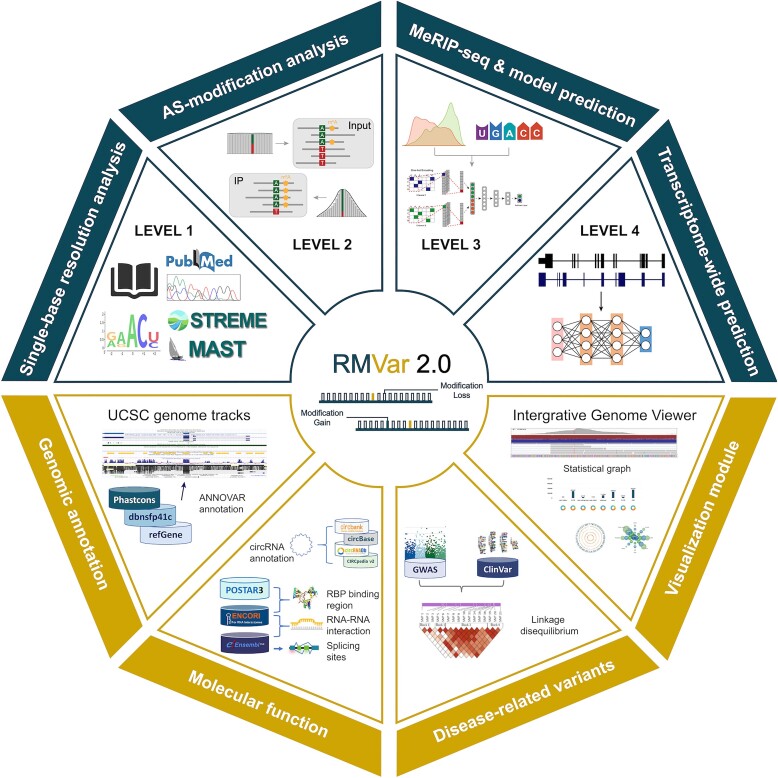
Evaluating the impact of genetic variants on RNA modifications (RMs) is crucial for identifying disease-associated variants and understanding the pathogenic mechanisms underlying human diseases. Previously, we developed a database called RMVar to catalog variants linked to RNA modifications in humans and mice. Here, we present an updated version RMVar 2.0 (http://rmvar.renlab.cn). In this updated version, we applied an enhanced analytical pipeline to the latest RNA modification datasets and genetic variant information to identify RM-associated variants. A notable advancement in RMVar 2.0 is our incorporation of allele-specific RNA modification analysis to identify RM-associated variants, a novel approach not utilized in RMVar 1.0 or other comparable databases. Furthermore, the database offers comprehensive annotations for various molecular events, including RNA-binding protein (RBP) interactions, RNA-RNA interactions, splicing events, and circular RNAs (circRNAs), which facilitate investigations into how RM-associated variants influence post-transcriptional regulation. Additionally, we provide disease-related information sourced from ClinVar and GWAS to help researchers explore the connections between RNA modifications and various diseases. We believe that RMVar 2.0 will significantly enhance our understanding of the functional implications of genetic variants affecting RNA modifications within the context of human disease research.
期刊介绍:
Nucleic Acids Research (NAR) is a scientific journal that publishes research on various aspects of nucleic acids and proteins involved in nucleic acid metabolism and interactions. It covers areas such as chemistry and synthetic biology, computational biology, gene regulation, chromatin and epigenetics, genome integrity, repair and replication, genomics, molecular biology, nucleic acid enzymes, RNA, and structural biology. The journal also includes a Survey and Summary section for brief reviews. Additionally, each year, the first issue is dedicated to biological databases, and an issue in July focuses on web-based software resources for the biological community. Nucleic Acids Research is indexed by several services including Abstracts on Hygiene and Communicable Diseases, Animal Breeding Abstracts, Agricultural Engineering Abstracts, Agbiotech News and Information, BIOSIS Previews, CAB Abstracts, and EMBASE.





 京公网安备 11010802042870号
京ICP备2023020795号-1
京公网安备 11010802042870号
京ICP备2023020795号-1

 分享
分享
 求助内容:
求助内容: 应助结果提醒方式:
 扫码关注我们
