Shu Su, Hua-qiong Qiu, Lian-Hong Cai, Wei-Feng Hou, Shu-Zhen Huang, Li-Bin Huang, Long Qian, Wei Cui, Yian-Qian Chen, Zhi-Yun Yang, Yan-Lai Tang, Li-Ping Lin
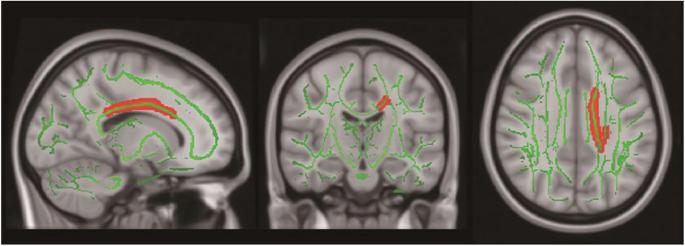
{"title":"Assessing changes in brain structure in new-onset children with acute lymphoblastic leukemia","authors":"Shu Su, Hua-qiong Qiu, Lian-Hong Cai, Wei-Feng Hou, Shu-Zhen Huang, Li-Bin Huang, Long Qian, Wei Cui, Yian-Qian Chen, Zhi-Yun Yang, Yan-Lai Tang, Li-Ping Lin","doi":"10.1038/s41390-024-03655-w","DOIUrl":null,"url":null,"abstract":"Brain structure injury was presented in acute lymphoblastic leukemia (ALL) after treatment; however, its alterations in new-onset stage are still unclear. We aim to explore white matter (WM) and grey matter (GM) alterations using surface-based morphometry (SBM) and tract-based spatial statistics (TBSS) in new-onset pediatric ALL. Thirty-five ALL and 33 typically developing (TD) children were prospectively recruited and underwent three-dimensional T1-weighted and diffusion tensor (DTI) imaging. DTI metrics, cortical GM features, and deep GM nuclei volume were compared between groups differences. In ALL, the only increased FA in the body of corpus callosum (PFWE-corrected = 0.023) and left superior corona radiata (PFWE-corrected = 0.045) were presented. Relative to TDs, pediatric ALL presented a significant decrease in cortical surface area (CSA), thickness (CT), and volume in orbital gyri, supramarginal gyrus, middle temporal gyrus, and superior temporal gyrus (all CWP = 0.01). Additionally, increased CT and CSA were found in lingual gyrus and left sulcus intermedius primus, respectively (all CWP = 0.01). Smaller volumes in pediatric ALL were observed in bilateral thalamus, caudate, hippocampus, and right putamen (PFDR-corrected < 0.05). Widespread brain structural abnormalities were found in new-onset pediatric ALL, which suggest disease itself can cause brain structural injury.","PeriodicalId":19829,"journal":{"name":"Pediatric Research","volume":"97 7","pages":"2398-2404"},"PeriodicalIF":3.1000,"publicationDate":"2024-10-20","publicationTypes":"Journal Article","fieldsOfStudy":null,"isOpenAccess":false,"openAccessPdf":"https://www.nature.com/articles/s41390-024-03655-w.pdf","citationCount":"0","resultStr":null,"platform":"Semanticscholar","paperid":null,"PeriodicalName":"Pediatric Research","FirstCategoryId":"3","ListUrlMain":"https://www.nature.com/articles/s41390-024-03655-w","RegionNum":3,"RegionCategory":"医学","ArticlePicture":[],"TitleCN":null,"AbstractTextCN":null,"PMCID":null,"EPubDate":"","PubModel":"","JCR":"Q1","JCRName":"PEDIATRICS","Score":null,"Total":0}
引用次数: 0
Abstract
Brain structure injury was presented in acute lymphoblastic leukemia (ALL) after treatment; however, its alterations in new-onset stage are still unclear. We aim to explore white matter (WM) and grey matter (GM) alterations using surface-based morphometry (SBM) and tract-based spatial statistics (TBSS) in new-onset pediatric ALL. Thirty-five ALL and 33 typically developing (TD) children were prospectively recruited and underwent three-dimensional T1-weighted and diffusion tensor (DTI) imaging. DTI metrics, cortical GM features, and deep GM nuclei volume were compared between groups differences. In ALL, the only increased FA in the body of corpus callosum (PFWE-corrected = 0.023) and left superior corona radiata (PFWE-corrected = 0.045) were presented. Relative to TDs, pediatric ALL presented a significant decrease in cortical surface area (CSA), thickness (CT), and volume in orbital gyri, supramarginal gyrus, middle temporal gyrus, and superior temporal gyrus (all CWP = 0.01). Additionally, increased CT and CSA were found in lingual gyrus and left sulcus intermedius primus, respectively (all CWP = 0.01). Smaller volumes in pediatric ALL were observed in bilateral thalamus, caudate, hippocampus, and right putamen (PFDR-corrected < 0.05). Widespread brain structural abnormalities were found in new-onset pediatric ALL, which suggest disease itself can cause brain structural injury.
期刊介绍:
Pediatric Research publishes original papers, invited reviews, and commentaries on the etiologies of children''s diseases and
disorders of development, extending from molecular biology to epidemiology. Use of model organisms and in vitro techniques
relevant to developmental biology and medicine are acceptable, as are translational human studies



 京公网安备 11010802042870号
京ICP备2023020795号-1
京公网安备 11010802042870号
京ICP备2023020795号-1

 分享
分享
 求助内容:
求助内容: 应助结果提醒方式:
 扫码关注我们
