Kaloyan Mitev, Kelsey L. Frewin, Maria Augustinova, Paula M. Niedenthal, Magdalena Rychlowska, Ross E. Vanderwert
{"title":"The who, when, and why of pacifier use","authors":"Kaloyan Mitev, Kelsey L. Frewin, Maria Augustinova, Paula M. Niedenthal, Magdalena Rychlowska, Ross E. Vanderwert","doi":"10.1038/s41390-024-03540-6","DOIUrl":null,"url":null,"abstract":"Social and familial consequences of pacifier use remain poorly understood. The present study attempts to shed more light on the characteristics of parents using pacifiers with their infants and to explore how pacifier use affects perceptions of infant emotionality, maternal stress, and parental efficacy. The study sample consisted of 428 mothers (range: 17–49 years) of infants (0–36 months) who completed a comprehensive questionnaire assessing infant and parent characteristics as well as parenting practices and pacifier use. We compared attitudes toward pacifiers, parenting stress, children’s levels of reactivity and self-regulation, and maternal efficacy among Pacifier Users, Never-Users, and families that Tried-Pacifiers. The reported results reveal benefits of pacifier use for the family relationships, namely reduced parenting stress (p = 0.018), better parent-child dynamics (p < 0.001), and more positive perceptions of child’s affectivity (p = 0.006), which are all important aspects of infant development. Our findings highlight developmental benefits of pacifier use, a practice that is known to have both positive and negative long-term consequences for healthy child development. It is, therefore, important for health professionals to have discussions about the pros and cons of pacifier use with parents.","PeriodicalId":19829,"journal":{"name":"Pediatric Research","volume":"97 7","pages":"2282-2287"},"PeriodicalIF":3.1000,"publicationDate":"2024-10-15","publicationTypes":"Journal Article","fieldsOfStudy":null,"isOpenAccess":false,"openAccessPdf":"https://www.nature.com/articles/s41390-024-03540-6.pdf","citationCount":"0","resultStr":null,"platform":"Semanticscholar","paperid":null,"PeriodicalName":"Pediatric Research","FirstCategoryId":"3","ListUrlMain":"https://www.nature.com/articles/s41390-024-03540-6","RegionNum":3,"RegionCategory":"医学","ArticlePicture":[],"TitleCN":null,"AbstractTextCN":null,"PMCID":null,"EPubDate":"","PubModel":"","JCR":"Q1","JCRName":"PEDIATRICS","Score":null,"Total":0}
引用次数: 0
Abstract
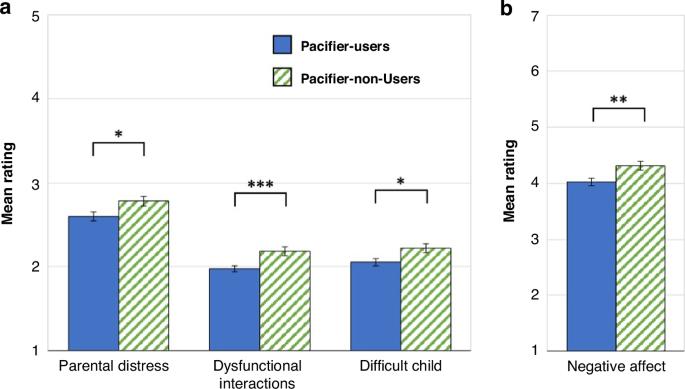
Social and familial consequences of pacifier use remain poorly understood. The present study attempts to shed more light on the characteristics of parents using pacifiers with their infants and to explore how pacifier use affects perceptions of infant emotionality, maternal stress, and parental efficacy. The study sample consisted of 428 mothers (range: 17–49 years) of infants (0–36 months) who completed a comprehensive questionnaire assessing infant and parent characteristics as well as parenting practices and pacifier use. We compared attitudes toward pacifiers, parenting stress, children’s levels of reactivity and self-regulation, and maternal efficacy among Pacifier Users, Never-Users, and families that Tried-Pacifiers. The reported results reveal benefits of pacifier use for the family relationships, namely reduced parenting stress (p = 0.018), better parent-child dynamics (p < 0.001), and more positive perceptions of child’s affectivity (p = 0.006), which are all important aspects of infant development. Our findings highlight developmental benefits of pacifier use, a practice that is known to have both positive and negative long-term consequences for healthy child development. It is, therefore, important for health professionals to have discussions about the pros and cons of pacifier use with parents.
期刊介绍:
Pediatric Research publishes original papers, invited reviews, and commentaries on the etiologies of children''s diseases and
disorders of development, extending from molecular biology to epidemiology. Use of model organisms and in vitro techniques
relevant to developmental biology and medicine are acceptable, as are translational human studies



 京公网安备 11010802042870号
京ICP备2023020795号-1
京公网安备 11010802042870号
京ICP备2023020795号-1

 分享
分享
 求助内容:
求助内容: 应助结果提醒方式:
 扫码关注我们
