Alexandra Vassilieva, Markus Harboe Olsen, Jane Skjøth-Rasmussen, Kirsten Møller, Martin Kryspin Sørensen
{"title":"Arterial to jugular-bulb lactate difference in patients undergoing elective brain tumor craniotomy.","authors":"Alexandra Vassilieva, Markus Harboe Olsen, Jane Skjøth-Rasmussen, Kirsten Møller, Martin Kryspin Sørensen","doi":"10.14814/phy2.70084","DOIUrl":null,"url":null,"abstract":"<p><p>Hyperlactatemia is common during tumor craniotomy, but the underlying pathophysiology is unclear. This study measured simultaneous arterial and jugular-bulb lactate concentrations in patients undergoing brain tumor craniotomy to investigate the hypothesis that hyperlactatemia was associated with a net cerebrovascular lactate input. In 20 patients, arterial and jugular-bulb blood was collected hourly from the start of surgery to 6 h postoperatively for measurement of lactate, glucose, and oxygen concentration. For each marker, data were analyzed using a linear mixed-effects model with jugular-bulb concentration as dependent variable, arterial concentration as fixed effect, and patient as random effect. Furthermore, we generated regression lines between arterial and jugular-bulb concentrations. The slope of the regression line between arterial and jugular-bulb lactate was 0.95 (95% CI 0.93-0.97, R<sup>2</sup> = 0.98), indicating that increasing arterial lactate levels were associated with an increasingly positive net cerebrovascular balance (net input). The line crossed the identity line at 2.86 (95% CI 0.57-5.16) mmol/L, indicating that lower levels of lactate were associated with a negative net cerebrovascular balance (net output). This suggests a switch from net lactate output during normolactatemia towards net input during hyperlactatemia. Hyperlactatemia in tumor-craniotomy patients probably does not originate from the brain.</p>","PeriodicalId":20083,"journal":{"name":"Physiological Reports","volume":"12 20","pages":"e70084"},"PeriodicalIF":2.2000,"publicationDate":"2024-10-01","publicationTypes":"Journal Article","fieldsOfStudy":null,"isOpenAccess":false,"openAccessPdf":"https://www.ncbi.nlm.nih.gov/pmc/articles/PMC11483513/pdf/","citationCount":"0","resultStr":null,"platform":"Semanticscholar","paperid":null,"PeriodicalName":"Physiological Reports","FirstCategoryId":"1085","ListUrlMain":"https://doi.org/10.14814/phy2.70084","RegionNum":0,"RegionCategory":null,"ArticlePicture":[],"TitleCN":null,"AbstractTextCN":null,"PMCID":null,"EPubDate":"","PubModel":"","JCR":"Q3","JCRName":"PHYSIOLOGY","Score":null,"Total":0}
引用次数: 0
Abstract
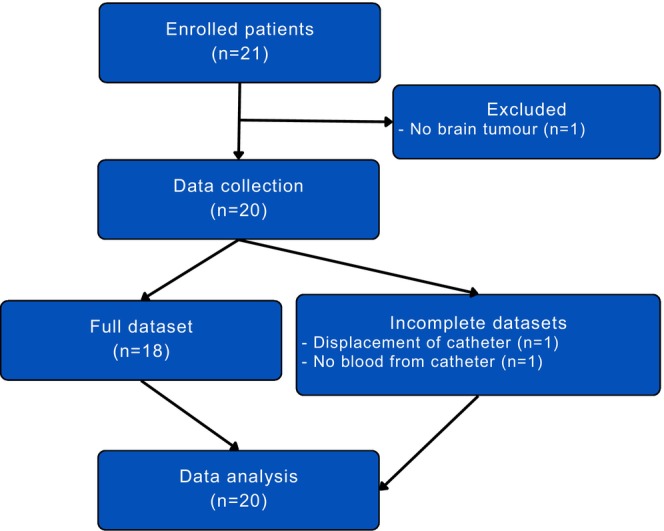
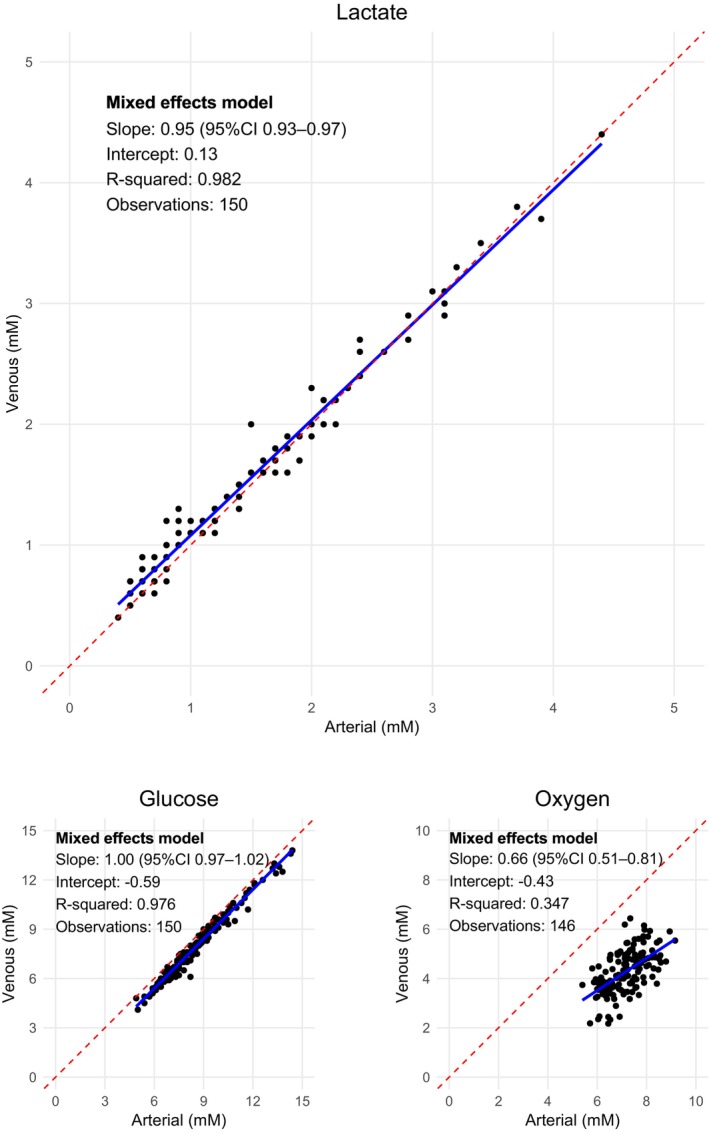
Hyperlactatemia is common during tumor craniotomy, but the underlying pathophysiology is unclear. This study measured simultaneous arterial and jugular-bulb lactate concentrations in patients undergoing brain tumor craniotomy to investigate the hypothesis that hyperlactatemia was associated with a net cerebrovascular lactate input. In 20 patients, arterial and jugular-bulb blood was collected hourly from the start of surgery to 6 h postoperatively for measurement of lactate, glucose, and oxygen concentration. For each marker, data were analyzed using a linear mixed-effects model with jugular-bulb concentration as dependent variable, arterial concentration as fixed effect, and patient as random effect. Furthermore, we generated regression lines between arterial and jugular-bulb concentrations. The slope of the regression line between arterial and jugular-bulb lactate was 0.95 (95% CI 0.93-0.97, R2 = 0.98), indicating that increasing arterial lactate levels were associated with an increasingly positive net cerebrovascular balance (net input). The line crossed the identity line at 2.86 (95% CI 0.57-5.16) mmol/L, indicating that lower levels of lactate were associated with a negative net cerebrovascular balance (net output). This suggests a switch from net lactate output during normolactatemia towards net input during hyperlactatemia. Hyperlactatemia in tumor-craniotomy patients probably does not originate from the brain.
期刊介绍:
Physiological Reports is an online only, open access journal that will publish peer reviewed research across all areas of basic, translational, and clinical physiology and allied disciplines. Physiological Reports is a collaboration between The Physiological Society and the American Physiological Society, and is therefore in a unique position to serve the international physiology community through quick time to publication while upholding a quality standard of sound research that constitutes a useful contribution to the field.





 京公网安备 11010802042870号
京ICP备2023020795号-1
京公网安备 11010802042870号
京ICP备2023020795号-1

 分享
分享
 求助内容:
求助内容: 应助结果提醒方式:
 扫码关注我们
