Elsayed Desouky, Peter Tsambarlis, Laurence A Levine
{"title":"Comparing 0.05% chlorhexidine gluconate monotherapy to conventional antibiotic irrigation in <i>de-novo</i> penile prosthesis implantation: a two-center prospective randomized controlled non-inferiority study (preliminary results).","authors":"Elsayed Desouky, Peter Tsambarlis, Laurence A Levine","doi":"10.21037/tau-24-278","DOIUrl":null,"url":null,"abstract":"<p><strong>Background: </strong>Infection remains a significant concern following penile prosthesis (PP) implantation surgery. Published guidelines have indicated the use of pre-operative intravenous (IV) antibiotics but have not provided specific recommendations regarding intra-operative irrigation. For long in our practice, we have been using a combination of antibiotics for irrigation (rifampin 600 mg/L of sterile water, gentamicin 80 mg/L of sterile water). Recently, 0.05% chlorhexidine gluconate (CHG) (Irrisept<sup>®</sup>) (Irrimax Corp, Lawrenceville, GA, USA), has shown promise as an alternative irrigant, with potential advantages in terms of cost, ease of administration and reduced antibiotic resistance risk. The study aims to assess the non-inferiority of CHG antiseptic irrigation compared to conventional combined antibiotic irrigation in preventing postoperative infections for men undergoing de-novo PP implantation.</p><p><strong>Methods: </strong>This is a two-center Institutional Review Board (IRB) approved prospective randomized controlled non inferiority trial, involving men undergoing de-novo PP implantation with a predetermined non-inferiority margin of 4%. Patients were randomly assigned into one of two groups: the CHG irrigation or the group receiving conventional antibiotic irrigation. All patients received IV antibiotics preoperatively and were sent home on oral antibiotics for 2 weeks post-operatively. The primary endpoint of this trial was to evaluate the incidence of PP infections. Secondary objectives encompassed the assessment of simplicity of use and cost-effectiveness.</p><p><strong>Results: </strong>A hundred patients were enrolled in our study so far (50 in each arm). Only one case of PP infection necessitating explanation was reported in each arm. Moreover, the use of CHG irrigation offered the potential advantages of ease of administration and less cost as compared to antibiotic irrigation solutions.</p><p><strong>Conclusions: </strong>Preliminary data from this non-inferiority study demonstrate that CHG irrigation is non-inferior to conventional antibiotic irrigation in preventing postoperative infection following PP implantation. These findings support the consideration of CHG irrigation as a viable alternative during PP implantation, offering both clinical effectiveness and potential cost savings as well as reducing the risk of antibiotic resistance.</p><p><strong>Trial registration: </strong>ClinicalTrials.gov NCT06489431.</p>","PeriodicalId":23270,"journal":{"name":"Translational andrology and urology","volume":"13 9","pages":"1905-1911"},"PeriodicalIF":1.9000,"publicationDate":"2024-09-30","publicationTypes":"Journal Article","fieldsOfStudy":null,"isOpenAccess":false,"openAccessPdf":"https://www.ncbi.nlm.nih.gov/pmc/articles/PMC11491223/pdf/","citationCount":"0","resultStr":null,"platform":"Semanticscholar","paperid":null,"PeriodicalName":"Translational andrology and urology","FirstCategoryId":"3","ListUrlMain":"https://doi.org/10.21037/tau-24-278","RegionNum":3,"RegionCategory":"医学","ArticlePicture":[],"TitleCN":null,"AbstractTextCN":null,"PMCID":null,"EPubDate":"2024/9/26 0:00:00","PubModel":"Epub","JCR":"Q4","JCRName":"ANDROLOGY","Score":null,"Total":0}
引用次数: 0
Abstract
Background: Infection remains a significant concern following penile prosthesis (PP) implantation surgery. Published guidelines have indicated the use of pre-operative intravenous (IV) antibiotics but have not provided specific recommendations regarding intra-operative irrigation. For long in our practice, we have been using a combination of antibiotics for irrigation (rifampin 600 mg/L of sterile water, gentamicin 80 mg/L of sterile water). Recently, 0.05% chlorhexidine gluconate (CHG) (Irrisept®) (Irrimax Corp, Lawrenceville, GA, USA), has shown promise as an alternative irrigant, with potential advantages in terms of cost, ease of administration and reduced antibiotic resistance risk. The study aims to assess the non-inferiority of CHG antiseptic irrigation compared to conventional combined antibiotic irrigation in preventing postoperative infections for men undergoing de-novo PP implantation.
Methods: This is a two-center Institutional Review Board (IRB) approved prospective randomized controlled non inferiority trial, involving men undergoing de-novo PP implantation with a predetermined non-inferiority margin of 4%. Patients were randomly assigned into one of two groups: the CHG irrigation or the group receiving conventional antibiotic irrigation. All patients received IV antibiotics preoperatively and were sent home on oral antibiotics for 2 weeks post-operatively. The primary endpoint of this trial was to evaluate the incidence of PP infections. Secondary objectives encompassed the assessment of simplicity of use and cost-effectiveness.
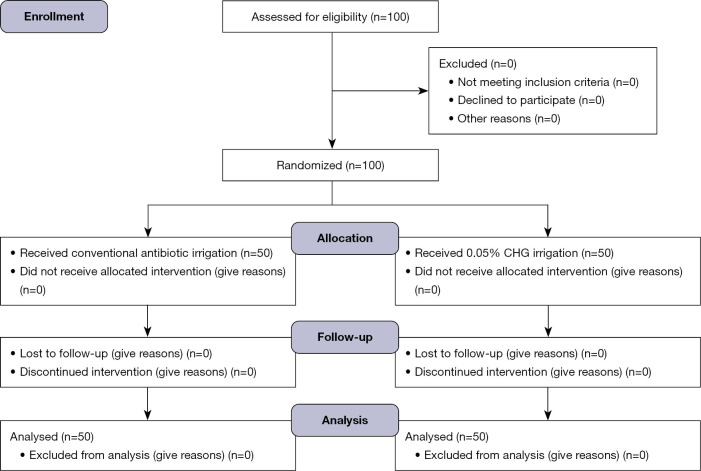
Results: A hundred patients were enrolled in our study so far (50 in each arm). Only one case of PP infection necessitating explanation was reported in each arm. Moreover, the use of CHG irrigation offered the potential advantages of ease of administration and less cost as compared to antibiotic irrigation solutions.
Conclusions: Preliminary data from this non-inferiority study demonstrate that CHG irrigation is non-inferior to conventional antibiotic irrigation in preventing postoperative infection following PP implantation. These findings support the consideration of CHG irrigation as a viable alternative during PP implantation, offering both clinical effectiveness and potential cost savings as well as reducing the risk of antibiotic resistance.
期刊介绍:
ranslational Andrology and Urology (Print ISSN 2223-4683; Online ISSN 2223-4691; Transl Androl Urol; TAU) is an open access, peer-reviewed, bi-monthly journal (quarterly published from Mar.2012 - Dec. 2014). The main focus of the journal is to describe new findings in the field of translational research of Andrology and Urology, provides current and practical information on basic research and clinical investigations of Andrology and Urology. Specific areas of interest include, but not limited to, molecular study, pathology, biology and technical advances related to andrology and urology. Topics cover range from evaluation, prevention, diagnosis, therapy, prognosis, rehabilitation and future challenges to urology and andrology. Contributions pertinent to urology and andrology are also included from related fields such as public health, basic sciences, education, sociology, and nursing.




 京公网安备 11010802042870号
京ICP备2023020795号-1
京公网安备 11010802042870号
京ICP备2023020795号-1

 分享
分享
 求助内容:
求助内容: 应助结果提醒方式:
 扫码关注我们
