{"title":"Resolved Chronic Non-Healing Ulcer After Distal Radius Giant Cell Tumor Resection: Nursing Experience and Wound Care.","authors":"Yiming Lin, Huiling Li, Jun Zhao","doi":"10.12659/AJCR.944971","DOIUrl":null,"url":null,"abstract":"<p><p>BACKGROUND Giant cell tumors of bone typically occur in early adulthood, when the growth plate has closed. The distal radius is the second most common location affected, accounting for 10% to 12% of cases. Complications of poor soft tissue healing are rare in the distal radius, owing to its rich blood supply. However, the curettage procedure and use of bone cement and external fixation can affect the local blood supply. CASE REPORT We present a rare case of a 24-year-old woman with no significant medical history who underwent surgery at a local hospital to treat a giant cell tumor of the radius. During postoperative wound dressing changes, a 4×3-cm area of flushed skin color with a small blister and reduced local sensation was found on the dorsal side of the wrist. The skin condition worsened despite treatment at the surgical outpatient clinic, leading to referral to scar specialist outpatient treatment. Examination revealed a well-healed surgical scar on the palmar side of the wrist, but a skin defect with necrotic tissue and tendon exposure on the dorsal side. The diagnosis was postoperative soft tissue necrosis of the skin with a giant cell tumor of the bone. CONCLUSIONS This case report discusses the management of chronic non-healing postoperative wounds in giant cell tumors of the distal radius. It emphasizes the importance of appropriate dressing changes, selecting suitable dressings, nutritional support, and effective nurse-patient communication. The case serves as an example of best practices for managing these types of wounds.</p>","PeriodicalId":39064,"journal":{"name":"American Journal of Case Reports","volume":"25 ","pages":"e944971"},"PeriodicalIF":0.7000,"publicationDate":"2024-10-20","publicationTypes":"Journal Article","fieldsOfStudy":null,"isOpenAccess":false,"openAccessPdf":"https://www.ncbi.nlm.nih.gov/pmc/articles/PMC11502519/pdf/","citationCount":"0","resultStr":null,"platform":"Semanticscholar","paperid":null,"PeriodicalName":"American Journal of Case Reports","FirstCategoryId":"1085","ListUrlMain":"https://doi.org/10.12659/AJCR.944971","RegionNum":0,"RegionCategory":null,"ArticlePicture":[],"TitleCN":null,"AbstractTextCN":null,"PMCID":null,"EPubDate":"","PubModel":"","JCR":"Q3","JCRName":"MEDICINE, GENERAL & INTERNAL","Score":null,"Total":0}
引用次数: 0
Abstract
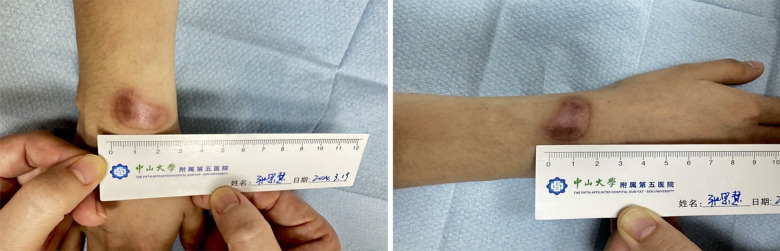
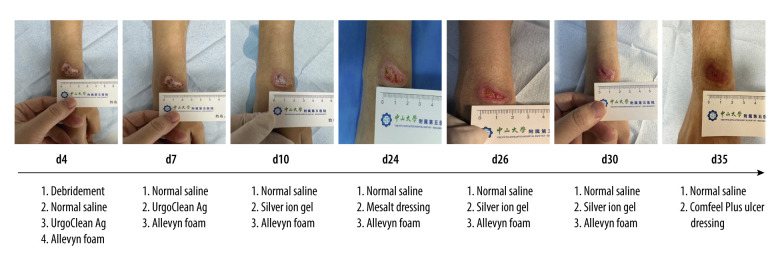
BACKGROUND Giant cell tumors of bone typically occur in early adulthood, when the growth plate has closed. The distal radius is the second most common location affected, accounting for 10% to 12% of cases. Complications of poor soft tissue healing are rare in the distal radius, owing to its rich blood supply. However, the curettage procedure and use of bone cement and external fixation can affect the local blood supply. CASE REPORT We present a rare case of a 24-year-old woman with no significant medical history who underwent surgery at a local hospital to treat a giant cell tumor of the radius. During postoperative wound dressing changes, a 4×3-cm area of flushed skin color with a small blister and reduced local sensation was found on the dorsal side of the wrist. The skin condition worsened despite treatment at the surgical outpatient clinic, leading to referral to scar specialist outpatient treatment. Examination revealed a well-healed surgical scar on the palmar side of the wrist, but a skin defect with necrotic tissue and tendon exposure on the dorsal side. The diagnosis was postoperative soft tissue necrosis of the skin with a giant cell tumor of the bone. CONCLUSIONS This case report discusses the management of chronic non-healing postoperative wounds in giant cell tumors of the distal radius. It emphasizes the importance of appropriate dressing changes, selecting suitable dressings, nutritional support, and effective nurse-patient communication. The case serves as an example of best practices for managing these types of wounds.
期刊介绍:
American Journal of Case Reports is an international, peer-reviewed scientific journal that publishes single and series case reports in all medical fields. American Journal of Case Reports is issued on a continuous basis as a primary electronic journal. Print copies of a single article or a set of articles can be ordered on demand.





 京公网安备 11010802042870号
京ICP备2023020795号-1
京公网安备 11010802042870号
京ICP备2023020795号-1

 分享
分享
 求助内容:
求助内容: 应助结果提醒方式:
 扫码关注我们
