Francesca Laneri, Cristina Parisi, Marta Maria Natile and Salvatore Sortino
{"title":"Electronic interaction-enhanced NO photorelease and photothermal conversion in N-doped carbon dot nanoconjugates","authors":"Francesca Laneri, Cristina Parisi, Marta Maria Natile and Salvatore Sortino","doi":"10.1039/D4TB01264J","DOIUrl":null,"url":null,"abstract":"<p >A nitric oxide (NO) photodonor (<strong>1</strong>) capable of releasing two NO molecules through a stepwise mechanism has been covalently grafted to blue-emitting N-doped carbon dots (<strong>NCDs</strong>). The resulting water-soluble nanoconjugate (<strong>NCDs-1</strong>), <em>ca.</em> 10 nm in diameter, exhibits a new absorption band not present in the simple physical mixture of the two components and is attributable to strong electronic interactions between them in the ground state. Blue light excitation of <strong>NCDs-1</strong> leads to NO photogeneration with an efficiency almost one order of magnitude higher than that observed for <strong>1</strong> alone, probably due to a photoinduced electron transfer between the <strong>NCDs</strong> and the grafted <strong>1</strong>. Photoexcitation of the nanoconjugate also results in effective photothermal conversion, which is negligible in the naked <strong>NCDs</strong>. Furthermore, in contrast to <strong>1</strong>, the nanoconjugate liberates NO also under excitation with green light. Finally, the typical blue fluorescence of the <strong>NCDs</strong> is quenched in <strong>NCDs-1</strong> but restored upon the photouncaging of the second NO molecule, providing readable and real-time information about the amount of NO photogenerated.</p>","PeriodicalId":83,"journal":{"name":"Journal of Materials Chemistry B","volume":" 45","pages":" 11817-11825"},"PeriodicalIF":6.1000,"publicationDate":"2024-10-10","publicationTypes":"Journal Article","fieldsOfStudy":null,"isOpenAccess":false,"openAccessPdf":"https://pubs.rsc.org/en/content/articlepdf/2024/tb/d4tb01264j?page=search","citationCount":"0","resultStr":null,"platform":"Semanticscholar","paperid":null,"PeriodicalName":"Journal of Materials Chemistry B","FirstCategoryId":"1","ListUrlMain":"https://pubs.rsc.org/en/content/articlelanding/2024/tb/d4tb01264j","RegionNum":3,"RegionCategory":"医学","ArticlePicture":[],"TitleCN":null,"AbstractTextCN":null,"PMCID":null,"EPubDate":"","PubModel":"","JCR":"Q1","JCRName":"MATERIALS SCIENCE, BIOMATERIALS","Score":null,"Total":0}
引用次数: 0
Abstract
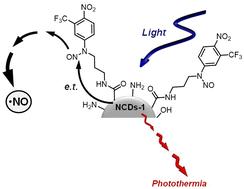
A nitric oxide (NO) photodonor (1) capable of releasing two NO molecules through a stepwise mechanism has been covalently grafted to blue-emitting N-doped carbon dots (NCDs). The resulting water-soluble nanoconjugate (NCDs-1), ca. 10 nm in diameter, exhibits a new absorption band not present in the simple physical mixture of the two components and is attributable to strong electronic interactions between them in the ground state. Blue light excitation of NCDs-1 leads to NO photogeneration with an efficiency almost one order of magnitude higher than that observed for 1 alone, probably due to a photoinduced electron transfer between the NCDs and the grafted 1. Photoexcitation of the nanoconjugate also results in effective photothermal conversion, which is negligible in the naked NCDs. Furthermore, in contrast to 1, the nanoconjugate liberates NO also under excitation with green light. Finally, the typical blue fluorescence of the NCDs is quenched in NCDs-1 but restored upon the photouncaging of the second NO molecule, providing readable and real-time information about the amount of NO photogenerated.
期刊介绍:
Journal of Materials Chemistry A, B & C cover high quality studies across all fields of materials chemistry. The journals focus on those theoretical or experimental studies that report new understanding, applications, properties and synthesis of materials. Journal of Materials Chemistry A, B & C are separated by the intended application of the material studied. Broadly, applications in energy and sustainability are of interest to Journal of Materials Chemistry A, applications in biology and medicine are of interest to Journal of Materials Chemistry B, and applications in optical, magnetic and electronic devices are of interest to Journal of Materials Chemistry C.Journal of Materials Chemistry B is a Transformative Journal and Plan S compliant. Example topic areas within the scope of Journal of Materials Chemistry B are listed below. This list is neither exhaustive nor exclusive:
Antifouling coatings
Biocompatible materials
Bioelectronics
Bioimaging
Biomimetics
Biomineralisation
Bionics
Biosensors
Diagnostics
Drug delivery
Gene delivery
Immunobiology
Nanomedicine
Regenerative medicine & Tissue engineering
Scaffolds
Soft robotics
Stem cells
Therapeutic devices



 京公网安备 11010802042870号
京ICP备2023020795号-1
京公网安备 11010802042870号
京ICP备2023020795号-1

 分享
分享
 求助内容:
求助内容: 应助结果提醒方式:
 扫码关注我们
