Recognizing the reactive sites of SnFe2O4 for the oxygen evolution reaction: the synergistic effect of SnII and FeIII in stabilizing reaction intermediates†
Anubha Rajput, Pandiyan Sivasakthi, Pralok K. Samanta and Biswarup Chakraborty
{"title":"Recognizing the reactive sites of SnFe2O4 for the oxygen evolution reaction: the synergistic effect of SnII and FeIII in stabilizing reaction intermediates†","authors":"Anubha Rajput, Pandiyan Sivasakthi, Pralok K. Samanta and Biswarup Chakraborty","doi":"10.1039/D4NR03107E","DOIUrl":null,"url":null,"abstract":"<p >Among the reported spinel ferrites, the p-block metal containing SnFe<small><sub>2</sub></small>O<small><sub>4</sub></small> is scarcely explored, but it is a promising water-splitting electrocatalyst. This study focuses on the reaction kinetics and atomic scale insight of the reaction mechanism of the oxygen evolution reaction (OER) catalyzed by SnFe<small><sub>2</sub></small>O<small><sub>4</sub></small> and analogous Fe<small><sub>3</sub></small>O<small><sub>4</sub></small>. The replacement of Fe<small><sup>II</sup></small><small><sub>Oh</sub></small> sites with Sn<small><sup>II</sup></small><small><sub>Oh</sub></small> in SnFe<small><sub>2</sub></small>O<small><sub>4</sub></small> improves the catalytic efficiency and various intrinsic parameters affecting the reaction kinetics. The variable temperature OER depicts a low activation energy (<em>E</em><small><sub>a</sub></small>) of 28.71 kJ mol<small><sup>−1</sup></small> on SnFe<small><sub>2</sub></small>O<small><sub>4</sub></small>. Experimentally determined second-order dependence on [OH<small><sup>−</sup></small>] and the prominent kinetic isotope effect observed during the deuterium labelling study implies the role of hydroxide ions in the rate-determining step (RDS). Using density functional theory, the reaction mechanism on the (001) surface of SnFe<small><sub>2</sub></small>O<small><sub>4</sub></small> and Fe<small><sub>3</sub></small>O<small><sub>4</sub></small> is modelled. The DFT simulated free energy diagram for the reaction intermediates shows an adsorbate evolution mechanism (AEM) on both the ferrites' surfaces where the formation of *OOH is the RDS on SnFe<small><sub>2</sub></small>O<small><sub>4</sub></small> while *O formation is the RDS on Fe<small><sub>3</sub></small>O<small><sub>4</sub></small>. In contrast to other spinel ferrites, where individual metal sites act independently, in case of SnFe<small><sub>2</sub></small>O<small><sub>4</sub></small>, a synergy between Fe<small><sup>III</sup></small><small><sub>Oh</sub></small> and the neighbouring Sn<small><sup>II</sup></small><small><sub>Oh</sub></small> atoms is responsible for stabilizing the OER intermediates, enhancing the catalytic OER activity of SnFe<small><sub>2</sub></small>O<small><sub>4</sub></small> as compared to isostructural Fe<small><sub>3</sub></small>O<small><sub>4</sub></small>.</p>","PeriodicalId":92,"journal":{"name":"Nanoscale","volume":" 46","pages":" 21388-21397"},"PeriodicalIF":5.1000,"publicationDate":"2024-10-22","publicationTypes":"Journal Article","fieldsOfStudy":null,"isOpenAccess":false,"openAccessPdf":"","citationCount":"0","resultStr":null,"platform":"Semanticscholar","paperid":null,"PeriodicalName":"Nanoscale","FirstCategoryId":"88","ListUrlMain":"https://pubs.rsc.org/en/content/articlelanding/2024/nr/d4nr03107e","RegionNum":3,"RegionCategory":"材料科学","ArticlePicture":[],"TitleCN":null,"AbstractTextCN":null,"PMCID":null,"EPubDate":"","PubModel":"","JCR":"Q1","JCRName":"CHEMISTRY, MULTIDISCIPLINARY","Score":null,"Total":0}
引用次数: 0
Abstract
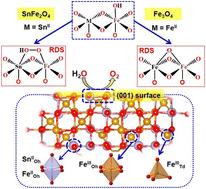
Among the reported spinel ferrites, the p-block metal containing SnFe2O4 is scarcely explored, but it is a promising water-splitting electrocatalyst. This study focuses on the reaction kinetics and atomic scale insight of the reaction mechanism of the oxygen evolution reaction (OER) catalyzed by SnFe2O4 and analogous Fe3O4. The replacement of FeIIOh sites with SnIIOh in SnFe2O4 improves the catalytic efficiency and various intrinsic parameters affecting the reaction kinetics. The variable temperature OER depicts a low activation energy (Ea) of 28.71 kJ mol−1 on SnFe2O4. Experimentally determined second-order dependence on [OH−] and the prominent kinetic isotope effect observed during the deuterium labelling study implies the role of hydroxide ions in the rate-determining step (RDS). Using density functional theory, the reaction mechanism on the (001) surface of SnFe2O4 and Fe3O4 is modelled. The DFT simulated free energy diagram for the reaction intermediates shows an adsorbate evolution mechanism (AEM) on both the ferrites' surfaces where the formation of *OOH is the RDS on SnFe2O4 while *O formation is the RDS on Fe3O4. In contrast to other spinel ferrites, where individual metal sites act independently, in case of SnFe2O4, a synergy between FeIIIOh and the neighbouring SnIIOh atoms is responsible for stabilizing the OER intermediates, enhancing the catalytic OER activity of SnFe2O4 as compared to isostructural Fe3O4.
期刊介绍:
Nanoscale is a high-impact international journal, publishing high-quality research across nanoscience and nanotechnology. Nanoscale publishes a full mix of research articles on experimental and theoretical work, including reviews, communications, and full papers.Highly interdisciplinary, this journal appeals to scientists, researchers and professionals interested in nanoscience and nanotechnology, quantum materials and quantum technology, including the areas of physics, chemistry, biology, medicine, materials, energy/environment, information technology, detection science, healthcare and drug discovery, and electronics.



 京公网安备 11010802042870号
京ICP备2023020795号-1
京公网安备 11010802042870号
京ICP备2023020795号-1

 分享
分享
 求助内容:
求助内容: 应助结果提醒方式:
 扫码关注我们
