{"title":"Interwoven Trimeric Cage-Catenanes with Topological Chirality","authors":"Lihua Chen, Zhenghong Chen, Weihao Wang, Chenhao Chen, Yoshiaki Kuboi, Chi Zhang, Chenfei Li, Shaodong Zhang","doi":"10.1021/jacs.4c10104","DOIUrl":null,"url":null,"abstract":"Catenanes have gained increasing attention for their unique features such as topological chirality. To date, the majority of works have focused on catenanes comprising monocyclic rings. Due to the lack of efficient synthetic strategy, catenanes of multiannulated monomers remain scarce. Here, we report the one-pot synthesis of an interwoven trimeric cage-catenane in high yield by dynamic imine condensation between diamine linkers of suitable length and trialdehyde panels in stoichiometry. The formation of cage-catenane is driven by the efficient 6-fold π–π stacking of panels. The monomeric cage and trimeric cage-catenane are interconvertible with reversible imine chemistry, with the latter thermodynamically being more favored. Using a topology-based statistical model, we first reveal that the formation probability of the interwoven catenane surpasses that of its chain-like isomer by 20%. When this pure mathematical model is refined by taking into account the strong template effect provided by the π–π stacking of aromatic panels, it shows that the interwoven structure emerges as the dominant species, almost ruling out the formation of the latter. Although composed of achiral cage monomers, the topological chirality of the interwoven trimeric catenane is unraveled by chiral-high-performance liquid chromatography (HPLC) and circular dichroism (CD) spectroscopy, and single-crystal X-ray diffraction (XRD) analysis of the interwoven cage-catenane also reveals a pair of two topological enantiomers. Our probability analysis-aided rationale would provide a design rationale for guiding the efficient synthesis of topologically sophisticated structures.","PeriodicalId":49,"journal":{"name":"Journal of the American Chemical Society","volume":"3 1","pages":""},"PeriodicalIF":15.6000,"publicationDate":"2024-10-22","publicationTypes":"Journal Article","fieldsOfStudy":null,"isOpenAccess":false,"openAccessPdf":"","citationCount":"0","resultStr":null,"platform":"Semanticscholar","paperid":null,"PeriodicalName":"Journal of the American Chemical Society","FirstCategoryId":"92","ListUrlMain":"https://doi.org/10.1021/jacs.4c10104","RegionNum":1,"RegionCategory":"化学","ArticlePicture":[],"TitleCN":null,"AbstractTextCN":null,"PMCID":null,"EPubDate":"","PubModel":"","JCR":"Q1","JCRName":"CHEMISTRY, MULTIDISCIPLINARY","Score":null,"Total":0}
引用次数: 0
Abstract
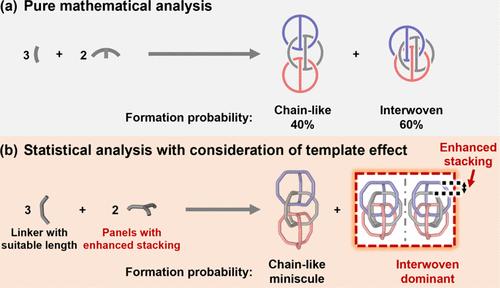
Catenanes have gained increasing attention for their unique features such as topological chirality. To date, the majority of works have focused on catenanes comprising monocyclic rings. Due to the lack of efficient synthetic strategy, catenanes of multiannulated monomers remain scarce. Here, we report the one-pot synthesis of an interwoven trimeric cage-catenane in high yield by dynamic imine condensation between diamine linkers of suitable length and trialdehyde panels in stoichiometry. The formation of cage-catenane is driven by the efficient 6-fold π–π stacking of panels. The monomeric cage and trimeric cage-catenane are interconvertible with reversible imine chemistry, with the latter thermodynamically being more favored. Using a topology-based statistical model, we first reveal that the formation probability of the interwoven catenane surpasses that of its chain-like isomer by 20%. When this pure mathematical model is refined by taking into account the strong template effect provided by the π–π stacking of aromatic panels, it shows that the interwoven structure emerges as the dominant species, almost ruling out the formation of the latter. Although composed of achiral cage monomers, the topological chirality of the interwoven trimeric catenane is unraveled by chiral-high-performance liquid chromatography (HPLC) and circular dichroism (CD) spectroscopy, and single-crystal X-ray diffraction (XRD) analysis of the interwoven cage-catenane also reveals a pair of two topological enantiomers. Our probability analysis-aided rationale would provide a design rationale for guiding the efficient synthesis of topologically sophisticated structures.
期刊介绍:
The flagship journal of the American Chemical Society, known as the Journal of the American Chemical Society (JACS), has been a prestigious publication since its establishment in 1879. It holds a preeminent position in the field of chemistry and related interdisciplinary sciences. JACS is committed to disseminating cutting-edge research papers, covering a wide range of topics, and encompasses approximately 19,000 pages of Articles, Communications, and Perspectives annually. With a weekly publication frequency, JACS plays a vital role in advancing the field of chemistry by providing essential research.



 京公网安备 11010802042870号
京ICP备2023020795号-1
京公网安备 11010802042870号
京ICP备2023020795号-1

 分享
分享
 求助内容:
求助内容: 应助结果提醒方式:
 扫码关注我们
