Weihao Li, Johannes Döhn, Jinyu Chen, Manuel Dillenz, Mohsen Sotoudeh, David M. Pickup, Shunrui Luo, Ryan Parmenter, Jordi Arbiol, Maria Alfredsson, Alan V. Chadwick, Axel Groß, Maider Zarrabeitia and Alexey Y. Ganin
{"title":"Reversible K-ion intercalation in CrSe2 cathodes for potassium-ion batteries: combined operando PXRD and DFT studies†","authors":"Weihao Li, Johannes Döhn, Jinyu Chen, Manuel Dillenz, Mohsen Sotoudeh, David M. Pickup, Shunrui Luo, Ryan Parmenter, Jordi Arbiol, Maria Alfredsson, Alan V. Chadwick, Axel Groß, Maider Zarrabeitia and Alexey Y. Ganin","doi":"10.1039/D4TA05114A","DOIUrl":null,"url":null,"abstract":"<p >In the pursuit of more affordable battery technologies, potassium-ion batteries (KIBs) have emerged as a promising alternative to lithium-ion systems, owing to the abundance and wide distribution of potassium resources. While chalcogenides are uncommon as intercalation cathodes in KIBs, this study's electrochemical tests on CrSe<small><sub>2</sub></small> revealed a reversible K<small><sup>+</sup></small> intercalation/deintercalation process. The CrSe<small><sub>2</sub></small> cathode achieved a KIB battery capacity of 125 mA h g<small><sup>−1</sup></small> at a 0.1C rate within a practical 1–3.5 V <em>vs.</em> K<small><sup>+</sup></small>/K operation range, nearly matching the theoretical capacity of 127.7 mA h g<small><sup>−1</sup></small>. Notably, the battery retained 85% of its initial capacity at a high 1C rate, suggesting that CrSe<small><sub>2</sub></small> is competitive for high-power applications with many current state-of-the-art cathodes. <em>In-operando</em> PXRD studies uncovered the nature of the intercalation behavior, revealing an initial biphasic region followed by a solid-solution formation during the potassium intercalation process. DFT calculations helped with the possible assignment of intermediate phase structures across the entire CrSe<small><sub>2</sub></small>–K<small><sub>1.0</sub></small>CrSe<small><sub>2</sub></small> composition range, providing insights into the experimentally observed phase transformations. The results of this work underscore CrSe<small><sub>2</sub></small>'s potential as a high-performance cathode material for KIBs, offering valuable insights into the intercalation mechanisms of layered transition metal chalcogenides and paving the way for future advancements in optimizing KIB cathodes.</p>","PeriodicalId":82,"journal":{"name":"Journal of Materials Chemistry A","volume":" 45","pages":" 31276-31283"},"PeriodicalIF":9.5000,"publicationDate":"2024-10-23","publicationTypes":"Journal Article","fieldsOfStudy":null,"isOpenAccess":false,"openAccessPdf":"https://pubs.rsc.org/en/content/articlepdf/2024/ta/d4ta05114a?page=search","citationCount":"0","resultStr":null,"platform":"Semanticscholar","paperid":null,"PeriodicalName":"Journal of Materials Chemistry A","FirstCategoryId":"88","ListUrlMain":"https://pubs.rsc.org/en/content/articlelanding/2024/ta/d4ta05114a","RegionNum":2,"RegionCategory":"材料科学","ArticlePicture":[],"TitleCN":null,"AbstractTextCN":null,"PMCID":null,"EPubDate":"","PubModel":"","JCR":"Q1","JCRName":"CHEMISTRY, PHYSICAL","Score":null,"Total":0}
引用次数: 0
Abstract
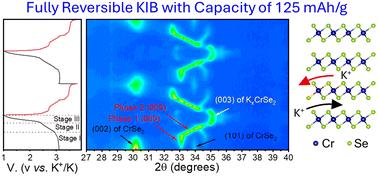
In the pursuit of more affordable battery technologies, potassium-ion batteries (KIBs) have emerged as a promising alternative to lithium-ion systems, owing to the abundance and wide distribution of potassium resources. While chalcogenides are uncommon as intercalation cathodes in KIBs, this study's electrochemical tests on CrSe2 revealed a reversible K+ intercalation/deintercalation process. The CrSe2 cathode achieved a KIB battery capacity of 125 mA h g−1 at a 0.1C rate within a practical 1–3.5 V vs. K+/K operation range, nearly matching the theoretical capacity of 127.7 mA h g−1. Notably, the battery retained 85% of its initial capacity at a high 1C rate, suggesting that CrSe2 is competitive for high-power applications with many current state-of-the-art cathodes. In-operando PXRD studies uncovered the nature of the intercalation behavior, revealing an initial biphasic region followed by a solid-solution formation during the potassium intercalation process. DFT calculations helped with the possible assignment of intermediate phase structures across the entire CrSe2–K1.0CrSe2 composition range, providing insights into the experimentally observed phase transformations. The results of this work underscore CrSe2's potential as a high-performance cathode material for KIBs, offering valuable insights into the intercalation mechanisms of layered transition metal chalcogenides and paving the way for future advancements in optimizing KIB cathodes.
期刊介绍:
The Journal of Materials Chemistry A, B & C covers a wide range of high-quality studies in the field of materials chemistry, with each section focusing on specific applications of the materials studied. Journal of Materials Chemistry A emphasizes applications in energy and sustainability, including topics such as artificial photosynthesis, batteries, and fuel cells. Journal of Materials Chemistry B focuses on applications in biology and medicine, while Journal of Materials Chemistry C covers applications in optical, magnetic, and electronic devices. Example topic areas within the scope of Journal of Materials Chemistry A include catalysis, green/sustainable materials, sensors, and water treatment, among others.



 京公网安备 11010802042870号
京ICP备2023020795号-1
京公网安备 11010802042870号
京ICP备2023020795号-1

 分享
分享
 求助内容:
求助内容: 应助结果提醒方式:
 扫码关注我们
