Ningyuan You, Chang Liu, Yuxin Gu, Rong Wang, Hanying Jia, Tianyun Zhang, Song Jiang, Jinsong Shi, Ming Chen, Min-Xin Guan, Siqi Sun, Shanshan Pei, Zhihong Liu, Ning Shen
{"title":"SpliceTransformer predicts tissue-specific splicing linked to human diseases","authors":"Ningyuan You, Chang Liu, Yuxin Gu, Rong Wang, Hanying Jia, Tianyun Zhang, Song Jiang, Jinsong Shi, Ming Chen, Min-Xin Guan, Siqi Sun, Shanshan Pei, Zhihong Liu, Ning Shen","doi":"10.1038/s41467-024-53088-6","DOIUrl":null,"url":null,"abstract":"<p>We present SpliceTransformer (SpTransformer), a deep-learning framework that predicts tissue-specific RNA splicing alterations linked to human diseases based on genomic sequence. SpTransformer outperforms all previous methods on splicing prediction. Application to approximately 1.3 million genetic variants in the ClinVar database reveals that splicing alterations account for 60% of intronic and synonymous pathogenic mutations, and occur at different frequencies across tissue types. Importantly, tissue-specific splicing alterations match their clinical manifestations independent of gene expression variation. We validate the enrichment in three brain disease datasets involving over 164,000 individuals. Additionally, we identify single nucleotide variations that cause brain-specific splicing alterations, and find disease-associated genes harboring these single nucleotide variations with distinct expression patterns involved in diverse biological processes. Finally, SpTransformer analysis of whole exon sequencing data from blood samples of patients with diabetic nephropathy predicts kidney-specific RNA splicing alterations with 83% accuracy, demonstrating the potential to infer disease-causing tissue-specific splicing events. SpTransformer provides a powerful tool to guide biological and clinical interpretations of human diseases.</p>","PeriodicalId":19066,"journal":{"name":"Nature Communications","volume":"30 1","pages":""},"PeriodicalIF":15.7000,"publicationDate":"2024-10-23","publicationTypes":"Journal Article","fieldsOfStudy":null,"isOpenAccess":false,"openAccessPdf":"","citationCount":"0","resultStr":null,"platform":"Semanticscholar","paperid":null,"PeriodicalName":"Nature Communications","FirstCategoryId":"103","ListUrlMain":"https://doi.org/10.1038/s41467-024-53088-6","RegionNum":1,"RegionCategory":"综合性期刊","ArticlePicture":[],"TitleCN":null,"AbstractTextCN":null,"PMCID":null,"EPubDate":"","PubModel":"","JCR":"Q1","JCRName":"MULTIDISCIPLINARY SCIENCES","Score":null,"Total":0}
引用次数: 0
Abstract
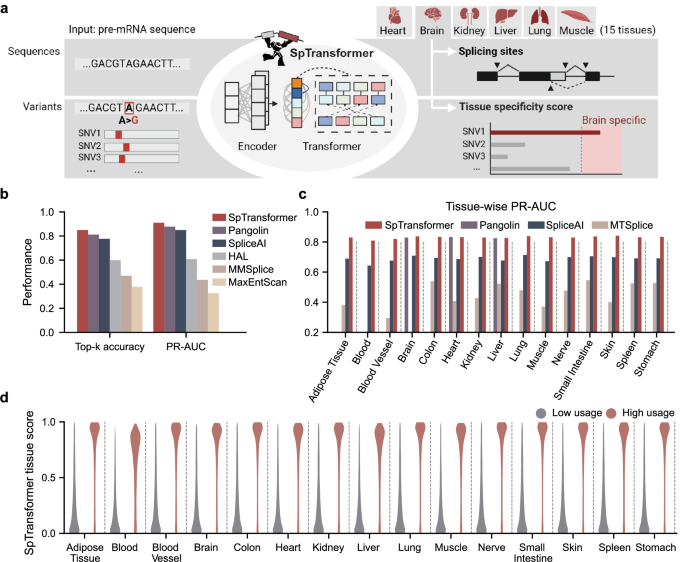
We present SpliceTransformer (SpTransformer), a deep-learning framework that predicts tissue-specific RNA splicing alterations linked to human diseases based on genomic sequence. SpTransformer outperforms all previous methods on splicing prediction. Application to approximately 1.3 million genetic variants in the ClinVar database reveals that splicing alterations account for 60% of intronic and synonymous pathogenic mutations, and occur at different frequencies across tissue types. Importantly, tissue-specific splicing alterations match their clinical manifestations independent of gene expression variation. We validate the enrichment in three brain disease datasets involving over 164,000 individuals. Additionally, we identify single nucleotide variations that cause brain-specific splicing alterations, and find disease-associated genes harboring these single nucleotide variations with distinct expression patterns involved in diverse biological processes. Finally, SpTransformer analysis of whole exon sequencing data from blood samples of patients with diabetic nephropathy predicts kidney-specific RNA splicing alterations with 83% accuracy, demonstrating the potential to infer disease-causing tissue-specific splicing events. SpTransformer provides a powerful tool to guide biological and clinical interpretations of human diseases.
期刊介绍:
Nature Communications, an open-access journal, publishes high-quality research spanning all areas of the natural sciences. Papers featured in the journal showcase significant advances relevant to specialists in each respective field. With a 2-year impact factor of 16.6 (2022) and a median time of 8 days from submission to the first editorial decision, Nature Communications is committed to rapid dissemination of research findings. As a multidisciplinary journal, it welcomes contributions from biological, health, physical, chemical, Earth, social, mathematical, applied, and engineering sciences, aiming to highlight important breakthroughs within each domain.



 京公网安备 11010802042870号
京ICP备2023020795号-1
京公网安备 11010802042870号
京ICP备2023020795号-1

 分享
分享
 求助内容:
求助内容: 应助结果提醒方式:
 扫码关注我们
