Rodolfo G. Gatto, Youssef Hossam, R. Ross Reichard, Val J. Lowe, Jennifer L. Whitwell, Keith A. Josephs
{"title":"Microscopy assessment of a fluorescence [18F] flortaucipir analog (T726) shows neuropathological overlap with 3R and 4R tau lesions","authors":"Rodolfo G. Gatto, Youssef Hossam, R. Ross Reichard, Val J. Lowe, Jennifer L. Whitwell, Keith A. Josephs","doi":"10.1002/alz.14330","DOIUrl":null,"url":null,"abstract":"<div>\n \n \n <section>\n \n <h3> BACKGROUND</h3>\n \n <p>[<sup>18</sup>F] flortaucipir (FTP) binding to paired helical filament (PHF) tau in Alzheimer's disease (AD) is well accepted. Binding to 3R and 4R tau in frontotemporal lobar degeneration (FTLD) is controversial. We aimed to investigate whether an FTP fluorescent analog (T726) can help shed light on this controversy.</p>\n </section>\n \n <section>\n \n <h3> METHOD</h3>\n \n <p>We assessed T726 binding to amyloid beta (Aβ) and different tau isoforms in nine subjects (one control, three with Alzheimer's disease [AD], and five with FTLD) with different 3R and 4R tauopathies using fluorescence confocal microscopy.</p>\n </section>\n \n <section>\n \n <h3> RESULTS</h3>\n \n <p>T726 did not colocalize with Aβ but showed significant co-localization with PHF tau in AD. We also observed some, albeit limited, co-localization of T726 with 3R and 4R tau lesions in FTLD.</p>\n </section>\n \n <section>\n \n <h3> DISCUSSION</h3>\n \n <p>This study's findings support FTP binding to some 3R and 4R tau lesions in FTLD. Further studies are needed to understand the biology of why FTP binds some but not all FTLD tau lesions.</p>\n </section>\n \n <section>\n \n <h3> Highlights</h3>\n \n <div>\n <ul>\n \n <li>Flortaucipir analog (T726) showed significant co-localization with paired helical filament (PHF) tau in Alzheimer's disease (AD).</li>\n \n <li>Colocalization between T726 with 3R and 4R tau lesions was observed in frontotemporal lobar degeneration (FTLD).</li>\n \n <li>Not all 4R tau lesions bind to T726 across different FTLD brain regions.</li>\n </ul>\n </div>\n </section>\n </div>","PeriodicalId":7471,"journal":{"name":"Alzheimer's & Dementia","volume":"20 12","pages":"8758-8768"},"PeriodicalIF":11.1000,"publicationDate":"2024-10-22","publicationTypes":"Journal Article","fieldsOfStudy":null,"isOpenAccess":false,"openAccessPdf":"https://onlinelibrary.wiley.com/doi/epdf/10.1002/alz.14330","citationCount":"0","resultStr":null,"platform":"Semanticscholar","paperid":null,"PeriodicalName":"Alzheimer's & Dementia","FirstCategoryId":"3","ListUrlMain":"https://alz-journals.onlinelibrary.wiley.com/doi/10.1002/alz.14330","RegionNum":1,"RegionCategory":"医学","ArticlePicture":[],"TitleCN":null,"AbstractTextCN":null,"PMCID":null,"EPubDate":"","PubModel":"","JCR":"Q1","JCRName":"CLINICAL NEUROLOGY","Score":null,"Total":0}
引用次数: 0
Abstract
BACKGROUND
[18F] flortaucipir (FTP) binding to paired helical filament (PHF) tau in Alzheimer's disease (AD) is well accepted. Binding to 3R and 4R tau in frontotemporal lobar degeneration (FTLD) is controversial. We aimed to investigate whether an FTP fluorescent analog (T726) can help shed light on this controversy.
METHOD
We assessed T726 binding to amyloid beta (Aβ) and different tau isoforms in nine subjects (one control, three with Alzheimer's disease [AD], and five with FTLD) with different 3R and 4R tauopathies using fluorescence confocal microscopy.
RESULTS
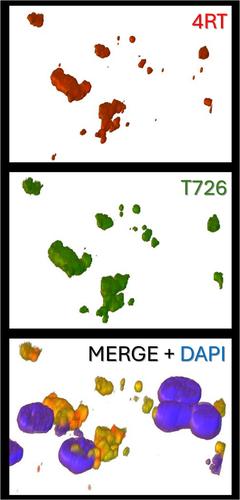
T726 did not colocalize with Aβ but showed significant co-localization with PHF tau in AD. We also observed some, albeit limited, co-localization of T726 with 3R and 4R tau lesions in FTLD.
DISCUSSION
This study's findings support FTP binding to some 3R and 4R tau lesions in FTLD. Further studies are needed to understand the biology of why FTP binds some but not all FTLD tau lesions.
Highlights
Flortaucipir analog (T726) showed significant co-localization with paired helical filament (PHF) tau in Alzheimer's disease (AD).
Colocalization between T726 with 3R and 4R tau lesions was observed in frontotemporal lobar degeneration (FTLD).
Not all 4R tau lesions bind to T726 across different FTLD brain regions.
期刊介绍:
Alzheimer's & Dementia is a peer-reviewed journal that aims to bridge knowledge gaps in dementia research by covering the entire spectrum, from basic science to clinical trials to social and behavioral investigations. It provides a platform for rapid communication of new findings and ideas, optimal translation of research into practical applications, increasing knowledge across diverse disciplines for early detection, diagnosis, and intervention, and identifying promising new research directions. In July 2008, Alzheimer's & Dementia was accepted for indexing by MEDLINE, recognizing its scientific merit and contribution to Alzheimer's research.





 京公网安备 11010802042870号
京ICP备2023020795号-1
京公网安备 11010802042870号
京ICP备2023020795号-1

 分享
分享
 求助内容:
求助内容: 应助结果提醒方式:
 扫码关注我们
