Lyuan Xu, Yu Zhao, Soyoung Choi, Muwei Li, Kurt G. Schilling, Zhongliang Zu, Baxter P. Rogers, Zhaohua Ding, Adam W. Anderson, Bennett A. Landman, John C. Gore, Yurui Gao, for the Alzheimer's Disease Neuroimaging Initiative
{"title":"Reductions in the white–gray functional connectome in preclinical Alzheimer's disease and their associations with amyloid and cognition","authors":"Lyuan Xu, Yu Zhao, Soyoung Choi, Muwei Li, Kurt G. Schilling, Zhongliang Zu, Baxter P. Rogers, Zhaohua Ding, Adam W. Anderson, Bennett A. Landman, John C. Gore, Yurui Gao, for the Alzheimer's Disease Neuroimaging Initiative","doi":"10.1002/alz.14334","DOIUrl":null,"url":null,"abstract":"<div>\n \n \n <section>\n \n <h3> BACKGROUND</h3>\n \n <p>The magnitudes and patterns of alterations of the white–gray matter (WM–GM) functional connectome in preclinical Alzheimer's disease (AD), and their associations with amyloid and cognition, remain unclear.</p>\n </section>\n \n <section>\n \n <h3> METHODS</h3>\n \n <p>We compared regional WM–GM functional connectivity (FC) and network properties in subjects with preclinical AD (or AD dementia) and controls (total <i>n</i> = 344). Their associations with positron emission tomography AV45-measured amyloid beta (Aβ) load and modified Preclinical Alzheimer Cognitive Composite (mPACC) scores were examined.</p>\n </section>\n \n <section>\n \n <h3> RESULTS</h3>\n \n <p>Preclinical AD subjects showed lower FC in specific WM–GM pairs and reduced segregation of control, dorsal attention, and somatomotor networks. A major portion of the reduced FC and network segregations were linked to elevated Aβ. Reduced FC of one WM–GM pair correlated with impaired mPACC. AD dementia exhibited broader reductions and stronger associations.</p>\n </section>\n \n <section>\n \n <h3> DISCUSSION</h3>\n \n <p>The WM–GM functional connectome undergoes regional and systemic dysfunctions as early as in the preclinical stage, correlating with amyloid deposition and predicting cognitive impairment.</p>\n </section>\n \n <section>\n \n <h3> Highlights</h3>\n \n <div>\n <ul>\n \n <li>Preclinical Alzheimer's disease (AD) subjects showed lower functional connectivity in specific white-gray matter (WM–GM) pairs and reduced segregations of control, dorsal attention, and somatomotor networks.</li>\n \n <li>A major portion of the reduced connectivity and network segregations were linked to elevated amyloid beta load.</li>\n \n <li>Only one WM–GM pair's reduced connectivity was linearly correlated with impaired cognitive composite scores.</li>\n \n <li>AD dementia showed more extensive reductions in connectivity, network integration, and segregation, with stronger associations with amyloid elevation and cognitive impairment.</li>\n \n <li>The WM–GM functional connectome offers a distinct perspective for understanding changes in brain functional architecture throughout the AD continuum.</li>\n </ul>\n </div>\n </section>\n </div>","PeriodicalId":7471,"journal":{"name":"Alzheimer's & Dementia","volume":"20 12","pages":"8317-8330"},"PeriodicalIF":11.1000,"publicationDate":"2024-10-23","publicationTypes":"Journal Article","fieldsOfStudy":null,"isOpenAccess":false,"openAccessPdf":"https://onlinelibrary.wiley.com/doi/epdf/10.1002/alz.14334","citationCount":"0","resultStr":null,"platform":"Semanticscholar","paperid":null,"PeriodicalName":"Alzheimer's & Dementia","FirstCategoryId":"3","ListUrlMain":"https://alz-journals.onlinelibrary.wiley.com/doi/10.1002/alz.14334","RegionNum":1,"RegionCategory":"医学","ArticlePicture":[],"TitleCN":null,"AbstractTextCN":null,"PMCID":null,"EPubDate":"","PubModel":"","JCR":"Q1","JCRName":"CLINICAL NEUROLOGY","Score":null,"Total":0}
引用次数: 0
Abstract
BACKGROUND
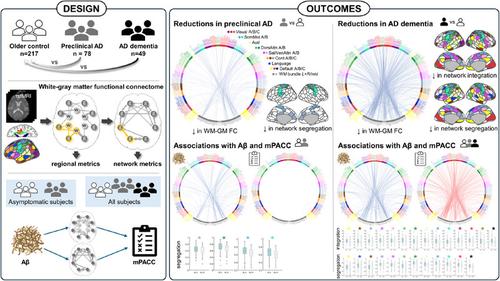
The magnitudes and patterns of alterations of the white–gray matter (WM–GM) functional connectome in preclinical Alzheimer's disease (AD), and their associations with amyloid and cognition, remain unclear.
METHODS
We compared regional WM–GM functional connectivity (FC) and network properties in subjects with preclinical AD (or AD dementia) and controls (total n = 344). Their associations with positron emission tomography AV45-measured amyloid beta (Aβ) load and modified Preclinical Alzheimer Cognitive Composite (mPACC) scores were examined.
RESULTS
Preclinical AD subjects showed lower FC in specific WM–GM pairs and reduced segregation of control, dorsal attention, and somatomotor networks. A major portion of the reduced FC and network segregations were linked to elevated Aβ. Reduced FC of one WM–GM pair correlated with impaired mPACC. AD dementia exhibited broader reductions and stronger associations.
DISCUSSION
The WM–GM functional connectome undergoes regional and systemic dysfunctions as early as in the preclinical stage, correlating with amyloid deposition and predicting cognitive impairment.
Highlights
Preclinical Alzheimer's disease (AD) subjects showed lower functional connectivity in specific white-gray matter (WM–GM) pairs and reduced segregations of control, dorsal attention, and somatomotor networks.
A major portion of the reduced connectivity and network segregations were linked to elevated amyloid beta load.
Only one WM–GM pair's reduced connectivity was linearly correlated with impaired cognitive composite scores.
AD dementia showed more extensive reductions in connectivity, network integration, and segregation, with stronger associations with amyloid elevation and cognitive impairment.
The WM–GM functional connectome offers a distinct perspective for understanding changes in brain functional architecture throughout the AD continuum.
期刊介绍:
Alzheimer's & Dementia is a peer-reviewed journal that aims to bridge knowledge gaps in dementia research by covering the entire spectrum, from basic science to clinical trials to social and behavioral investigations. It provides a platform for rapid communication of new findings and ideas, optimal translation of research into practical applications, increasing knowledge across diverse disciplines for early detection, diagnosis, and intervention, and identifying promising new research directions. In July 2008, Alzheimer's & Dementia was accepted for indexing by MEDLINE, recognizing its scientific merit and contribution to Alzheimer's research.





 京公网安备 11010802042870号
京ICP备2023020795号-1
京公网安备 11010802042870号
京ICP备2023020795号-1

 分享
分享
 求助内容:
求助内容: 应助结果提醒方式:
 扫码关注我们
