Alexander P. Gabrielli, Lesya Novikova, Amol Ranjan, Xiaowan Wang, Nicholas J. Ernst, Dhanushki Abeykoon, Anysja Roberts, Annie Kopp, Clayton Mansel, Linlan Qiao, Colton R. Lysaker, Ian W. Wiedling, Heather M. Wilkins, Russell H. Swerdlow
{"title":"Inhibiting mtDNA transcript translation alters Alzheimer's disease-associated biology","authors":"Alexander P. Gabrielli, Lesya Novikova, Amol Ranjan, Xiaowan Wang, Nicholas J. Ernst, Dhanushki Abeykoon, Anysja Roberts, Annie Kopp, Clayton Mansel, Linlan Qiao, Colton R. Lysaker, Ian W. Wiedling, Heather M. Wilkins, Russell H. Swerdlow","doi":"10.1002/alz.14275","DOIUrl":null,"url":null,"abstract":"<div>\n \n \n <section>\n \n <h3> INTRODUCTION</h3>\n \n <p>Alzheimer's disease (AD) features changes in mitochondrial structure and function. Investigators debate where to position mitochondrial pathology within the chronology and context of other AD features.</p>\n </section>\n \n <section>\n \n <h3> METHODS</h3>\n \n <p>To address whether mitochondrial dysfunction alters AD-implicated genes and proteins, we treated SH-SY5Y cells and induced pluripotent stem cell (iPSC)-derived neurons with chloramphenicol, an antibiotic that inhibits mtDNA-generated transcript translation. We characterized adaptive, AD-associated gene, and AD-associated protein responses.</p>\n </section>\n \n <section>\n \n <h3> RESULTS</h3>\n \n <p>SH-SY5Y cells and iPSC neurons responded to mtDNA transcript translation inhibition by increasing mtDNA copy number and transcription. Nuclear-expressed respiratory chain mRNA and protein levels also changed. There were AD-consistent concordant and model-specific changes in amyloid precursor protein, beta amyloid, apolipoprotein E, tau, and α-synuclein biology.</p>\n </section>\n \n <section>\n \n <h3> DISCUSSION</h3>\n \n <p>Primary mitochondrial dysfunction induces compensatory organelle responses, changes nuclear gene expression, and alters the biology of AD-associated genes and proteins in ways that may recapitulate brain aging and AD molecular phenomena.</p>\n </section>\n \n <section>\n \n <h3> Highlights</h3>\n \n <div>\n <ul>\n \n <li>In AD, mitochondrial dysfunction could represent a disease cause or consequence.</li>\n \n <li>We inhibited mitochondrial translation in human neuronal cells and neurons.</li>\n \n <li>Mitochondrial and nuclear gene expression shifted in adaptive-consistent patterns.</li>\n \n <li>APP, Aβ, APOE, tau, and α-synuclein biology changed in AD-consistent patterns.</li>\n \n <li>Mitochondrial stress creates an environment that promotes AD pathology.</li>\n </ul>\n </div>\n </section>\n </div>","PeriodicalId":7471,"journal":{"name":"Alzheimer's & Dementia","volume":"20 12","pages":"8429-8443"},"PeriodicalIF":11.1000,"publicationDate":"2024-10-23","publicationTypes":"Journal Article","fieldsOfStudy":null,"isOpenAccess":false,"openAccessPdf":"https://onlinelibrary.wiley.com/doi/epdf/10.1002/alz.14275","citationCount":"0","resultStr":null,"platform":"Semanticscholar","paperid":null,"PeriodicalName":"Alzheimer's & Dementia","FirstCategoryId":"3","ListUrlMain":"https://alz-journals.onlinelibrary.wiley.com/doi/10.1002/alz.14275","RegionNum":1,"RegionCategory":"医学","ArticlePicture":[],"TitleCN":null,"AbstractTextCN":null,"PMCID":null,"EPubDate":"","PubModel":"","JCR":"Q1","JCRName":"CLINICAL NEUROLOGY","Score":null,"Total":0}
引用次数: 0
Abstract
INTRODUCTION
Alzheimer's disease (AD) features changes in mitochondrial structure and function. Investigators debate where to position mitochondrial pathology within the chronology and context of other AD features.
METHODS
To address whether mitochondrial dysfunction alters AD-implicated genes and proteins, we treated SH-SY5Y cells and induced pluripotent stem cell (iPSC)-derived neurons with chloramphenicol, an antibiotic that inhibits mtDNA-generated transcript translation. We characterized adaptive, AD-associated gene, and AD-associated protein responses.
RESULTS
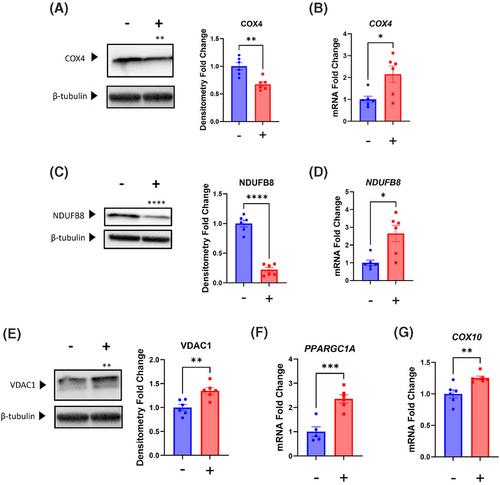
SH-SY5Y cells and iPSC neurons responded to mtDNA transcript translation inhibition by increasing mtDNA copy number and transcription. Nuclear-expressed respiratory chain mRNA and protein levels also changed. There were AD-consistent concordant and model-specific changes in amyloid precursor protein, beta amyloid, apolipoprotein E, tau, and α-synuclein biology.
DISCUSSION
Primary mitochondrial dysfunction induces compensatory organelle responses, changes nuclear gene expression, and alters the biology of AD-associated genes and proteins in ways that may recapitulate brain aging and AD molecular phenomena.
Highlights
In AD, mitochondrial dysfunction could represent a disease cause or consequence.
We inhibited mitochondrial translation in human neuronal cells and neurons.
Mitochondrial and nuclear gene expression shifted in adaptive-consistent patterns.
APP, Aβ, APOE, tau, and α-synuclein biology changed in AD-consistent patterns.
Mitochondrial stress creates an environment that promotes AD pathology.
期刊介绍:
Alzheimer's & Dementia is a peer-reviewed journal that aims to bridge knowledge gaps in dementia research by covering the entire spectrum, from basic science to clinical trials to social and behavioral investigations. It provides a platform for rapid communication of new findings and ideas, optimal translation of research into practical applications, increasing knowledge across diverse disciplines for early detection, diagnosis, and intervention, and identifying promising new research directions. In July 2008, Alzheimer's & Dementia was accepted for indexing by MEDLINE, recognizing its scientific merit and contribution to Alzheimer's research.





 京公网安备 11010802042870号
京ICP备2023020795号-1
京公网安备 11010802042870号
京ICP备2023020795号-1

 分享
分享
 求助内容:
求助内容: 应助结果提醒方式:
 扫码关注我们
