Vincent Mittag, Sebastian Schüttler, Christian Strelow, Tobias Kipp, Alf Mews
{"title":"CdSe-Dot/CdS-Rod/PbS-Dot Nanocrystals by Partial Cation Exchange Reaction","authors":"Vincent Mittag, Sebastian Schüttler, Christian Strelow, Tobias Kipp, Alf Mews","doi":"10.1021/acs.chemmater.4c02553","DOIUrl":null,"url":null,"abstract":"Dual-emissive nanorods with fluorescence in both the visible and infrared range are prepared by a combination of a CdSe-nanocrystal-seeded growth of CdS nanorods and a successive partial Cd-to-Pb cation exchange. We show that the exchange reaction, which involves Pb halides in oleylamine, starts at the tip of the rods, leading to the formation of CdSe-dot/CdS-rod/PbS-dot nanocrystals (DRDs). Besides these DRDs, the reaction product also contains shorter nanorods and spherical quantum dots. Their fraction strongly depends on the amount of lead halide precursor and the reaction time. The reaction mechanism is investigated in detail, such that by carefully adjusting the reaction conditions, it is possible to synthesize DRDs of distinct PbS-dot sizes with yields of over 95%. The resulting DRDs are crystalline and show a CdSe-fluorescence band in the visible range at 600 nm and also a fluorescence band in the near-infrared at 1440 nm, resulting from the PbS part of the rods. The dual emission is confirmed by single-DRD spectroscopy. For that, scanning fluorescence and transmission electron microscopy imaging are correlated, and time-resolved single-photon counting experiments simultaneously in the near-infrared and visible range are performed.","PeriodicalId":33,"journal":{"name":"Chemistry of Materials","volume":"194 1","pages":""},"PeriodicalIF":7.0000,"publicationDate":"2024-10-23","publicationTypes":"Journal Article","fieldsOfStudy":null,"isOpenAccess":false,"openAccessPdf":"","citationCount":"0","resultStr":null,"platform":"Semanticscholar","paperid":null,"PeriodicalName":"Chemistry of Materials","FirstCategoryId":"88","ListUrlMain":"https://doi.org/10.1021/acs.chemmater.4c02553","RegionNum":2,"RegionCategory":"材料科学","ArticlePicture":[],"TitleCN":null,"AbstractTextCN":null,"PMCID":null,"EPubDate":"","PubModel":"","JCR":"Q2","JCRName":"CHEMISTRY, PHYSICAL","Score":null,"Total":0}
引用次数: 0
Abstract
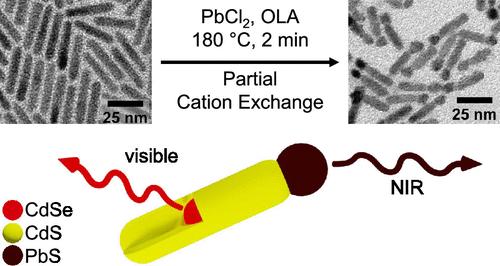
Dual-emissive nanorods with fluorescence in both the visible and infrared range are prepared by a combination of a CdSe-nanocrystal-seeded growth of CdS nanorods and a successive partial Cd-to-Pb cation exchange. We show that the exchange reaction, which involves Pb halides in oleylamine, starts at the tip of the rods, leading to the formation of CdSe-dot/CdS-rod/PbS-dot nanocrystals (DRDs). Besides these DRDs, the reaction product also contains shorter nanorods and spherical quantum dots. Their fraction strongly depends on the amount of lead halide precursor and the reaction time. The reaction mechanism is investigated in detail, such that by carefully adjusting the reaction conditions, it is possible to synthesize DRDs of distinct PbS-dot sizes with yields of over 95%. The resulting DRDs are crystalline and show a CdSe-fluorescence band in the visible range at 600 nm and also a fluorescence band in the near-infrared at 1440 nm, resulting from the PbS part of the rods. The dual emission is confirmed by single-DRD spectroscopy. For that, scanning fluorescence and transmission electron microscopy imaging are correlated, and time-resolved single-photon counting experiments simultaneously in the near-infrared and visible range are performed.
期刊介绍:
The journal Chemistry of Materials focuses on publishing original research at the intersection of materials science and chemistry. The studies published in the journal involve chemistry as a prominent component and explore topics such as the design, synthesis, characterization, processing, understanding, and application of functional or potentially functional materials. The journal covers various areas of interest, including inorganic and organic solid-state chemistry, nanomaterials, biomaterials, thin films and polymers, and composite/hybrid materials. The journal particularly seeks papers that highlight the creation or development of innovative materials with novel optical, electrical, magnetic, catalytic, or mechanical properties. It is essential that manuscripts on these topics have a primary focus on the chemistry of materials and represent a significant advancement compared to prior research. Before external reviews are sought, submitted manuscripts undergo a review process by a minimum of two editors to ensure their appropriateness for the journal and the presence of sufficient evidence of a significant advance that will be of broad interest to the materials chemistry community.



 京公网安备 11010802042870号
京ICP备2023020795号-1
京公网安备 11010802042870号
京ICP备2023020795号-1

 分享
分享
 求助内容:
求助内容: 应助结果提醒方式:
 扫码关注我们
