{"title":"Hydrogenolysis of Polyethylene by Metal–Organic Framework Confined Single-Site Ruthenium Catalysts","authors":"Manav Chauhan, Chhaya Thadhani, Bharti Rana, Poorvi Gupta, Biplab Ghosh, Kuntal Manna","doi":"10.1021/acs.chemmater.4c02186","DOIUrl":null,"url":null,"abstract":"Upcycling polyolefins into value-added hydrocarbons via catalytic hydrogenolysis is challenging due to poor product selectivity, random C–C bond cleavage, and the formation of volatile alkanes. We have developed two isoreticular porous aluminum metal–organic framework (MOF) node-supported mononuclear ruthenium dihydride catalysts (DUT-5-RuH<sub>2</sub> and MIL-53-RuH<sub>2</sub>), which are efficient in the hydrogenolysis of low-density polyethylene (LDPE) at 200 °C into a narrow distribution of liquid hydrocarbons (C8-C24). By systematic tuning of the pore sizes of the MOFs, high yields of desirable liquid alkanes were afforded with varying degrees of branching, achieving 80% selectivity. DUT-5-RuH<sub>2</sub> produced a C22-centered bell-shaped alkane distribution with a polyethylene conversion of 98%, while MIL-53-RuH<sub>2</sub>, being selective for shorter alkanes, produced a C9-centered bell-shaped alkane distribution. Based on our spectroscopic and theoretical studies, the high catalytic activity and selectivity of these MOF catalysts are primarily attributed to the stabilization of single-site mono-RuH<sub>2</sub> species at the MOF’s nodes via active-site isolation and the confinement of the active catalytic species within porous MOFs. Theoretical calculations suggest that RuH<sub>2</sub>-mediated polyolefin C–C bond cleavage primarily occurs via turnover-limiting σ-bond metathesis. This study underscores the significance of MOFs in the rational design of heterogeneous catalysts for the efficient upcycling of plastic waste.","PeriodicalId":33,"journal":{"name":"Chemistry of Materials","volume":"25 1","pages":""},"PeriodicalIF":7.0000,"publicationDate":"2024-10-23","publicationTypes":"Journal Article","fieldsOfStudy":null,"isOpenAccess":false,"openAccessPdf":"","citationCount":"0","resultStr":null,"platform":"Semanticscholar","paperid":null,"PeriodicalName":"Chemistry of Materials","FirstCategoryId":"88","ListUrlMain":"https://doi.org/10.1021/acs.chemmater.4c02186","RegionNum":2,"RegionCategory":"材料科学","ArticlePicture":[],"TitleCN":null,"AbstractTextCN":null,"PMCID":null,"EPubDate":"","PubModel":"","JCR":"Q2","JCRName":"CHEMISTRY, PHYSICAL","Score":null,"Total":0}
引用次数: 0
Abstract
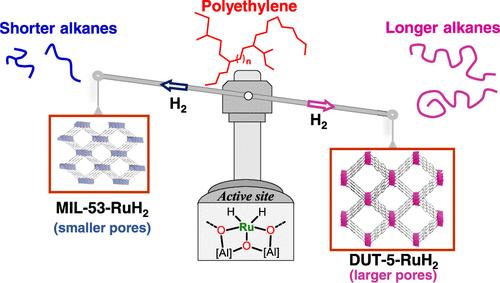
Upcycling polyolefins into value-added hydrocarbons via catalytic hydrogenolysis is challenging due to poor product selectivity, random C–C bond cleavage, and the formation of volatile alkanes. We have developed two isoreticular porous aluminum metal–organic framework (MOF) node-supported mononuclear ruthenium dihydride catalysts (DUT-5-RuH2 and MIL-53-RuH2), which are efficient in the hydrogenolysis of low-density polyethylene (LDPE) at 200 °C into a narrow distribution of liquid hydrocarbons (C8-C24). By systematic tuning of the pore sizes of the MOFs, high yields of desirable liquid alkanes were afforded with varying degrees of branching, achieving 80% selectivity. DUT-5-RuH2 produced a C22-centered bell-shaped alkane distribution with a polyethylene conversion of 98%, while MIL-53-RuH2, being selective for shorter alkanes, produced a C9-centered bell-shaped alkane distribution. Based on our spectroscopic and theoretical studies, the high catalytic activity and selectivity of these MOF catalysts are primarily attributed to the stabilization of single-site mono-RuH2 species at the MOF’s nodes via active-site isolation and the confinement of the active catalytic species within porous MOFs. Theoretical calculations suggest that RuH2-mediated polyolefin C–C bond cleavage primarily occurs via turnover-limiting σ-bond metathesis. This study underscores the significance of MOFs in the rational design of heterogeneous catalysts for the efficient upcycling of plastic waste.
期刊介绍:
The journal Chemistry of Materials focuses on publishing original research at the intersection of materials science and chemistry. The studies published in the journal involve chemistry as a prominent component and explore topics such as the design, synthesis, characterization, processing, understanding, and application of functional or potentially functional materials. The journal covers various areas of interest, including inorganic and organic solid-state chemistry, nanomaterials, biomaterials, thin films and polymers, and composite/hybrid materials. The journal particularly seeks papers that highlight the creation or development of innovative materials with novel optical, electrical, magnetic, catalytic, or mechanical properties. It is essential that manuscripts on these topics have a primary focus on the chemistry of materials and represent a significant advancement compared to prior research. Before external reviews are sought, submitted manuscripts undergo a review process by a minimum of two editors to ensure their appropriateness for the journal and the presence of sufficient evidence of a significant advance that will be of broad interest to the materials chemistry community.



 京公网安备 11010802042870号
京ICP备2023020795号-1
京公网安备 11010802042870号
京ICP备2023020795号-1

 分享
分享
 求助内容:
求助内容: 应助结果提醒方式:
 扫码关注我们
