Peixia Li, Yayin Du, Jingru Qiu, Qiaoyun Jiang, Weijia Chen, Xinke Zhang, Guiling Li, Donghai Li, Gang Shan
{"title":"Immune Checkpoint-Modulating Photosensitizer That Targets BRD4 for Cancer Photoimmunotherapy","authors":"Peixia Li, Yayin Du, Jingru Qiu, Qiaoyun Jiang, Weijia Chen, Xinke Zhang, Guiling Li, Donghai Li, Gang Shan","doi":"10.1021/acs.jmedchem.4c01362","DOIUrl":null,"url":null,"abstract":"Photodynamic therapy is an efficient approach to promote cytotoxic T lymphocyte tumor infiltration to convert immunologically cold tumors into hot tumors through the induction of immunogenic cell death . However, tumors usually overexpress immune checkpoints such as PD-L1 to suppress T lymphocyte antitumor activity and evade immune surveillance. Therefore, the design of efficient photosensitizers to overcome checkpoint-mediated immune evasion is highly necessary. In this work, we report the design of <b>BRD-PS</b>, a BRD4-targeting photosensitizer, as a new class of immunomodulatory photosensitizer termed an immune checkpoint-modulating photosensitizer, to solve this issue. On one hand, <b>BRD-PS</b> induces immunogenic pyroptosis and ferroptosis to promote the activation and tumor infiltration of cytotoxic T cells. On the other hand, <b>BRD-PS</b> suppresses the expression of PD-L1 to avoid immune evasion. This work demonstrated the feasibility of utilizing a single photosensitizer to simultaneously induce immunogenic cell death and PD-L1 downregulation for synergistic cancer photoimmunotherapy.","PeriodicalId":46,"journal":{"name":"Journal of Medicinal Chemistry","volume":"14 1","pages":""},"PeriodicalIF":6.8000,"publicationDate":"2024-10-24","publicationTypes":"Journal Article","fieldsOfStudy":null,"isOpenAccess":false,"openAccessPdf":"","citationCount":"0","resultStr":null,"platform":"Semanticscholar","paperid":null,"PeriodicalName":"Journal of Medicinal Chemistry","FirstCategoryId":"3","ListUrlMain":"https://doi.org/10.1021/acs.jmedchem.4c01362","RegionNum":1,"RegionCategory":"医学","ArticlePicture":[],"TitleCN":null,"AbstractTextCN":null,"PMCID":null,"EPubDate":"","PubModel":"","JCR":"Q1","JCRName":"CHEMISTRY, MEDICINAL","Score":null,"Total":0}
引用次数: 0
Abstract
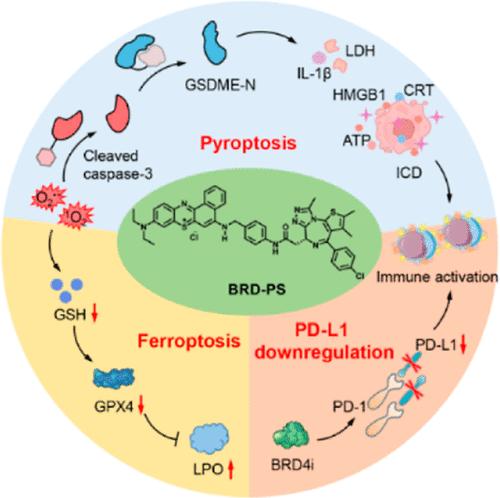
Photodynamic therapy is an efficient approach to promote cytotoxic T lymphocyte tumor infiltration to convert immunologically cold tumors into hot tumors through the induction of immunogenic cell death . However, tumors usually overexpress immune checkpoints such as PD-L1 to suppress T lymphocyte antitumor activity and evade immune surveillance. Therefore, the design of efficient photosensitizers to overcome checkpoint-mediated immune evasion is highly necessary. In this work, we report the design of BRD-PS, a BRD4-targeting photosensitizer, as a new class of immunomodulatory photosensitizer termed an immune checkpoint-modulating photosensitizer, to solve this issue. On one hand, BRD-PS induces immunogenic pyroptosis and ferroptosis to promote the activation and tumor infiltration of cytotoxic T cells. On the other hand, BRD-PS suppresses the expression of PD-L1 to avoid immune evasion. This work demonstrated the feasibility of utilizing a single photosensitizer to simultaneously induce immunogenic cell death and PD-L1 downregulation for synergistic cancer photoimmunotherapy.
期刊介绍:
The Journal of Medicinal Chemistry is a prestigious biweekly peer-reviewed publication that focuses on the multifaceted field of medicinal chemistry. Since its inception in 1959 as the Journal of Medicinal and Pharmaceutical Chemistry, it has evolved to become a cornerstone in the dissemination of research findings related to the design, synthesis, and development of therapeutic agents.
The Journal of Medicinal Chemistry is recognized for its significant impact in the scientific community, as evidenced by its 2022 impact factor of 7.3. This metric reflects the journal's influence and the importance of its content in shaping the future of drug discovery and development. The journal serves as a vital resource for chemists, pharmacologists, and other researchers interested in the molecular mechanisms of drug action and the optimization of therapeutic compounds.



 京公网安备 11010802042870号
京ICP备2023020795号-1
京公网安备 11010802042870号
京ICP备2023020795号-1

 分享
分享
 求助内容:
求助内容: 应助结果提醒方式:
 扫码关注我们
