Bee Ha Gan, Etienne Bonvin, Thierry Paschoud, Hippolyte Personne, Jérémie Reusser, Xingguang Cai, Robert Rauscher, Thilo Köhler, Christian van Delden, Norbert Polacek, Jean-Louis Reymond
{"title":"Stereorandomized Oncocins with Preserved Ribosome Binding and Antibacterial Activity","authors":"Bee Ha Gan, Etienne Bonvin, Thierry Paschoud, Hippolyte Personne, Jérémie Reusser, Xingguang Cai, Robert Rauscher, Thilo Köhler, Christian van Delden, Norbert Polacek, Jean-Louis Reymond","doi":"10.1021/acs.jmedchem.4c01768","DOIUrl":null,"url":null,"abstract":"We recently showed that solid-phase peptide synthesis using racemic amino acids yields stereorandomized peptides comprising all possible diastereomers as homogeneous, single-mass products that can be purified by HPLC and that stereorandomization modulates activity, toxicity, and stability of membrane-disruptive cyclic and linear antimicrobial peptides (AMPs) and dendrimers. Here, we tested if stereorandomization might be compatible with target binding peptides with the example of the proline-rich AMP oncocin, which inhibits the bacterial ribosome. Stereorandomization of up to nine <i>C</i>-terminal residues preserved ribosome binding and antibacterial effects including activities against drug-resistant bacteria and protected against serum degradation. Surprisingly, fully stereorandomized oncocin was as active as L-oncocin in dilute growth media stimulating peptide uptake, although it did not bind the ribosome, indicative of an alternative mechanism of action. These experiments show that stereorandomization can be compatible with target binding peptides and can help understand their mechanism of action.","PeriodicalId":46,"journal":{"name":"Journal of Medicinal Chemistry","volume":"235 1","pages":""},"PeriodicalIF":6.8000,"publicationDate":"2024-10-24","publicationTypes":"Journal Article","fieldsOfStudy":null,"isOpenAccess":false,"openAccessPdf":"","citationCount":"0","resultStr":null,"platform":"Semanticscholar","paperid":null,"PeriodicalName":"Journal of Medicinal Chemistry","FirstCategoryId":"3","ListUrlMain":"https://doi.org/10.1021/acs.jmedchem.4c01768","RegionNum":1,"RegionCategory":"医学","ArticlePicture":[],"TitleCN":null,"AbstractTextCN":null,"PMCID":null,"EPubDate":"","PubModel":"","JCR":"Q1","JCRName":"CHEMISTRY, MEDICINAL","Score":null,"Total":0}
引用次数: 0
Abstract
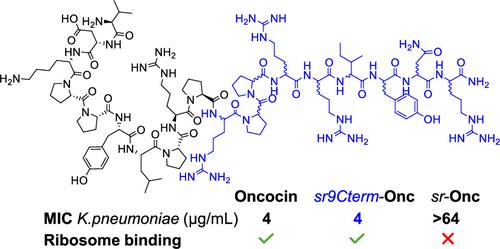
We recently showed that solid-phase peptide synthesis using racemic amino acids yields stereorandomized peptides comprising all possible diastereomers as homogeneous, single-mass products that can be purified by HPLC and that stereorandomization modulates activity, toxicity, and stability of membrane-disruptive cyclic and linear antimicrobial peptides (AMPs) and dendrimers. Here, we tested if stereorandomization might be compatible with target binding peptides with the example of the proline-rich AMP oncocin, which inhibits the bacterial ribosome. Stereorandomization of up to nine C-terminal residues preserved ribosome binding and antibacterial effects including activities against drug-resistant bacteria and protected against serum degradation. Surprisingly, fully stereorandomized oncocin was as active as L-oncocin in dilute growth media stimulating peptide uptake, although it did not bind the ribosome, indicative of an alternative mechanism of action. These experiments show that stereorandomization can be compatible with target binding peptides and can help understand their mechanism of action.
期刊介绍:
The Journal of Medicinal Chemistry is a prestigious biweekly peer-reviewed publication that focuses on the multifaceted field of medicinal chemistry. Since its inception in 1959 as the Journal of Medicinal and Pharmaceutical Chemistry, it has evolved to become a cornerstone in the dissemination of research findings related to the design, synthesis, and development of therapeutic agents.
The Journal of Medicinal Chemistry is recognized for its significant impact in the scientific community, as evidenced by its 2022 impact factor of 7.3. This metric reflects the journal's influence and the importance of its content in shaping the future of drug discovery and development. The journal serves as a vital resource for chemists, pharmacologists, and other researchers interested in the molecular mechanisms of drug action and the optimization of therapeutic compounds.



 京公网安备 11010802042870号
京ICP备2023020795号-1
京公网安备 11010802042870号
京ICP备2023020795号-1

 分享
分享
 求助内容:
求助内容: 应助结果提醒方式:
 扫码关注我们
