Aron Emmi PhD, Veronica Macchi MD, PhD, Elena Stocco PhD, Aleksandar Tushevski MSc, Angelo Antonini MD, PhD, Raffaele De Caro MD, Andrea Porzionato MD, PhD
{"title":"α-Synuclein Pathology in the Carotid Body: Experimental Evidence for a possible Contributor to Respiratory Impairment in Parkinson's Disease","authors":"Aron Emmi PhD, Veronica Macchi MD, PhD, Elena Stocco PhD, Aleksandar Tushevski MSc, Angelo Antonini MD, PhD, Raffaele De Caro MD, Andrea Porzionato MD, PhD","doi":"10.1002/mds.30036","DOIUrl":null,"url":null,"abstract":"<p>The carotid body (CB) is a paired chemosensory organ located at the bifurcation of the common carotid artery. It instantly senses the arterial partial pressure of O<sub>2</sub> and passes afferent signals to the brainstem via the carotid sinus nerve (of the glossopharyngeal nerve).<span><sup>1, 2</sup></span> It stimulates ventilatory responses, acting on central respiratory centers, in response to hypoxia, hypercapnia, or reduced blood pH. Morphologically, it is composed of lobules containing type I cells, positive for neuronal markers, such as PGP9.5, β-III tubulin, and tyrosine hydroxylase, and type II cells, with a supportive role and positive for glial fibrillary acidic protein.<span><sup>2</sup></span> Type I cells are considered the true chemoreceptor elements. Neurotransmitters and neuromodulators released by type I cells act on the afferent endings of the carotid sinus nerve arising from the petrosal ganglion. The CB also shows sensory innervation from jugular and nodose ganglia, postganglionic sympathetic nerve fibers from the superior cervical ganglion, and preganglionic parasympathetic and sympathetic fibers reaching ganglion cells in the CB. Efferent parasympathetic and sympathetic innervation of the CB plays a pivotal role in the modulation of blood flow. Thus, the CB is key for the control of the internal milieu of tissues and body homeostasis.</p><p>Although the role of the CB has been investigated in numerous diseases, its role in central nervous system diseases, and particularly neurodegenerative diseases, has been scarcely investigated. Among these, α-synucleinopathies, such as Parkinson's disease (PD) and multiple system atrophy, often present with cardiorespiratory abnormalities, but their prevalence is currently underestimated.<span><sup>3</sup></span> Although respiratory changes are usually correlated with peripheral motor impairment, several causes have been reported, including obstructive and restrictive patterns, as well as changes in the central ventilatory control.<span><sup>3, 4</sup></span> Deposition of α-synuclein in the brain often begins in the caudal portion of the brainstem, and structures involved in the respiratory control, as those responsible for coordinating ventilation and detecting peripheral hypoxemia or hypercapnia, may be directly affected by neurodegeneration at an early stage. Central respiratory impairment may contribute to PD mortality in later stages of the disease, as it may worsen respiratory diseases, which often represent one of the main mortality causes in PD.</p><p>In this study, our aim was to document α-synuclein deposition and pathology of the CB and carotid sinus nerve in PD patients, suggesting the contributory role of the structure in respiratory dysfunction occurring in this disease.</p><p>The subjects and methods employed for this study are reported in the Supplementary Information and based on previously established protocols.<span><sup>5</sup></span></p><p>The immunoreactivity of phosphorylated α-synuclein (pSYN SER129) and oligomeric α-synuclein (5G4) was detected within the CB and carotid sinus nerve, colocalizing with neuronal marker β-III tubulin. In the nerve bundles of the carotid sinus nerve, coursing between the external and internal carotid arteries, phosphorylated- and oligomeric α-synuclein reactivity was detected, colocalizing with neuronal marker β-III tubulin. Similarly, phosphorylated α-synuclein and oligomeric α-synuclein reactivity strictly colocalized with β-III-tubulin-positive cells in the CB, suggesting exclusive involvement of type I glomus cells. Interestingly, in one of the examined cases, 5G4 immunoreactivity revealed distinct round-shaped cytoplasmic inclusions in CB cells reminiscent of Lewy bodies (Fig. 1). In both cases, α-synuclein pathology was detected in the caudal and rostral medulla, at the level of the lateral reticular formation and the solitary tract nucleus, among other involved nuclei.</p><p>Our findings indicate that the CB, along with the carotid sinus nerve, is affected by α-synuclein deposition and pathology in PD. The detection of oligomeric α-synuclein, with occasional Lewy-body-like appearance, within type I glomus cells, and the evidence of morphological alterations in the CB (increase in interlobular connective tissue, decrease in lobular size, increase in type II cells suggestive of gliosis) support the hypothesis of CB dysfunction. This may play a yet-underevaluated role in central (and peripheral) respiratory impairment in PD, which can manifest early in the disease, presenting as a distinct symptom in a subgroup of patients, or contribute to late-stage mechanisms that worsen respiratory control and determine an increased mortality risk in case of respiratory infections.<span><sup>4</sup></span> Whether CB pathology in PD manifests early or represents a late manifestation of the disease remains to be determined, also with regard to the current debate concerning body-first versus brain-first spreading of α-synuclein. Of interest, in this context, is the use of CB autotransplantation to ameliorate parkinsonism.<span><sup>6</sup></span> Although the implantation of autologous CB cells was shown to ameliorate PD motor symptoms, as glomus cells produce both dopamine and growth factors that increase cell survival in the implant site,<span><sup>7</sup></span> the presence of α-synuclein pathology in the CB may represent an issue in terms of seeding within the implantation site. Regardless, these findings highlight the potential role of the CB in respiratory control of PD and require further investigation concerning mechanisms of action and pathophysiological implications.</p><p>A.A. has received compensation for consultancy and speaker-related activities from UCB, Boehringer Ingelheim, Ever Pharma, General Electric, Britannia, AbbVie, Kyowa Kirin, Zambon, Bial, Theravance Biopharma, Jazz Pharmaceuticals, Roche, and Medscape; he receives research support from Bial, Lundbeck, Roche, Angelini Pharmaceuticals, Horizon 2020 Grant 825785, Horizon 2020 Grant 101016902, Ministry of Education University and Research (MIUR) Grant ARS01_01081, Cariparo Foundation, and Movement Disorders Society for NMS Scale validation. He serves as consultant for Boehringer Ingelheim for legal cases on pathological gambling.</p><p>(1) Research project: A. Conception, B.Organization, C. Execution; (2) Statistical analysis: A. Design, B. Execution,C. Review and critique; (3) Manuscript: A. Writing of the firstdraft, B. Review and critique.</p><p>A.E.: 1A, 1B, 1C, 2A, 2B, 2C, 2D</p><p>V.M.: 1A, 1B, 2A, 2B, 2D</p><p>E.S.: 1A, 1B, 2A, 2B, 2D</p><p>A.T.: 1B, 1C, 2B, 2D</p><p>A.A.: 1A, 1B, 2A, 2B, 2D</p><p>R.D.C: 1A, 1B, 2A, 2B, 2D</p><p>A.P.: 1A, 1B, 2A, 2B, 2D</p>","PeriodicalId":213,"journal":{"name":"Movement Disorders","volume":"40 1","pages":"176-178"},"PeriodicalIF":7.6000,"publicationDate":"2024-10-24","publicationTypes":"Journal Article","fieldsOfStudy":null,"isOpenAccess":false,"openAccessPdf":"https://onlinelibrary.wiley.com/doi/epdf/10.1002/mds.30036","citationCount":"0","resultStr":null,"platform":"Semanticscholar","paperid":null,"PeriodicalName":"Movement Disorders","FirstCategoryId":"3","ListUrlMain":"https://movementdisorders.onlinelibrary.wiley.com/doi/10.1002/mds.30036","RegionNum":1,"RegionCategory":"医学","ArticlePicture":[],"TitleCN":null,"AbstractTextCN":null,"PMCID":null,"EPubDate":"","PubModel":"","JCR":"Q1","JCRName":"CLINICAL NEUROLOGY","Score":null,"Total":0}
引用次数: 0
Abstract
The carotid body (CB) is a paired chemosensory organ located at the bifurcation of the common carotid artery. It instantly senses the arterial partial pressure of O2 and passes afferent signals to the brainstem via the carotid sinus nerve (of the glossopharyngeal nerve).1, 2 It stimulates ventilatory responses, acting on central respiratory centers, in response to hypoxia, hypercapnia, or reduced blood pH. Morphologically, it is composed of lobules containing type I cells, positive for neuronal markers, such as PGP9.5, β-III tubulin, and tyrosine hydroxylase, and type II cells, with a supportive role and positive for glial fibrillary acidic protein.2 Type I cells are considered the true chemoreceptor elements. Neurotransmitters and neuromodulators released by type I cells act on the afferent endings of the carotid sinus nerve arising from the petrosal ganglion. The CB also shows sensory innervation from jugular and nodose ganglia, postganglionic sympathetic nerve fibers from the superior cervical ganglion, and preganglionic parasympathetic and sympathetic fibers reaching ganglion cells in the CB. Efferent parasympathetic and sympathetic innervation of the CB plays a pivotal role in the modulation of blood flow. Thus, the CB is key for the control of the internal milieu of tissues and body homeostasis.
Although the role of the CB has been investigated in numerous diseases, its role in central nervous system diseases, and particularly neurodegenerative diseases, has been scarcely investigated. Among these, α-synucleinopathies, such as Parkinson's disease (PD) and multiple system atrophy, often present with cardiorespiratory abnormalities, but their prevalence is currently underestimated.3 Although respiratory changes are usually correlated with peripheral motor impairment, several causes have been reported, including obstructive and restrictive patterns, as well as changes in the central ventilatory control.3, 4 Deposition of α-synuclein in the brain often begins in the caudal portion of the brainstem, and structures involved in the respiratory control, as those responsible for coordinating ventilation and detecting peripheral hypoxemia or hypercapnia, may be directly affected by neurodegeneration at an early stage. Central respiratory impairment may contribute to PD mortality in later stages of the disease, as it may worsen respiratory diseases, which often represent one of the main mortality causes in PD.
In this study, our aim was to document α-synuclein deposition and pathology of the CB and carotid sinus nerve in PD patients, suggesting the contributory role of the structure in respiratory dysfunction occurring in this disease.
The subjects and methods employed for this study are reported in the Supplementary Information and based on previously established protocols.5
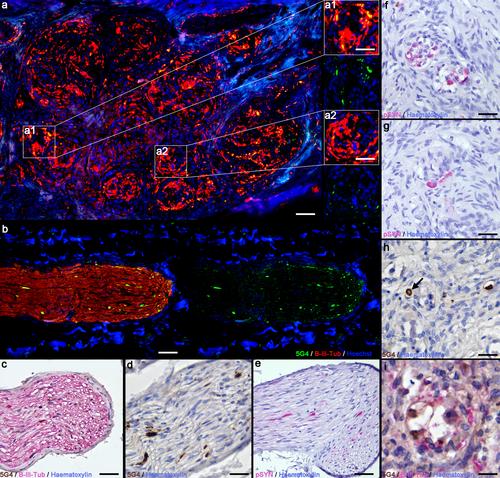
The immunoreactivity of phosphorylated α-synuclein (pSYN SER129) and oligomeric α-synuclein (5G4) was detected within the CB and carotid sinus nerve, colocalizing with neuronal marker β-III tubulin. In the nerve bundles of the carotid sinus nerve, coursing between the external and internal carotid arteries, phosphorylated- and oligomeric α-synuclein reactivity was detected, colocalizing with neuronal marker β-III tubulin. Similarly, phosphorylated α-synuclein and oligomeric α-synuclein reactivity strictly colocalized with β-III-tubulin-positive cells in the CB, suggesting exclusive involvement of type I glomus cells. Interestingly, in one of the examined cases, 5G4 immunoreactivity revealed distinct round-shaped cytoplasmic inclusions in CB cells reminiscent of Lewy bodies (Fig. 1). In both cases, α-synuclein pathology was detected in the caudal and rostral medulla, at the level of the lateral reticular formation and the solitary tract nucleus, among other involved nuclei.
Our findings indicate that the CB, along with the carotid sinus nerve, is affected by α-synuclein deposition and pathology in PD. The detection of oligomeric α-synuclein, with occasional Lewy-body-like appearance, within type I glomus cells, and the evidence of morphological alterations in the CB (increase in interlobular connective tissue, decrease in lobular size, increase in type II cells suggestive of gliosis) support the hypothesis of CB dysfunction. This may play a yet-underevaluated role in central (and peripheral) respiratory impairment in PD, which can manifest early in the disease, presenting as a distinct symptom in a subgroup of patients, or contribute to late-stage mechanisms that worsen respiratory control and determine an increased mortality risk in case of respiratory infections.4 Whether CB pathology in PD manifests early or represents a late manifestation of the disease remains to be determined, also with regard to the current debate concerning body-first versus brain-first spreading of α-synuclein. Of interest, in this context, is the use of CB autotransplantation to ameliorate parkinsonism.6 Although the implantation of autologous CB cells was shown to ameliorate PD motor symptoms, as glomus cells produce both dopamine and growth factors that increase cell survival in the implant site,7 the presence of α-synuclein pathology in the CB may represent an issue in terms of seeding within the implantation site. Regardless, these findings highlight the potential role of the CB in respiratory control of PD and require further investigation concerning mechanisms of action and pathophysiological implications.
A.A. has received compensation for consultancy and speaker-related activities from UCB, Boehringer Ingelheim, Ever Pharma, General Electric, Britannia, AbbVie, Kyowa Kirin, Zambon, Bial, Theravance Biopharma, Jazz Pharmaceuticals, Roche, and Medscape; he receives research support from Bial, Lundbeck, Roche, Angelini Pharmaceuticals, Horizon 2020 Grant 825785, Horizon 2020 Grant 101016902, Ministry of Education University and Research (MIUR) Grant ARS01_01081, Cariparo Foundation, and Movement Disorders Society for NMS Scale validation. He serves as consultant for Boehringer Ingelheim for legal cases on pathological gambling.
(1) Research project: A. Conception, B.Organization, C. Execution; (2) Statistical analysis: A. Design, B. Execution,C. Review and critique; (3) Manuscript: A. Writing of the firstdraft, B. Review and critique.
期刊介绍:
Movement Disorders publishes a variety of content types including Reviews, Viewpoints, Full Length Articles, Historical Reports, Brief Reports, and Letters. The journal considers original manuscripts on topics related to the diagnosis, therapeutics, pharmacology, biochemistry, physiology, etiology, genetics, and epidemiology of movement disorders. Appropriate topics include Parkinsonism, Chorea, Tremors, Dystonia, Myoclonus, Tics, Tardive Dyskinesia, Spasticity, and Ataxia.





 京公网安备 11010802042870号
京ICP备2023020795号-1
京公网安备 11010802042870号
京ICP备2023020795号-1

 分享
分享
 求助内容:
求助内容: 应助结果提醒方式:
 扫码关注我们
