Elena M. Şteţco, Traian Petrişor, Jr., Ovidiu A. Pop, Mohamed Belmeguenai, Ioan M. Miron, Mihai S. Gabor
{"title":"Diode and Selective Routing Functionalities Controlled by Geometry in Current-Induced Spin–Orbit Torque Driven Magnetic Domain Wall Devices","authors":"Elena M. Şteţco, Traian Petrişor, Jr., Ovidiu A. Pop, Mohamed Belmeguenai, Ioan M. Miron, Mihai S. Gabor","doi":"10.1021/acs.nanolett.4c03339","DOIUrl":null,"url":null,"abstract":"Research on current-induced domain wall (DW) motion in heavy metal/ferromagnet structures is crucial for advancing memory, logic, and computing devices. Here, we demonstrate that adjusting the angle between the DW conduit and the current direction provides an additional degree of control over the current-induced DW motion. A DW conduit with a 45° section relative to the current direction enables asymmetrical DW behavior: for one DW polarity, motion proceeds freely, while for the opposite polarity, motion is impeded or even blocked in the 45° zone, depending on the interfacial Dzyaloshinskii–Moriya interaction strength. This enables the device to function as a DW diode. Leveraging this velocity asymmetry, we designed a Y-shaped DW conduit with one input and two output branches at +45° and −45°, functioning as a DW selector. A DW injected into the junction exits through one branch, while a reverse polarity DW exits through the other, demonstrating selective DW routing.","PeriodicalId":53,"journal":{"name":"Nano Letters","volume":"75 1","pages":""},"PeriodicalIF":9.1000,"publicationDate":"2024-10-27","publicationTypes":"Journal Article","fieldsOfStudy":null,"isOpenAccess":false,"openAccessPdf":"","citationCount":"0","resultStr":null,"platform":"Semanticscholar","paperid":null,"PeriodicalName":"Nano Letters","FirstCategoryId":"88","ListUrlMain":"https://doi.org/10.1021/acs.nanolett.4c03339","RegionNum":1,"RegionCategory":"材料科学","ArticlePicture":[],"TitleCN":null,"AbstractTextCN":null,"PMCID":null,"EPubDate":"","PubModel":"","JCR":"Q1","JCRName":"CHEMISTRY, MULTIDISCIPLINARY","Score":null,"Total":0}
引用次数: 0
Abstract
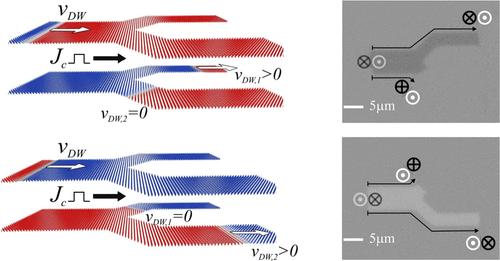
Research on current-induced domain wall (DW) motion in heavy metal/ferromagnet structures is crucial for advancing memory, logic, and computing devices. Here, we demonstrate that adjusting the angle between the DW conduit and the current direction provides an additional degree of control over the current-induced DW motion. A DW conduit with a 45° section relative to the current direction enables asymmetrical DW behavior: for one DW polarity, motion proceeds freely, while for the opposite polarity, motion is impeded or even blocked in the 45° zone, depending on the interfacial Dzyaloshinskii–Moriya interaction strength. This enables the device to function as a DW diode. Leveraging this velocity asymmetry, we designed a Y-shaped DW conduit with one input and two output branches at +45° and −45°, functioning as a DW selector. A DW injected into the junction exits through one branch, while a reverse polarity DW exits through the other, demonstrating selective DW routing.
期刊介绍:
Nano Letters serves as a dynamic platform for promptly disseminating original results in fundamental, applied, and emerging research across all facets of nanoscience and nanotechnology. A pivotal criterion for inclusion within Nano Letters is the convergence of at least two different areas or disciplines, ensuring a rich interdisciplinary scope. The journal is dedicated to fostering exploration in diverse areas, including:
- Experimental and theoretical findings on physical, chemical, and biological phenomena at the nanoscale
- Synthesis, characterization, and processing of organic, inorganic, polymer, and hybrid nanomaterials through physical, chemical, and biological methodologies
- Modeling and simulation of synthetic, assembly, and interaction processes
- Realization of integrated nanostructures and nano-engineered devices exhibiting advanced performance
- Applications of nanoscale materials in living and environmental systems
Nano Letters is committed to advancing and showcasing groundbreaking research that intersects various domains, fostering innovation and collaboration in the ever-evolving field of nanoscience and nanotechnology.



 京公网安备 11010802042870号
京ICP备2023020795号-1
京公网安备 11010802042870号
京ICP备2023020795号-1

 分享
分享
 求助内容:
求助内容: 应助结果提醒方式:
 扫码关注我们
